
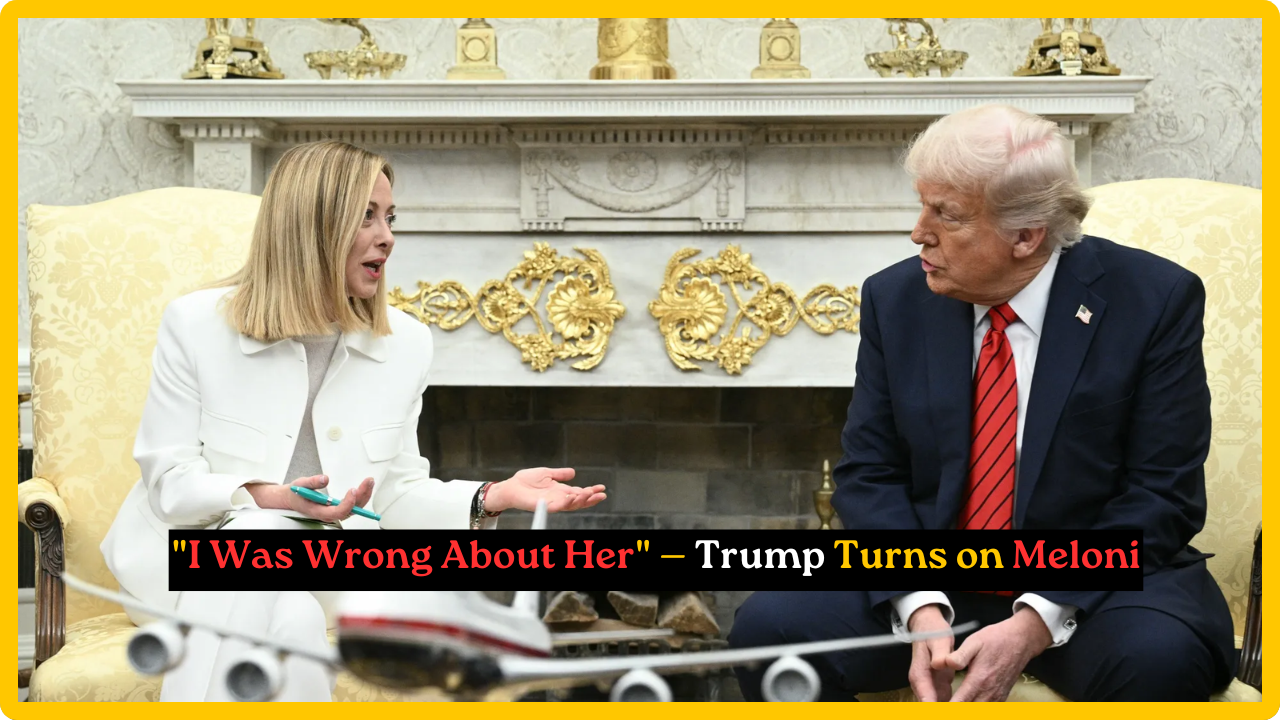
U.S. President Donald Trump publicly attacked Italian Prime Minister Giorgia Meloni on Tuesday, April 14, 2026, declaring he was “shocked” by her refusal to support America’s ongoing military campaign against Iran. In a brief but explosive telephone interview with Italy’s leading newspaper Corriere della Sera, Trump said he had misjudged the Italian leader, accusing her of lacking the very “courage” he once praised her for. The sharp rebuke marks a dramatic and sudden collapse of what was once one of Washington’s most celebrated political partnerships in Europe.
A Friendship Turned Sour
Not long ago, Donald Trump could barely say enough good things about Giorgia Meloni. Just a month before this latest outburst, he told the same Italian newspaper – Corriere della Sera – that Meloni was “a friend and a great leader” who “always tries to help.” That warm language now feels like a distant memory.
On Tuesday, in a six-minute phone call with the newspaper, Trump turned on Meloni with full force. He questioned whether Italians were happy with a leader who, in his view, was “doing nothing” to secure oil supplies from the Gulf region amid a war that is reshaping the entire Middle East. His frustration was palpable. He said he had not spoken to Meloni “in a long time” — a telling sign of how badly the relationship had deteriorated.
I thought she had courage, but I was wrong, Trump said during the interview, according to multiple Italian media reports including ANSA and L’Unione Sarda. The comment was sharp, personal, and clearly aimed at embarrassing the Italian leader on her home turf.
What Sparked the Fallout
The immediate trigger for Trump’s tirade was Meloni’s response to his earlier attack on Pope Leo XIV. The newly elected Pope had spoken out against the U.S.-led war on Iran, calling for peace and advocating for migrants — positions that drew Trump’s fierce public criticism over the weekend. When Meloni stood up for the Pope, calling Trump’s remarks toward the Pontiff “unacceptable,” Trump fired back — and he did not hold back.
It’s you who’s unacceptable,” Trump said, addressing Meloni directly, “because you don’t care if Iran has a nuclear weapon and would blow up Italy in two minutes if they had the chance.
The statement was loaded with drama and geopolitical messaging. Trump was essentially arguing that Meloni’s reluctance to back Washington’s war in Iran was a form of strategic blindness — that Italy, which imports a significant share of its energy from the Gulf region, was benefiting from American military action without contributing to it.
“She simply says that Italy doesn’t want to get involved,” Trump told Corriere della Sera. “Even though Italy gets its oil from there, even though America is very important to Italy — she thinks America should do the work for her.”
Meloni Holds Her Ground
For her part, Meloni did not cave under the pressure. Speaking at a public event earlier the same day — without directly naming Trump – she made clear that true alliances require honesty.
“When you have friends and allies, especially strategic ones, you also have to have the courage to say when you disagree,” she said, according to Sky TG24. “That is what I do every day.”
Her message was pointed: she is not abandoning the U.S. relationship, but she will not blindly follow Washington into a war that Italy was not even consulted on. Reports have confirmed that Rome was not forewarned before U.S. and Israeli forces launched strikes on Iran — a grievance that has quietly fueled Italian frustration for weeks.
Italy’s refusal to allow American bombers to refuel at a military base in southern Italy was another sign of how far the relationship had drifted. The Italian government has also suspended the automatic renewal of its defense cooperation agreement with Israel, signaling a broader shift in Rome’s foreign policy calculus.
The Pope Factor
Pope Leo XIV’s role in this drama cannot be understated. As the leader of the world’s 1.4 billion Catholics, he swiftly and publicly condemned the U.S.-led war in Iran, telling reporters he had “no fear” of the Trump administration and pledging to keep speaking out. For Meloni, who leads a conservative Catholic-leaning government, choosing between Trump and the Pope was never going to be comfortable – but she ultimately sided with the Vatican.
Trump responded to the Pope directly in the Corriere interview, saying the Pontiff “has no idea what is happening in Iran” and claiming that Iran had “killed 42,000 protesters last month.” He said the Pope “should not speak about war” because he does not understand the nuclear threat Tehran poses to the region.
Italy’s Energy Vulnerability
One of the more substantive arguments Trump made was about Italy’s dependence on Gulf energy. Italy relies on Qatar alone for roughly 10% of its natural gas needs, with the broader Gulf region supplying around 15% of the country’s total oil. With the Strait of Hormuz under a U.S. naval blockade and global oil prices surging — Brent crude recently hit $110 per barrel — Italy is feeling the economic pressure acutely.
Meloni had herself acknowledged this during a recent visit to Qatar, warning that disruption to production or transit in the Persian Gulf could leave Italy short of the energy it needs. That makes her position diplomatically delicate: she cannot afford to alienate Washington entirely, but she also cannot afford a war that risks cutting off her country’s fuel supply.
A Broader European Rift
Italy is not alone in its reluctance. Trump’s war on Iran has generated significant pushback across Europe, with French President Emmanuel Macron and British Prime Minister Keir Starmer both taking more cautious positions. The two leaders have reportedly scheduled a joint conference in Paris for Friday, bringing together non-belligerent nations willing to discuss a protection mission for the Strait of Hormuz “when security conditions allow.”
For Meloni specifically, though, the break with Trump is particularly significant because she had positioned herself as Washington’s most reliable European partner — the bridge between the Trump White House and a skeptical European Union. That positioning now looks politically costly at home and abroad.
Roberto D’Alimonte, a professor of political science at Luiss University in Rome, had warned earlier this month that Meloni’s strategy was becoming a liability. “She wanted to play the role of the bridge between Trump and European allies, and this initially looked like a good idea,” he told Al Jazeera. “But today it has become a liability and she is trying to correct this.”
Conclusion
What began as one of the most celebrated political friendships in recent transatlantic history has crumbled remarkably fast. Trump’s decision to call out Meloni publicly – in an Italian newspaper, no less — suggests he is not interested in quiet diplomacy. For Meloni, the challenge now is to maintain Italy’s strategic relationship with the United States while charting an independent course on a war her country did not choose and cannot easily afford.
The coming days will be telling. With the Strait of Hormuz still blockaded, Iran-U.S. ceasefire talks having broken down in Islamabad over the weekend, and European nations now coordinating a separate diplomatic track, Meloni will face pressure from all sides. Whether she can hold her ground or whether Washington’s pressure eventually forces a policy shift that could define her political legacy.
What do you think — was Meloni right to stand up to Trump, or should she have maintained the alliance at all costs? Leave your thoughts below.
CHECKOUT LATEST NEWS
Be First to Comment