
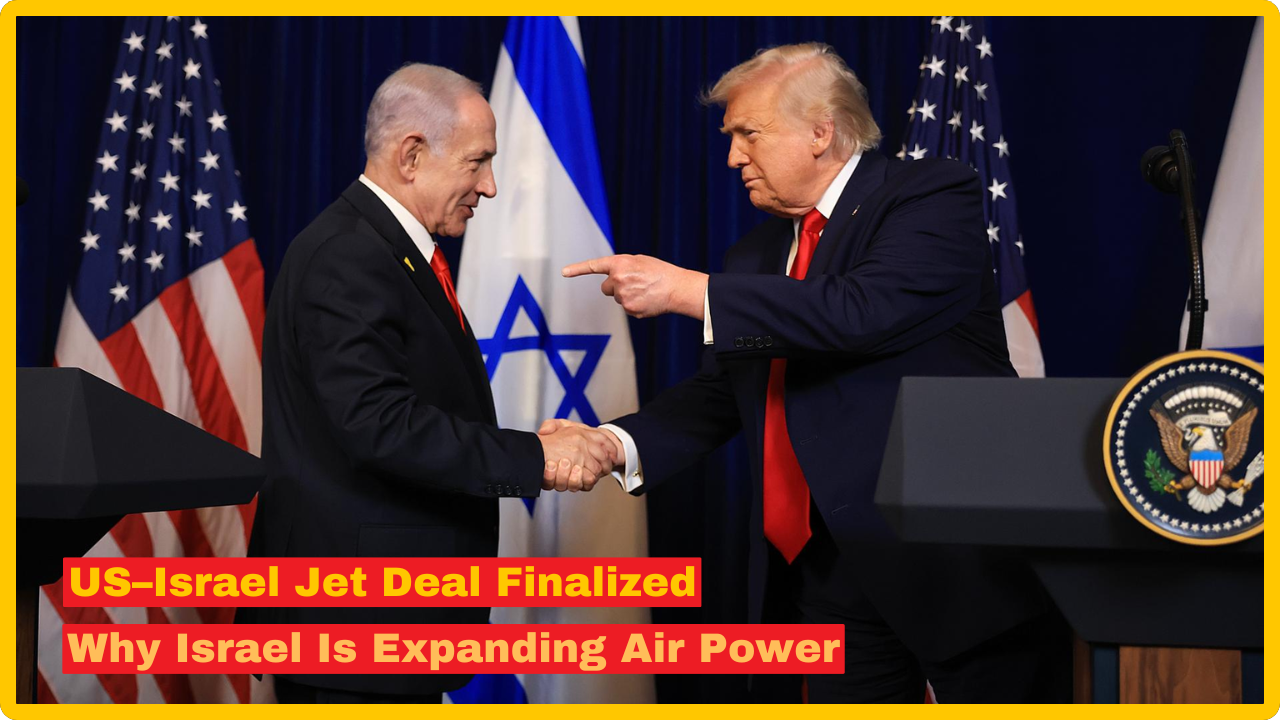
In one of the most consequential defense procurement decisions in Israel’s modern history, the country’s Ministerial Committee on Procurement has given final approval to a plan to purchase two entirely new combat squadrons of advanced fighter aircraft from American manufacturers — formalizing the latest and most ambitious chapter of the US-Israel F-35 Deal that has defined the two countries’ defense relationship for more than a decade.
The approved plan covers a fourth squadron of F-35 stealth fighters manufactured by Lockheed Martin and a second squadron of F-15IA Eagle II aircraft built by Boeing, in a combined arrangement described as worth tens of billions of dollars and forming the opening phase of a sweeping 350-billion-shekel — approximately $119 billion – decade-long military modernization program.
The announcement, made by Israel’s Defense Ministry on Sunday, May 3, carries both immediate strategic weight and a clear long-term message: Israel intends to ensure its qualitative military edge over regional adversaries not just for the conflicts it is currently fighting, but for the threats it expects to face well into the 2030s and beyond.
The Approval: A First Step in Israel’s $119 Billion Military Build-Up
The decision ratified Sunday represents the opening phase of what Israeli defense officials have branded the “Shield of Israel” plan — a comprehensive, decade-long framework for military modernization that is the most ambitious in the country’s history.
The overarching budget is staggering by any measure. Israel’s defense establishment has earmarked 350 billion shekels – approximately $119 billion at current exchange rates — for force development over the coming ten years. Of that total, roughly 100 billion shekels is expected to be generated through internal efficiency measures within the Israeli Defense Forces, with the remainder drawn from state budget appropriations and US military assistance under the current and future memoranda of understanding between Washington and Jerusalem.
The two fighter squadrons approved on Sunday are explicitly described as the first major procurement action within that larger plan. Defense Ministry Director General Amir Baram framed the decision in terms that made clear its dual purpose — addressing immediate operational gaps exposed by recent conflicts while building structural capacity for the decade ahead. “The approval of this procurement is the first major step in executing the 350-billion-NIS force buildup plan for an intense security decade ahead,” Baram said. He added that the ongoing US-Israel war on Iran
“reinforced just how critical the US-Israel strategic relationship is, and how essential advanced air power remains.”
The US-Israel F-35 Deal: A Fourth Squadron Takes Shape
The centerpiece of Sunday’s approval is the expansion of the US-Israel F-35 Deal to include a fourth combat squadron of Lockheed Martin F-35I Adir aircraft — the Israeli Air Force’s designation for a specially configured, locally modified variant of the world’s most advanced stealth fighter. Israel was the first country outside the United States to acquire the F-35, and it remains the only nation in the Middle East operating the platform in frontline service. The Adir — meaning “Mighty” in Hebrew — has become the backbone of the Israeli Air Force’s long-range precision strike and intelligence-gathering capability.
As of early 2026, Israel had taken delivery of 48 of its 50-aircraft first and second squadron order, with two remaining aircraft due later this year. A third squadron of 25 additional aircraft, contracted in June 2024 for approximately $3 billion and financed through US Foreign Military Financing, is scheduled to begin arriving in 2028 at a rate of three to five aircraft per year. The fourth squadron approved on Sunday would add a further 25 aircraft, ultimately bringing Israel’s F-35I fleet to 100 aircraft — an extraordinary concentration of fifth-generation air power in a country the geographic size of New Jersey.
The F-35’s combat performance in the Iran conflict has been decisive. During the Twelve-Day War of June 2025, F-35I aircraft were central to the opening phase of the campaign, systematically penetrating and destroying Iran’s most sophisticated radar networks and surface-to-air missile infrastructure in a way that cleared the path for the heavier strike packages that followed. On March 4, 2026, an Israeli F-35I made aeronautical history by shooting down a Russian-made Iranian Yak-130 fighter jet in a within-visual-range engagement — the first confirmed air-to-air kill by a stealth aircraft against a manned fighter in the history of aerial warfare.
The Defense Ministry statement accompanying Sunday’s announcement noted that the F-35 and F-15IA acquisitions are designed to give the Israeli Air Force the flexibility to handle “a broad range of combat scenarios” and to integrate future capabilities including autonomous flight systems, next-generation air defense, and space-based military dominance.
The F-15IA Program: Boeing’s Eagle Returns to Israeli Service
Alongside the expansion of the US-Israel F-35 Deal, Sunday’s approval also covers a second squadron of Boeing F-15IA aircraft — the most advanced production version of the legendary F-15 Eagle family, based on the F-15EX Eagle II currently entering service with the US Air Force. In December 2025, Boeing was awarded an $8.6 billion Foreign Military Sales contract for an initial 25 F-15IAs with an option for an additional 25. Initial deliveries under that contract are scheduled to begin in 2031, with four to six aircraft per year through the end of 2035.
Sunday’s approval of a second F-15IA squadron signals that Israel intends to exercise the option — and potentially go further — dramatically expanding the fleet of new-build Eagles beyond the original 25-aircraft contract. If both squadrons of 25 aircraft are delivered, Israel would field 50 brand-new F-15IAs alongside its existing 66 older-generation F-15 variants — creating a combined Eagle fleet of 116 aircraft, the largest concentration of F-15s outside the United States Air Force.
The F-15IA fills a fundamentally different role from the F-35I, and it is that complementarity that makes the dual-platform strategy so compelling for Israeli planners. Where the F-35I is optimized for stealth penetration of defended airspace, sensor fusion, and the destruction of air defense networks, the F-15IA is a large, twin-engine aircraft capable of carrying enormous quantities of ordnance over very long ranges. Powered by twin GE Aerospace F110 turbofan engines producing a combined 81,000 pounds of thrust, it can reach Mach 2.5, climb to 50,000 feet, and carry nearly 30,000 pounds of payload — the heaviest weapons load of any aircraft in the Israeli arsenal, including the bunker-busting munitions essential for targeting hardened underground facilities.
In the operational logic developed through years of combat, the two aircraft work in sequence: the F-35I opens the door through enemy air defenses, and the F-15IA walks through it carrying the firepower to destroy what lies beyond.
The Strategic Rationale: Lessons Learned in Blood and Fire
The urgency behind Sunday’s procurement approval is inseparable from the operational experience of the Israeli Air Force since October 7, 2023. In the years since Hamas’s surprise attack on Israel triggered what has become a multi-front campaign spanning Gaza, Lebanon, Yemen, Syria, and Iran, the Israeli Air Force has flown at a tempo and operational intensity that has stressed its existing fleet in ways that prewar planning did not fully anticipate.
The F-35I alone has accumulated more than 15,000 flight hours across all active fronts of the conflict. It was used to strike Iranian air defense systems in three separate rounds of operations before and during the Twelve-Day War, was modified in the field to carry JDAM precision-guided munitions from external wing stations rather than its original internal bay configuration, and flew strike missions against targets in Yemen more than 1,700 kilometers from Israeli territory.
The sheer operational demand of maintaining simultaneous combat readiness across multiple fronts while conducting complex deep-strike missions against a major regional power revealed a structural truth that Israeli defense planners could no longer defer: the Israeli Air Force is too small for the threat environment it now faces. The procurement of four new combat squadrons – two F-35I and two F-15IA – directly addresses that gap.
Israeli Air Force Chief of Staff Lieutenant General Eyal Zamira captured the institutional consensus in remarks accompanying the announcement:
“The lessons of that campaign require us to keep pressing forward on force buildup, to ensure air superiority for decades to come. The F-35 and F-15IA acquisitions are central to the Shield of Israel plan, which is designed to give the IDF a lasting qualitative edge.”
Industrial Partnership: Two-Way Defense Cooperation
One of the defining and often underappreciated features of the US-Israel F-35 Deal and the broader arms relationship is its bidirectional industrial character. Under the terms of the original F-35 agreement, Lockheed Martin and engine manufacturer Pratt & Whitney committed to involving Israeli defense companies in the production of components supplied both to Israel and to other F-35 customers worldwide. Israeli manufacturers currently produce wings for the global F-35 program and supply helmet-mounted display systems used by F-35 pilots in multiple air forces.
The F-15IA program carries similar industrial cooperation obligations. The aircraft Israel will receive are expected to incorporate advanced Israeli-specific electronic warfare systems, communications equipment, and weapons integration developed by domestic defense firms — continuing a tradition of technology exchange and joint development that has characterized every previous Israeli acquisition of American combat aircraft.
This bidirectional industrial partnership reinforces the depth of the US-Israel defense relationship in ways that extend well beyond any single arms transfer. It creates interoperability, shared technological knowledge, and mutual industrial dependencies that serve both countries’ long-term security interests.
What Comes Next: Finalizing Agreements With Washington
Sunday’s approval by Israel’s Ministerial Committee on Procurement is a formal political authorization, not yet a signed contract. Defense Ministry Director General Amir Baram confirmed that the next step is to move forward with finalizing the formal agreements with the US government and American military counterparts — a process that involves the State Department, the Pentagon’s Defense Security Cooperation Agency, and the relevant program offices for both the F-35 and F-15EX.
Completing the US-Israel F-35 Deal for the fourth squadron will require formal letters of agreement between both governments, congressional notification under the Arms Export Control Act, and final contract negotiations with Lockheed Martin. The F-15IA second-squadron option exercise will follow a similar path through Boeing and the Foreign Military Sales mechanism. Defense analysts expect both formal agreements to be concluded within the next several months, given the political priority both governments are placing on the relationship and the urgency created by the ongoing regional security environment.
Conclusion
Sunday’s approval of the expanded US-Israel F-35 Deal and the second F-15IA squadron marks a watershed moment in Israeli air power development and in the US-Israel defense relationship. For an Israeli Air Force that has been tested across four simultaneous fronts of conflict, the procurement of two additional combat squadrons — one of the world’s most advanced stealth fighter and one of its most capable heavy strike aircraft — represents both a recognition of the lessons learned in recent combat and a declaration of strategic intent for the decade ahead. The 350-billion-shekel Shield of Israel plan, of which this approval is the first major step, will shape the military balance in the Middle East for a generation.
Given that Israel has now committed to building a fleet of up to 100 F-35I Adir stealth fighters and potentially 50 new F-15IA Eagle IIs as the foundation of its future air power, do you think this dual-platform heavy investment strategy is the right approach for the security challenges Israel will face in the 2030s — or should resources be directed toward unmanned systems, missile defense, and other next-generation capabilities instead?
Frequently Asked Questions (FAQ)
Q1: What specifically did Israel approve on May 3, 2026, regarding the US-Israel F-35 deal?
Israel’s Ministerial Committee on Procurement gave final approval on Sunday for a plan to purchase two entirely new combat squadrons of advanced fighter aircraft from American manufacturers. The first is a fourth squadron of 25 F-35I Adir stealth fighters from Lockheed Martin, which would bring Israel’s total F-35I fleet from 75 to 100 aircraft when delivered. The second is a second squadron of 25 Boeing F-15IA Eagle II aircraft, expanding on the initial $8.6 billion contract signed in December 2025. The combined procurement is described as worth tens of billions of dollars and forms the opening phase of a sweeping 350-billion-shekel — approximately $119 billion — military modernization program called the Shield of Israel plan.
Q2: Why is Israel investing in both F-35I and F-15IA aircraft rather than choosing a single platform?
The dual-platform strategy reflects a deliberate operational logic refined through years of multi-front combat. The F-35I Adir is valued for its stealth characteristics, sensor fusion, and ability to penetrate heavily defended airspace undetected — making it the weapon of choice for destroying enemy radar networks and air defense systems in the opening phase of a complex strike operation. Its limitation is a reduced weapons payload when operating in full stealth mode.
The F-15IA, by contrast, is a large, twin-engine aircraft optimized for carrying massive quantities of ordnance — including bunker-busting bombs and air-launched ballistic missiles — over very long distances. In practice, the two aircraft are designed to operate together: the F-35I opens a corridor through enemy air defenses, and the F-15IA follows with the heavy-payload strike package needed to destroy hardened targets such as underground nuclear facilities.
Q3: How does this procurement fit into the broader US-Israel defense relationship, and what are the next steps?
The approval is directly rooted in the operational lessons of the US-Israel war on Iran that began on February 28, 2026, and the multi-front campaigns that preceded it. Defense Ministry Director General Amir Baram explicitly stated that the Iran conflict
“reinforced just how critical the US-Israel strategic relationship is.”
The next steps involve finalizing formal government-to-government agreements with the US State Department and Pentagon, followed by final contract negotiations with Lockheed Martin and Boeing through the Foreign Military Sales mechanism. Both agreements will also require congressional notification under the Arms Export Control Act. Defense analysts expect the formal contracts to be concluded within months, given the political priority both governments are placing on completing the deal.





Be First to Comment