
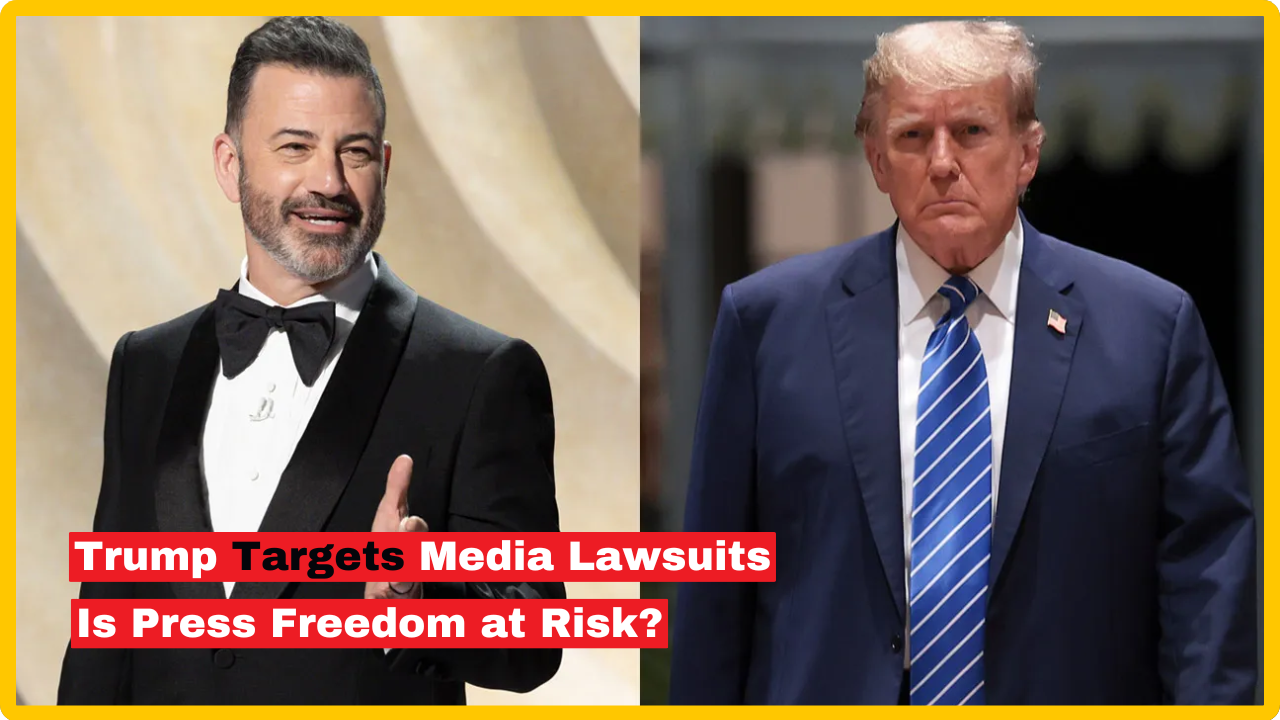
Despite repeated court losses, Trump media lawsuits and regulatory pressure campaign against the press continue to reshape how news organizations operate in 2026. When a federal judge dismissed President Donald Trump’s $10 billion defamation lawsuit against the Wall Street Journal on April 13, it was the latest in a long and consistent pattern: Trump media lawsuits brought against major American news organizations, argued in federal courts, and thrown out by judges applying the same First Amendment standards that have governed press freedom in the United States for decades. Yet for all the courtroom losses, something more consequential may be happening beyond the docket.
Legal experts, First Amendment attorneys, and press freedom advocates argue that the administration’s broader campaign of pressure against critical media — a campaign fought on regulatory fronts, through public denunciation, and via the chilling economics of prolonged litigation — is inflicting real costs on American journalism regardless of how individual cases are resolved.
The pattern is striking in its scope. Since 2020, Trump has filed at least nine defamation lawsuits against major media companies, seeking tens of billions of dollars in damages. Nearly every one of them has been dismissed. And yet, as April 2026 draws to a close, the administration is simultaneously restricting press access to government agencies, threatening to deploy regulatory powers against critical broadcasters, defunding public media through executive orders, and demanding the firing of individual journalists and on-air personalities by name. The Trump media lawsuits are only the most visible part of a much larger machine.
The Wall Street Journal Dismissal: The Latest in a Long Line
“Nowhere Close” to the Legal Standard
The most recent legal defeat arrived on April 13, when U.S. District Judge Darrin P. Gayles threw out Trump’s lawsuit against the Wall Street Journal and its parent company, Dow Jones & Company. The case centered on a Journal story reporting on a birthday letter allegedly signed by Trump and addressed to disgraced financier Jeffrey Epstein. Trump had denied writing the letter, characterizing it as fabricated, and filed a $10 billion suit against the paper.
Judge Gayles was unsparing in his assessment. He found that Trump’s complaint fell nowhere close to plausibly alleging that the Journal had knowingly published false information or acted with reckless disregard for the truth — the so-called “actual malice” standard established by the Supreme Court in New York Times v. Sullivan in 1964, which governs defamation claims brought by public figures. Gayles dismissed the case without prejudice, allowing Trump’s legal team a chance to refile an amended complaint, with a deadline of April 27.
The dismissal echoed a series of nearly identical outcomes stretching back years. Trump’s 2022 lawsuit against CNN over coverage of his 2020 election claims was dismissed in 2023 and upheld on appeal. A $15 billion suit against The New York Times, filed in 2025, was thrown out within four days of filing — not primarily on the merits, but because a federal judge found the legal submission itself procedurally inadequate. Cases against The Washington Post, journalist Bob Woodward, and social media platforms have met similar fates.
When Losing Is Still Winning
While Trump has lost nearly every case that has gone before a judge, not every media company has chosen to fight. Two prominent organizations have instead reached financial settlements with the president — decisions that legal experts widely characterized as driven by pragmatic calculation rather than legal merit.
ABC News agreed to donate $15 million to Trump’s presidential library after he sued the network over inaccurate on-air characterizations of a civil jury verdict that had found Trump liable for sexual abuse. CBS reached a separate settlement after Trump sued over editorial decisions made during an interview with his 2024 election opponent, Kamala Harris.
Both settlements were widely described by legal analysts as cases where the underlying lawsuits were unlikely to prevail in court. But the calculus for the networks was clear: prolonged litigation is expensive, disruptive, and uncertain even for defendants with strong cases. Settling, even without admitting wrongdoing, eliminates that risk.
Defamation law specialist Tre Lovell put the dynamic plainly: “The way our legal system works, it can cost a lot of time and money, and the president is able to take advantage of that.” It is a form of leverage that operates entirely independently of whether any given lawsuit has legal merit — and it has produced tangible financial results for an administration whose cases have otherwise fared poorly in court.
Notably, News Corp — the parent of both Fox News and the Wall Street Journal — has taken a different approach, choosing to contest Trump’s claims in court rather than settle. The 95-year-old Rupert Murdoch has simultaneously maintained a complicated but cozy relationship with Trump, including multiple White House meetings even as the litigation proceeds.
Regulatory Threats and Access Restrictions
The Trump media lawsuits are only one dimension of what First Amendment attorney Doug Mirell described as a campaign so multifaceted that judicial efforts to contain it are fundamentally insufficient. “Trump’s campaign against the media is one that is so multifaceted that the judicial efforts to control him are insufficient,” Mirell said.
The administration has pursued a parallel track of regulatory pressure and access restriction that operates entirely outside the courts. In the past month alone, federal judges have issued rulings blocking four separate administration actions against media organizations: a Trump executive order eliminating federal funding for public broadcasting, an attempt to dismantle the government-run Voice of America, and two sets of Pentagon press access rules that courts found unconstitutional because they discriminated against specific outlets based on viewpoint.
In each of those cases, courts ruled that the administration had violated the First Amendment. But here, too, the administration has demonstrated an ability to outmaneuver a judicial process that moves slowly and deliberatively. By the time a court issues an injunction, the administration has often already achieved a portion of its objective — creating confusion, delaying publication, restricting access to officials or briefings – and can pivot to a new approach while appealing the adverse ruling through the courts.
National Public Radio filed suit in May 2025 to block the executive order defunding public broadcasting. Nearly a year later, that litigation continues to work its way through the system.
The Kimmel Case: Pressure Without Legal Process
Demanding Firings, Urging Regulatory Action
The administration’s campaign against the press has also extended to individual personalities in ways that bypass legal channels entirely. Trump’s public feud with ABC late-night host Jimmy Kimmel illustrates the approach. Rather than filing a lawsuit, the president and his allies have publicly demanded that Kimmel be fired and urged regulatory authorities to scrutinize ABC’s broadcast license — applying a form of political pressure that requires no legal proceeding and produces no court record.
It is a tactic with echoes of the broader pressure campaign: force media organizations to make internal decisions about personnel, coverage, and tone based not on any legal compulsion but on the perceived risk of further confrontation with the executive branch.
The New York Times lawsuit, meanwhile, is still proceeding — Trump’s lawyers refiled an amended complaint, and the parties have been ordered to pursue mediation before the case moves toward trial. A separate lawsuit has also been lodged against the BBC, which has stated it will defend itself vigorously.
What the Courts Have Said – And What That Means
The consistent thread running through virtually every judicial ruling in these cases is the robustness of First Amendment protections for the press under existing American law. The actual malice standard established in 1964 was designed specifically to protect news organizations from being silenced by powerful public figures wielding defamation law as a tool of suppression. Courts have applied that standard consistently and, so far, to the clear detriment of the administration’s legal efforts.
But the broader question raised by the Trump media lawsuits and the parallel pressure campaign is whether legal victories for the press are sufficient to preserve a genuinely free and independent media environment. When organizations calculate whether to fight or settle based on financial exposure rather than legal merit, when regulatory threats shape editorial decisions, and when access to government information can be restricted based on perceived viewpoint, the chilling effect on journalism is real and measurable — even when no court has ruled against a single news outlet.
Conclusion
The record of Trump media lawsuits in 2026 is, by any objective legal measure, one of consistent failure in the courts. But measuring the administration’s campaign against the press solely by its litigation scorecard misses the larger picture.
Through settlements that extracted millions of dollars from news organizations, regulatory pressure that kept broadcasters in legal limbo, access restrictions that slowed newsgathering at federal agencies, and public demands for the firing of individual journalists, the administration has maintained a sustained and multifaceted pressure campaign that has produced real-world consequences for American journalism regardless of what judges have decided. The courts remain an essential backstop for press freedom — but as First Amendment experts have repeatedly noted in 2026, they were never designed to be the only one.
Given that Trump’s media lawsuits have failed repeatedly in court while settlements, regulatory threats, and access restrictions have produced tangible results, do you think existing First Amendment protections are sufficient to preserve a genuinely free press — or does the current moment reveal gaps in those protections that need to be addressed?
Frequently Asked Questions (FAQ)
Q1: How many media lawsuits has Trump filed, and how have they fared in court?
Since 2020, President Trump has filed at least nine defamation lawsuits against major American media companies, seeking tens of billions of dollars in combined damages. The overwhelming majority of those cases have been dismissed by federal judges applying the “actual malice” standard, which requires public figures suing for defamation to prove that a news organization knowingly published false information or acted with reckless disregard for the truth – a high legal bar that courts have consistently found Trump’s complaints fail to clear.
Cases against CNN, The New York Times, The Washington Post, the Wall Street Journal, and journalist Bob Woodward have all been rejected by courts. Two cases — against ABC and CBS – resulted in financial settlements that legal experts widely characterized as driven by litigation cost calculations rather than legal merit.
Q2: Why did ABC and CBS settle with Trump if legal experts said the cases lacked merit?
Both ABC and CBS made calculated financial decisions that settling was less costly and disruptive than fighting the lawsuits through what could have been years of expensive litigation, even in cases where they likely would have prevailed in court. ABC agreed to donate $15 million to Trump’s presidential library following a lawsuit over inaccurate on-air comments about a civil jury verdict. CBS reached a similar arrangement after Trump sued over editorial decisions made during a 2024 interview with his election opponent. Defamation law specialists noted that the economics of prolonged litigation create genuine leverage for plaintiffs — particularly a sitting president with substantial legal resources — entirely independent of the underlying merits of any given case.
Q3: What actions has the Trump administration taken against the media outside of the courts?
Beyond the defamation litigation, the administration has pursued a broad parallel campaign of pressure against critical media outlets through regulatory and administrative means. In recent months alone, courts have blocked four separate administration actions found to violate the First Amendment:
an executive order eliminating federal funding for public broadcasting, an attempt to dismantle Voice of America, and two sets of Pentagon press access rules that discriminated against specific outlets based on their viewpoint coverage. The administration has also publicly demanded the firing of individual journalists and television personalities, urged regulatory scrutiny of broadcast licenses held by critical outlets, and restricted press access to government agencies. Critics and First Amendment attorneys argue this multifaceted approach produces real chilling effects on journalism even when individual legal actions are ultimately blocked or rejected by the courts.


Be First to Comment