
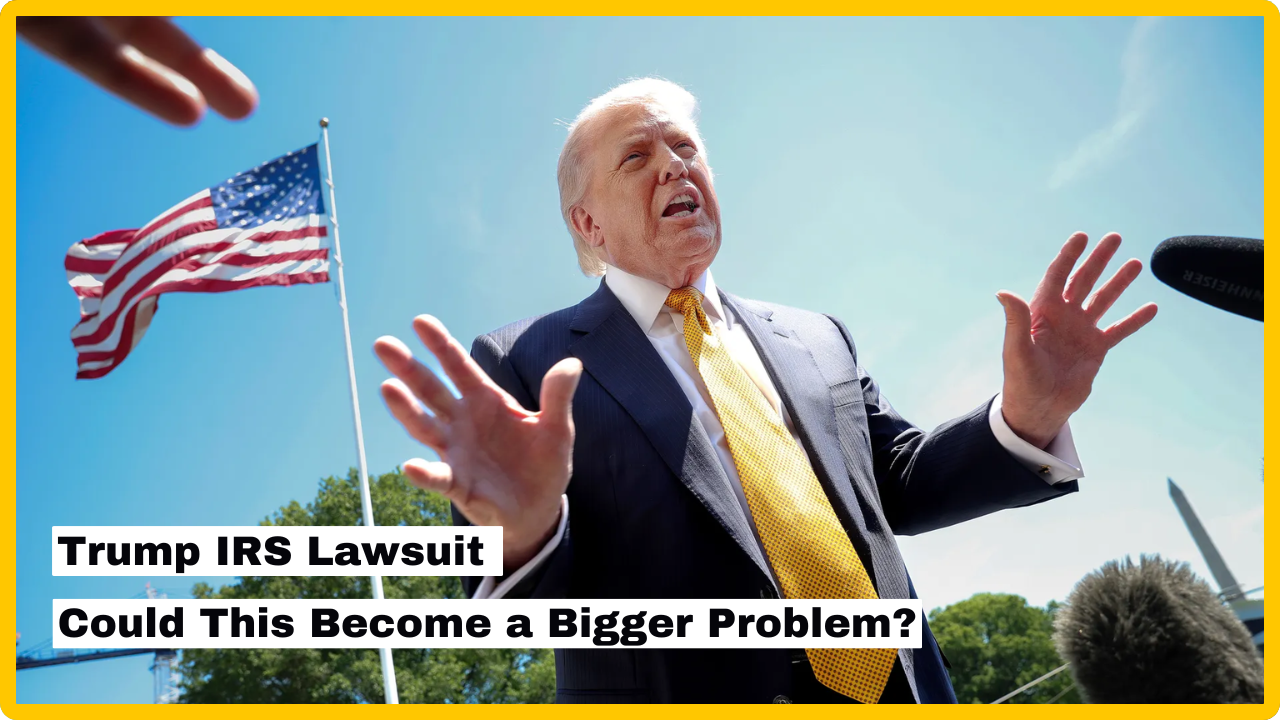
President Donald Trump officially settled the Trump IRS lawsuit on Monday, May 18, 2026, withdrawing his $10 billion legal claim against the Internal Revenue Service in exchange for the creation of a $1.776 billion government fund aimed at compensating individuals who allege they were wrongfully targeted by what his administration calls a “weaponized” justice system. The move, announced simultaneously by Trump’s legal team through a federal court filing and by the Department of Justice, has triggered an immediate and fierce political firestorm — with supporters calling it a historic accountability measure and critics denouncing it as an unprecedented abuse of taxpayer money.
Trump IRS Lawsuit Settled: What the Deal Actually Says
President Donald Trump, his two eldest sons, and the Trump Organization dropped their $10 billion lawsuit against the Internal Revenue Service on Monday, with a Miami federal court filing showing the dismissal was made voluntarily and with prejudice — meaning the same claims cannot be refiled.
The phrase “with prejudice” is legally significant. It permanently closes the door on the original Trump IRS lawsuit claims, foreclosing any future attempt to revive the case in federal civil court on the same grounds.
In place of any direct payment to Trump or his family, the Department of Justice announced the establishment of a new taxpayer-funded mechanism. The Justice Department announced the creation of a $1.776 billion fund to compensate President Donald Trump’s allies who claim they were unfairly targeted by the previous administration — an unprecedented move that would allow the president’s administration to pay his supporters from a government agency he controls with taxpayer money. Trump himself will not receive any payments but will receive a formal apology, the Justice Department said.
The $1.776 billion figure is not accidental. Its symbolism is unmistakable — a direct reference to the year of American independence, a number the administration chose deliberately to reinforce its “anti-weaponization” narrative.
Origins of the Trump IRS Lawsuit: The Tax Return Leak
To understand why this settlement is so consequential, it’s essential to understand how the Trump IRS lawsuit came to exist in the first place.
Trump sued the IRS after a government contractor pleaded guilty in 2023 to stealing the tax information of Trump and other wealthy Americans and leaking it to media outlets in 2019 and 2020. The leaked records were published by major news organizations, exposing detailed financial information about Trump and his business empire at a politically sensitive moment during his first and second presidential campaigns.
According to Trump’s legal team:
“The IRS wrongly allowed a rogue, politically-motivated employee to leak private and confidential information about President Trump, his family, and the Trump Organization to the New York Times, ProPublica and other left-wing news outlets, which was then illegally released to millions of people.”
Legal experts described the original case as weak, since the leak has been attributed to a federal contractor, not a full-time employee of the US government. That legal vulnerability ultimately came to a head when the judge overseeing the case began asking pointed questions about whether the lawsuit could even move forward.
The settlement came two days before a court-imposed deadline to explain why the case should proceed. US District Judge Kathleen Williams had questioned whether Trump and the agencies he controls were “sufficiently adverse” to justify the lawsuit — a foundational legal requirement for any civil case.
In plain terms, the judge was asking a question that many legal observers had been asking since the suit was filed: How can a president sue his own executive branch agencies?
How the Anti-Weaponization Fund Will Work
The mechanics of the new fund are both detailed and, critics say, deeply problematic.
A five-member commission appointed by the attorney general will hear claims. The commission can both distribute money and issue formal apologies. Trump can remove any member. The fund has until December 2028, just before the end of Trump’s term, to process claims. The money comes from the Treasury Department’s Judgment Fund, paid for by taxpayers to pay government settlements.
The commission would be under no obligation to disclose its procedures or decision-making process for awarding more than a billion dollars, according to sources. The process for awarding money and the identities of recipients could be kept private.
The breadth of who may be eligible to file claims is sweeping. The fund would be used to pay damages to people who say they were harmed by the Biden administration’s “weaponization” of the legal system, including the nearly 1,600 individuals charged in connection with the January 6, 2021, Capitol attack, as well as potentially entities associated with President Trump himself.
Acting Attorney General Todd Blanche — who notably served as a member of Trump’s personal defense legal team before his current role — framed the fund in broad terms. Blanche said:
“The machinery of government should never be weaponized against any American, and it is this department’s intention to make right the wrongs that were previously done while ensuring this never happens again. As part of this settlement, we are setting up a lawful process for victims of lawfare and weaponization to be heard and seek redress.”
Democrats and Ethics Watchdogs React With Alarm
The reaction from Democratic lawmakers was immediate, sharp, and bipartisan in its intensity. Critics have coalesced around a central argument: that the arrangement constitutes a president effectively negotiating a settlement with his own government to create a fund he controls — using money that belongs to taxpayers.
Senator Ron Wyden of Oregon said:
Regardless of whether Trump filed this lawsuit with a personal payday or a slush fund in mind, he deserves no credit for dropping it, and even by his standards the move he’s trying to get away with now is a stunning act of corruption.
Representative Brad Sherman said: “By settling his absurd $10 billion lawsuit against his own administration, Trump and the Justice Department just engaged in the most brazen act of self-dealing in the history of the presidency, and did so quickly in order to avoid the scrutiny of the judicial process, while quite likely violating the Constitution’s Domestic Emoluments Clause in the process.”
The Emoluments Clause reference is legally significant. The Constitution bars the president from receiving financial benefits from the federal government beyond the president’s official salary. Critics argue that while Trump personally receives no payment, the creation of a fund that benefits his political allies — and potentially January 6 defendants — still amounts to the president directing government resources toward his own political coalition.
Ethics watchdogs and Democrats in Congress are already attempting to intervene in the arrangement.
Trump’s Own Earlier Acknowledgment of Awkwardness
The unusual nature of the Trump IRS lawsuit was not lost even on Trump himself. When asked about his legal claims last year, Trump acknowledged the lawsuit “sort of looks bad,” but claimed he would donate any money he received from the claims to charity. “It’s interesting because I’m the one that makes a decision, right, and, you know, that decision would have to go across my desk,” Trump said in the Oval Office in October. “It’s awfully strange to make a decision where I’m paying myself.”
That self-aware admission makes the resolution of the case all the more notable. Rather than receiving a personal payment — which even Trump acknowledged would appear inappropriate — the settlement channels the financial outcome into a broader fund, one that Trump’s administration controls and whose beneficiaries could include a wide swath of his political base.
Constitutional and Legal Questions Ahead
The settlement may have resolved the Trump IRS lawsuit in court, but it has opened a new and potentially lengthy chapter of legal and constitutional scrutiny.
The so-called “Anti-Weaponization Fund,” with its symbolic 1776 figure, is likely to face significant legal challenges.
Constitutional scholars are examining multiple angles of potential vulnerability, including the Emoluments Clause argument raised by Democratic lawmakers, questions about whether the Treasury Department’s Judgment Fund can legally be deployed in this way without specific congressional appropriation, and due process concerns about a secretive commission with no disclosure obligations distributing more than $1.7 billion in public funds.
The proposed creation of the compensation fund led some administration officials to raise ethical concerns about the arrangement — stemming not only from Trump suing his own government but from the structure of the resulting settlement itself.
The fund’s deadline of December 15, 2028 — just weeks before the end of Trump’s second term — adds a time-bounded urgency to the legal challenges being prepared by critics and watchdog organizations.
Conclusion
The resolution of the Trump IRS lawsuit through the creation of a $1.776 billion Anti-Weaponization Fund represents one of the most legally novel and politically charged developments of Trump’s second term. By dropping a $10 billion suit against his own administration just before a judge was likely to question the case’s very legal standing, and exchanging it for a taxpayer-funded compensation mechanism his administration will control, Trump has both avoided a courtroom loss and created a new instrument his critics are already calling unconstitutional. How the courts, Congress, and the American public ultimately judge this arrangement will likely define a significant part of his second-term legacy.
Do you believe the $1.776 billion Anti-Weaponization Fund is a legitimate accountability mechanism for government overreach, or does it cross a line that undermines public trust in how taxpayer money is used?
Frequently Asked Questions (FAQ)
Q1: Why did Trump originally file the $10 billion IRS lawsuit?
Trump filed the lawsuit after a government contractor admitted to stealing and leaking his confidential tax returns to media organizations. The leaked records were published during politically sensitive periods in 2019 and 2020. Trump sued the IRS and Treasury Department, arguing the agencies failed to protect his private financial information, seeking $10 billion in damages.
Q2: What exactly is the Anti-Weaponization Fund, and who can claim from it?
The Anti-Weaponization Fund is a $1.776 billion mechanism established by the Department of Justice as part of the settlement resolving the Trump IRS lawsuit. It will be overseen by a five-member commission appointed by the attorney general and will hear claims from individuals who allege they were wrongfully targeted by the Biden administration. Eligible claimants could include January 6 defendants and others who claim politically motivated prosecution. The fund will operate through December 15, 2028.
Q3: Will Trump personally receive any money from this settlement?
No. Under the terms of the settlement, Trump, Donald Trump Jr., Eric Trump, and the Trump Organization will not receive any financial payment. Instead, Trump and his family will receive a formal apology. The nearly $1.8 billion is directed into the broader Anti-Weaponization Fund for third-party claimants, though critics argue the president still benefits politically by directing taxpayer funds toward his political base.





Be First to Comment