
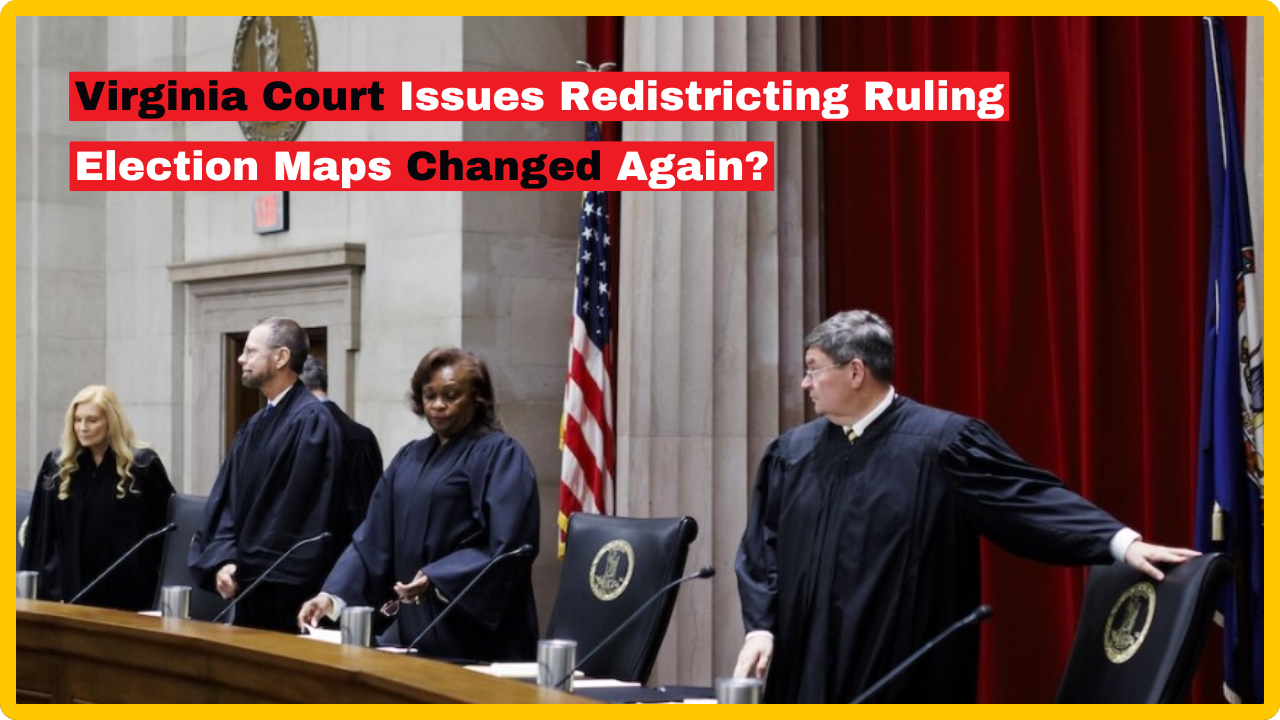
Here you’ll come to know about Virginia Supreme Court redistricting ruling. For weeks, millions of Americans – and virtually every political strategist working on the 2026 midterm elections — were asking the same urgent questions: Will the Virginia Supreme Court rule on redistricting? When does the Virginia Supreme Court rule on redistricting? And has the Virginia Supreme Court ruled on redistricting yet? On Friday, May 8, 2026, every one of those questions received a definitive and dramatic answer.
In a 4-3 decision that immediately reshaped the political map of the United States, the Virginia Supreme Court ruling on redistricting struck down a constitutional amendment that voters had narrowly approved just seventeen days earlier, declared the results of the April 21 special election null and void, and left the state’s existing congressional maps — currently giving Democrats a 6-5 House advantage — in place through the November midterm elections.
The ruling is one of the most consequential state court decisions in recent American political history, and its reverberations will be felt from Richmond to Washington and across every competitive congressional district in the country.
Did the Virginia Supreme Court Rule on Redistricting? Yes — Here’s Exactly What Happened
For readers searching did the Virginia Supreme Court rule on redistricting, the answer is an unambiguous yes — and the ruling arrived with the full force of the state’s highest court behind it, even if only four of its seven justices agreed. The Virginia Supreme Court redistricting hearing that preceded the final decision was itself the culmination of a legal battle stretching back to October 2025, when Democrat-controlled state lawmakers first advanced a constitutional amendment designed to allow the General Assembly to redraw Virginia’s congressional districts mid-decade.
The amendment’s journey to the court was extraordinarily turbulent. After receiving its first legislative approval on October 31, 2025, it was challenged in circuit court in January 2026 and declared unlawful by a Tazewell County circuit judge. Democrats appealed, and in February, the VA Supreme Court on redistricting allowed the referendum to proceed as scheduled — while explicitly reserving judgment on the underlying constitutional questions.
A second circuit court challenge on different grounds also failed to stop the vote. Early voting opened on March 6 and ran through April 18. The special election took place April 21, with Virginians approving the amendment 52 percent to 48 percent.
The day after the vote, a circuit court judge issued an injunction against certifying the results. On April 28, the Virginia Supreme Court denied a stay of that injunction, leaving it in place. Then, on May 8, the court issued its final word: the amendment is unconstitutional, the referendum results are void, and Virginia’s congressional districts will not be redrawn before November.
Will Virginia Supreme Court Rule on Redistricting Again? Understanding the 4-3 Split
Those who were wondering will Virginia Supreme Court rule on redistricting again may get their answer sooner than expected — through a US Supreme Court appeal that Virginia Democrats have already announced. But to understand why that appeal has any viable basis, it is essential to understand the nature of the 4-3 split in Friday’s ruling.
The majority’s reasoning rested entirely on a single constitutional question: what does “general election” mean in the context of Virginia’s constitutional amendment process? Virginia’s constitution requires a proposed amendment to pass the General Assembly twice, with an intervening general election between the two votes.
Democrats passed the amendment the first time on October 31, 2025. Republicans argued — and the four-justice majority agreed — that this was too late, because early voting for the 2025 House of Delegates elections had already begun before that date. If early voting is part of the general election, the majority reasoned, then the required intervening election had already started when Democrats pushed the amendment through — violating the constitutional sequencing requirement.
“This violation irreparably undermines the integrity of the resulting referendum vote and renders it null and void,”
the majority wrote in its 46-page opinion. The constitutional violation, in the majority’s framing, “incurably tainted” the entire process — meaning that even the fact that more than three million Virginians subsequently voted in favor of the amendment could not cure the original procedural defect.
The three dissenting justices — who represented a substantial minority of the court — disagreed with the majority’s definition of “general election,” arguing that the term refers to a single day in November rather than the entire voting period including early voting. That disagreement is not merely academic.
It represents a genuine and unresolved question of Virginia constitutional interpretation that could provide the basis for a federal constitutional argument on appeal, particularly if Democrats can frame the nullification of three million votes as a violation of due process or equal protection under the US Constitution.
When Does the Virginia Supreme Court Rule on Redistricting: The Timeline That Brought Us Here
For those who spent months asking when does Virginia Supreme Court rule on redistricting, the timeline of events that produced Friday’s decision reveals just how protracted and legally complex the process was.
The redistricting effort was triggered directly by Trump’s 2025 campaign to convince Republican-led states to redraw their congressional maps mid-decade. Virginia Democrats framed their response in explicitly reactive terms — arguing that a temporary, one-time redistricting was necessary to counter Republican gerrymandering in states including Texas, Florida, and North Carolina. The General Assembly’s first approval of the amendment came on October 31, 2025. The required second approval came on January 16, 2026, in another party-line vote.
Between those two approvals and the eventual May 8 ruling, the legal proceedings included at least four separate circuit court proceedings, two Virginia Supreme Court emergency orders, a statewide special election that cost $5.2 million in public funds, and nearly $100 million in outside spending by political organizations on both sides.
The Virginia Supreme Court redistricting hearing that preceded the final ruling was held in late April, after the special election had already taken place — a sequencing that the majority opinion itself acknowledged was unusual but legally appropriate.
Has the Virginia Supreme Court Ruled on Redistricting Before? The 2020 Context
For those asking has the Virginia Supreme Court ruled on redistricting in the past, the context of Virginia’s redistricting history is essential to understanding Friday’s decision. In 2020, Virginia voters approved a different constitutional amendment – this one establishing a bipartisan redistricting commission composed of eight legislators and eight citizens – to take the power of drawing congressional districts away from the partisan General Assembly. That 2020 amendment was itself a significant democratic statement: voters wanted their districts drawn by a body that was not controlled by either party acting alone.
The 2026 amendment that Friday’s ruling struck down was designed to temporarily bypass that 2020 commission – granting the General Assembly a one-time authority to draw new maps for 2026, 2028, and 2030 elections, before the commission’s standard process resumed after the 2030 census. Republicans characterized this as Democrats attempting to undo what voters had approved in 2020 for partisan gain. Democrats argued it was a temporary and necessary response to Republican gerrymandering in other states.
The Virginia Supreme Court’s ruling means the 2020 commission framework remains in place. The bipartisan body retains full authority to draw Virginia’s next set of congressional maps after the 2030 census. The General Assembly’s partisan map — which would have produced a 10-1 Democratic advantage — has been nullified.
Virginia Supreme Court Redistricting Reddit and Public Reaction: A Nation Divided
Discussion of the Virginia Supreme Court redistricting referendum outcome has exploded across social media platforms, with the ruling generating some of the most heated political commentary of the 2026 election cycle. The political reactions from official figures reflected the same sharp partisan divide visible in online discourse.
Trump celebrated on Truth Social, calling it a “Huge win for the Republican Party, and America.” Republican National Committee Chair Joe Gruters declared: “Democrats just learned that when you try to rig elections, you lose.” Former Virginia Attorney General Jason Miyares, who co-chaired the Virginians for Fair Maps group opposing the referendum, said:
“Virginians spoke loud and clear in 2020 that voters should pick their elected officials, not the other way around. Today, their voices were heard.”
Democratic leaders focused on the democratic legitimacy question. House Minority Leader Hakeem Jeffries called the ruling “an unprecedented and undemocratic action that cannot stand.” DCCC Chair Suzan DelBene said four unelected judges had chosen to “cast aside the will of the voters,” adding:
“This is a setback that sends a terrible message to Americans – the powerful and elite will do everything they can to silence you.”
Virginia Attorney General Jay Jones was more direct: “Today the Supreme Court of Virginia has chosen to put politics over the rule of law.”
Governor Abigail Spanberger, while expressing disappointment, channeled the reaction toward electoral action: “More than three million Virginians cast their ballots in Virginia’s redistricting referendum, and the majority voted to push back against a president who said he is ‘entitled’ to more Republican seats in Congress. They made their voices heard.” She added that her administration would now focus on maximizing voter participation in November.
The National Stakes: What the Ruling Means for House Control
The VA Supreme court on redistricting ruling did not occur in isolation — it is part of a sweeping national redistricting battle that may ultimately decide which party controls the US House of Representatives after November. Republicans are now projected to gain a net advantage of as many as 14 House seats from redrawn maps across six states, compared with six for Democrats. Virginia’s Democratic map would have added four net Democratic seats – directly offsetting a significant portion of Republican gains elsewhere. With that map eliminated, Republicans’ structural advantage in the November map has grown considerably.
The US Supreme Court’s recent ruling weakening racial gerrymandering protections in the Voting Rights Act has simultaneously opened the door for Republican-controlled legislatures in Tennessee, Alabama, and Louisiana to advance their own redistricting plans. Tennessee approved a new map Thursday – one day before Virginia’s ruling — aimed at flipping a Democratic seat. Florida completed its own redistricting in April. The combined effect is a national redistricting environment that now tilts decisively toward Republicans heading into November.
Conclusion
The Virginia Supreme Court ruling on redistricting has closed one chapter of this extraordinary legal and political saga — while opening another. The 4-3 decision, resting on a narrow but consequential interpretation of what constitutes a “general election” under Virginia’s constitution, has nullified three million votes, preserved a bipartisan map-drawing process, and handed Republicans a major advantage in the national redistricting competition.
Democrats are planning a US Supreme Court appeal, and the legal battle may produce one more ruling before November’s elections determine which party controls the House. But for now, the answer to every question Virginians were asking is clear: yes, the Virginia Supreme Court ruled on redistricting, it ruled against Democrats, and the map stays as it was.
Given that more than three million Virginians voted to approve the redistricting amendment by a three-point margin in a special election the courts allowed to proceed, do you believe the Virginia Supreme Court made the right call by striking the results down on procedural grounds — or did the ruling prioritize legal technicality over the democratic will of the voters?
Frequently Asked Questions (FAQ)
Q1: Did the Virginia Supreme Court rule on redistricting, and what did it decide?
Yes. On May 8, 2026, the Virginia Supreme Court issued a 4-3 ruling that struck down a constitutional amendment Virginia voters had approved in a special election on April 21, 2026. The court found that the amendment process violated Virginia’s constitutional requirements because the General Assembly gave the amendment its first approval after early voting had already begun for the 2025 House of Delegates elections – violating the rule that a general election must occur between the two required legislative approvals.
The ruling declared the referendum results null and void, meaning Virginia’s current congressional maps – giving Democrats a 6-5 House advantage — remain in place through the 2026 midterm elections. The highly partisan Democratic map that would have produced a 10-1 Democratic advantage will not take effect.
Q2: When did the Virginia Supreme Court rule on redistricting, and what was the timeline leading to the decision?
The Virginia Supreme Court issued its final ruling on May 8, 2026, but the legal process that led to it began in October 2025. The General Assembly gave the redistricting amendment its first approval on October 31, 2025, and its second approval on January 16, 2026. Multiple circuit court challenges were filed and resolved — sometimes in Democrats’ favor, sometimes against them — before the Virginia Supreme Court allowed the special election to proceed in February while reserving judgment on constitutionality.
Early voting ran from March 6 through April 18. The special election was held April 21, with voters approving the amendment 52-to-48. The Virginia Supreme Court held its redistricting hearing in late April after the election, denied a stay of an injunction against certifying results on April 28, and issued its final ruling on May 8 — nullifying the entire process after eight months of legal warfare and nearly $100 million in outside spending.
Q3: Will Virginia appeal the redistricting ruling, and could the US Supreme Court reverse it?
Virginia Democrats and Attorney General Jay Jones have announced their intent to appeal the ruling to the United States Supreme Court. Whether the high court will agree to hear the case is uncertain — the Supreme Court accepts only a fraction of the cases it is asked to review, typically focusing on unresolved questions of federal constitutional or statutory law.
Democrats’ strongest potential argument on appeal is that nullifying the results of a special election in which more than three million people voted — after the Virginia Supreme Court itself allowed the election to proceed — raises federal constitutional concerns under the due process and equal protection clauses.
However, the Virginia Supreme Court’s ruling rested primarily on state constitutional interpretation, which federal courts are generally reluctant to second-guess. Any US Supreme Court appeal would need to be filed and resolved on an extraordinarily compressed timeline if it is to have any effect on the November 2026 midterm elections.




Be First to Comment