
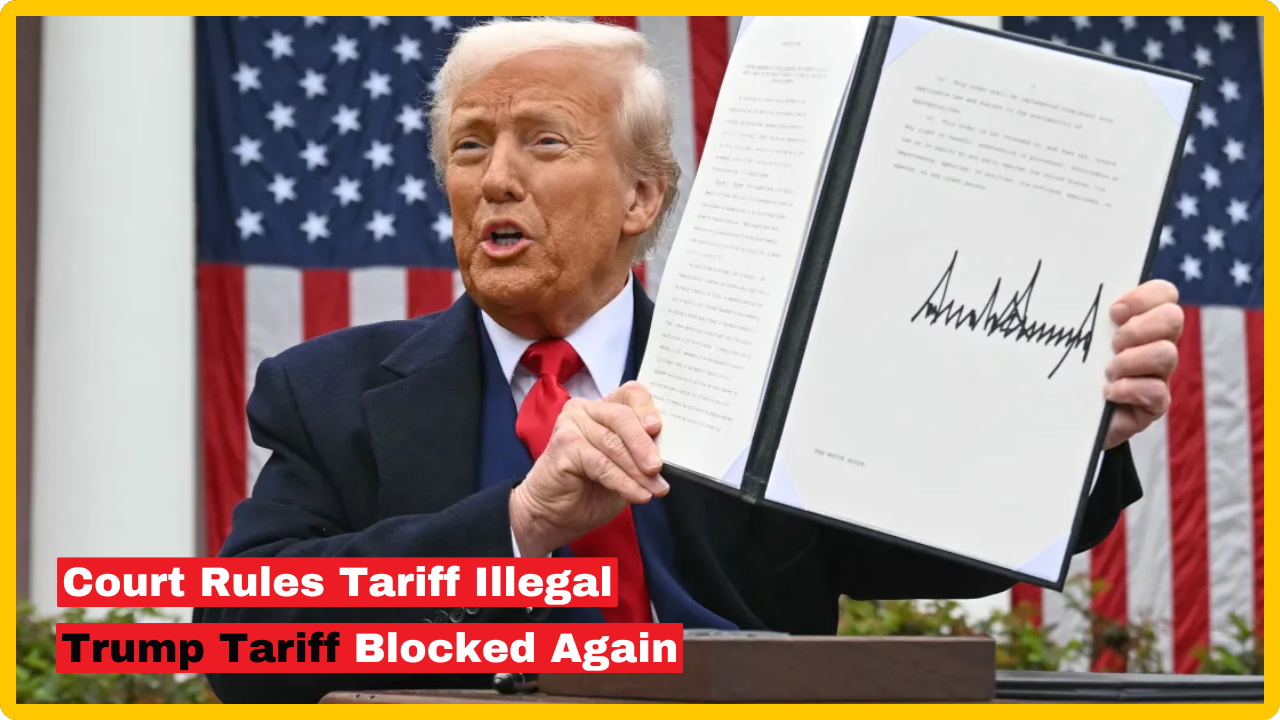
In what has become a recurring pattern for the Trump administration’s trade policy – announce, impose, litigate, lose – a federal trade court delivered the second major judicial blow of 2026 to the president’s signature economic agenda on Thursday, ruling in a 2-1 decision that his Trump 10% tariff imposed on goods imported from virtually every country on Earth is illegal. The US Court of International Trade, the specialized federal court that handles disputes arising from international trade law,
found that the administration lacked the legal justification required to impose the sweeping across-the-board surcharge under Section 122 of the Trade Act of 1974 — the previously untested statutory provision Trump turned to after the Supreme Court invalidated his even broader tariff regime in February.
The ruling is a significant legal setback, even if its immediate practical effect is limited, and it raises urgent questions about whether the administration can keep its tariff architecture standing through any legal mechanism available to it.
The Legal Road That Led Here: From IEEPA to Section 122
A Supreme Court Blow Forced a Pivot – And Now That Pivot Has Also Failed
To fully understand Thursday’s Trump 10% tariff ruling, it is essential to trace the legal journey that produced it. In 2025, Trump imposed some of the most sweeping tariffs in American history using authority drawn from the International Emergency Economic Powers Act — a national security statute that critics argued was never intended to serve as a blank check for broad peacetime trade policy. That legal theory was challenged in the courts almost immediately, and in February 2026, the Supreme Court delivered its verdict: the bulk of those IEEPA-based tariffs were illegal.
The administration needed a replacement framework within hours. Trump turned to Section 122 of the Trade Act of 1974 — a provision that had never before been invoked by any president in the 52 years since the law was enacted. Section 122 allows the president to impose a temporary tariff of up to 15 percent for a period not exceeding 150 days to address what it describes as a “large and serious” balance-of-payments deficit. On the same day the Supreme Court issued its February ruling, Trump signed an order imposing a 10 percent across-the-board surcharge on imports from essentially all countries, effective February 24 — a tariff scheduled to expire on July 24 of this year.
Thursday’s ruling by the Court of International Trade found that invoking Section 122 in these circumstances was not legally supportable. The case was brought by two small businesses — a spice company and a toy retailer – represented by the Liberty Justice Center, the same nonprofit legal organization that had successfully argued the earlier IEEPA challenge before the Supreme Court. In a 2-1 decision, the majority found that the administration’s interpretation of Section 122 would grant the president effectively unlimited tariff power — an authority that the Constitution assigns to Congress, not the executive branch.
What the Court Said: “Such an Expansive Reading”
Separating Powers in Trade Policy
The majority opinion was clear in its constitutional reasoning. Section 122 was enacted in 1974 in a specific historical context: the era of fixed exchange rates and gold-standard monetary arrangements, when balance-of-payments crises — in which a country pays out more to the rest of the world than it takes in, creating pressure on its currency reserves — were a recognized and acute economic threat. The majority opinion noted that the type of monetary crisis the law was designed to address has not existed in the same form since the United States departed from the gold standard in the early 1970s.
“Such an expansive reading of the statute”
as the administration proposed, the court found, would give the president unlimited tariff authority that the Constitution reserves to Congress — a separation of powers violation that the court was unwilling to endorse. The administration had argued that the current account deficit — the broadest measure of what the United States pays out to the rest of the world versus what it takes in — constitutes the modern equivalent of a balance-of-payments crisis sufficient to trigger Section 122. The government pointed to a $1.2 trillion annual goods trade deficit and a current account deficit equal to 4 percent of GDP.
The majority was not persuaded. Plaintiffs had argued, and the court agreed, that a trade deficit of the kind the United States has run persistently for decades does not constitute the kind of “large and serious” balance-of-payments emergency that Congress had in mind when it enacted Section 122 in 1974.
The dissenting judge took a narrower procedural view, finding it premature to grant a complete victory to the small business plaintiffs at this stage of the litigation — not because the majority was wrong on the merits, but because of concerns about the timing and scope of the injunctive relief granted.
The Practical Effect: Narrow But Symbolically Large
Despite the clarity of the ruling on the merits, its immediate practical effect is more limited than the headline might suggest. Unlike the Court of International Trade’s earlier order following the Supreme Court’s February ruling — which issued a nationwide injunction covering all importers — Thursday’s permanent injunction applies only to the specific plaintiffs in the case: the two small businesses that brought the challenge. All other importers continue to pay the 10 percent Trump 10% tariff while the administration appeals the ruling.
The administration is widely expected to seek a stay from the Federal Circuit Court of Appeals — the appellate court that handles trade-related cases — before Thursday’s injunction takes practical effect even for the two plaintiff businesses. That appeal will take time to work through the system, and the administration has signaled it is prepared to pursue every available avenue of review.
Plan C: Section 301 Investigations Already Underway
The Administration Has Another Tool Ready
If the judicial record has made one thing clear in 2026, it is that the Trump administration approaches tariff policy as a multi-tool enterprise. When one legal mechanism is struck down, another is prepared and waiting. Trade lawyers and administration officials have both confirmed that the “Plan C” for tariff imposition — already underway as of Thursday — involves Section 301 of the Trade Act of 1974, a different provision that authorizes tariffs in response to specific unfair trade practices by particular countries.
Unlike Section 122 — which was designed for short-term emergency tariff authority — Section 301 is a more established and legally tested mechanism that has survived judicial scrutiny in multiple prior administrations. It requires the US Trade Representative to conduct formal investigations into alleged unfair trade practices, after which tariffs can be imposed as a remedy. Those investigations are already underway across a broad range of countries and trade relationships, giving the administration a legally different pathway to many of the same economic outcomes it was pursuing under IEEPA and Section 122.
“This decision will surely be appealed by the administration, and there is already a ‘Plan C’ in place,”
Tim Brightbill, co-chair of the international trade practice at law firm Wiley Rein, noted Thursday. The administration has not yet indicated which specific Section 301 actions it plans to finalize, or on what timeline, but the infrastructure for that approach is being built in parallel with the current legal battles.
Small Businesses at the Center: The Spice Company and the Toy Retailer
Liberty Justice Center’s Winning Streak Continues
One of the more striking aspects of the Trump 10% tariff legal battle is the identity of the challengers who have brought the administration’s trade architecture to its knees twice in the same year. In both the IEEPA Supreme Court case and Thursday’s Section 122 ruling, the successful plaintiffs were not multinational corporations with armies of trade lawyers — they were small businesses with thin margins and direct exposure to the cost of tariffs on imported goods.
Trump 10% Tariff Ruled Illegal by US Trade Court Again
The spice company and toy retailer who prevailed Thursday faced a straightforward economic reality: a 10 percent across-the-board surcharge on imported goods raises their costs directly and immediately, with no ability to absorb those costs the way a large corporation with diversified supply chains and pricing power might. Their legal representation by the Liberty Justice Center — a nonprofit that has made presidential tariff overreach a signature focus of its litigation portfolio — has now produced two landmark victories in a single year, establishing the organization as one of the most consequential actors in the current trade policy legal landscape.
One industry representative, welcoming Thursday’s decision, noted that the ruling “brings needed clarity and stability for companies navigating global supply chains” — a sentiment reflecting the broader frustration within the business community at the repeated policy reversals, legal uncertainties, and contested authority that have made tariff planning nearly impossible for importers since 2025.
Importers and Refunds: A Complicated Road Back
When Will the Money Come Back?
For the importers who have already paid duties under both the IEEPA tariffs struck down by the Supreme Court in February and the Section 122 tariffs now struck down by the Court of International Trade, the ruling raises a practical question: when will they get their money back?
The refund process for the IEEPA tariffs is already expected to roll out in phases, and it remains unclear when the system will be open to all payments subject to refund. Payments could be further delayed if the administration takes additional legal actions that affect the calculation of refund amounts. For the Section 122 tariffs, Thursday’s injunction applies only to the two plaintiff businesses — so the broader refund question for other importers depends entirely on the outcome of the Federal Circuit appeal and any subsequent proceedings.
The overall picture for importers is one of profound uncertainty: duties paid, legal victories won, but practical relief still pending through a refund system being built in real time against the backdrop of ongoing litigation.
Conclusion
Thursday’s ruling against the Trump 10% tariff under Section 122 is the second time in 2026 that a federal court has found that the administration’s chosen legal mechanism for imposing sweeping tariffs exceeds the president’s statutory authority. The pattern — announce broad tariffs, face legal challenge, lose in court, pivot to new legal theory, face legal challenge again — has defined the Trump trade agenda’s relationship with the judiciary across both of his presidential terms.
With Section 301 investigations already underway as the administration’s next planned mechanism, the legal battles over American trade policy are far from over. But for the second time this year, the courts have drawn a clear line between the executive’s desired tariff powers and what the law actually permits.
Given that federal courts have now struck down Trump’s tariff mechanisms twice in 2026 — finding both IEEPA and Section 122 insufficient legal bases for broad across-the-board tariffs — do you think the administration’s “Plan C” reliance on Section 301 investigations will finally provide a durable legal foundation for its trade agenda, or are further courtroom setbacks inevitable?
Frequently Asked Questions (FAQ)
Q1: What did the Court of International Trade rule on Thursday regarding Trump’s 10% global tariff?
In a 2-1 ruling issued on May 7, 2026, the US Court of International Trade found that President Trump’s 10 percent across-the-board tariff imposed on February 24, 2026, under Section 122 of the Trade Act of 1974, is illegal. The court found that the administration lacked the legal justification required by Section 122, which authorizes temporary tariffs of up to 15 percent for up to 150 days to address a “large and serious” balance-of-payments deficit.
The majority found that accepting the government’s interpretation would give the president effectively unlimited tariff power that the Constitution assigns to Congress rather than the executive branch. The court entered a permanent injunction requiring the administration to cease collecting these tariffs from the plaintiff businesses and refund prior payments, though the injunction currently applies only to the two small business plaintiffs — a spice company and a toy retailer — and not to all importers.
Q2: How does this ruling relate to the Supreme Court’s earlier decision on Trump’s tariffs?
In February 2026, the Supreme Court struck down the bulk of the sweeping tariffs Trump had imposed using the International Emergency Economic Powers Act, finding that IEEPA did not provide adequate legal authority for that scale of broad peacetime tariff imposition. On the same day that ruling was issued, Trump turned to the previously untested Section 122 of the Trade Act of 1974 — a different statutory provision — to impose a replacement 10 percent across-the-board tariff.
The two small businesses that brought Thursday’s successful challenge, represented by the Liberty Justice Center — the same organization that helped argue the earlier IEEPA challenge — argued that the Section 122 tariffs were an attempt to sidestep the Supreme Court’s ruling. The Court of International Trade agreed, finding the Section 122 authority insufficient for the administration’s purposes, making Thursday’s decision the second major judicial invalidation of Trump’s tariff architecture in a single year.
Q3: Will tariffs actually stop being collected following Thursday’s ruling, and what happens next?
In the immediate term, Thursday’s ruling has limited practical effect for most importers. The injunction applies only to the two plaintiff businesses in the case — not to the broader universe of American importers, who continue to pay the 10 percent tariff while the administration appeals. The administration is widely expected to seek a stay from the Federal Circuit Court of Appeals, which handles trade-related appeals, before the injunction takes effect even for the plaintiff businesses.
Additionally, the Section 122 tariffs are scheduled to expire by their own terms on July 24, 2026 — regardless of the court’s ruling – which may limit the long-term legal significance of the decision for this specific set of duties. The administration has signaled it is already developing a “Plan C” through Section 301 investigations under the Trade Act of 1974, a more legally tested mechanism that allows tariffs to be imposed as a remedy for specific unfair trade practices by particular countries.

Be First to Comment