
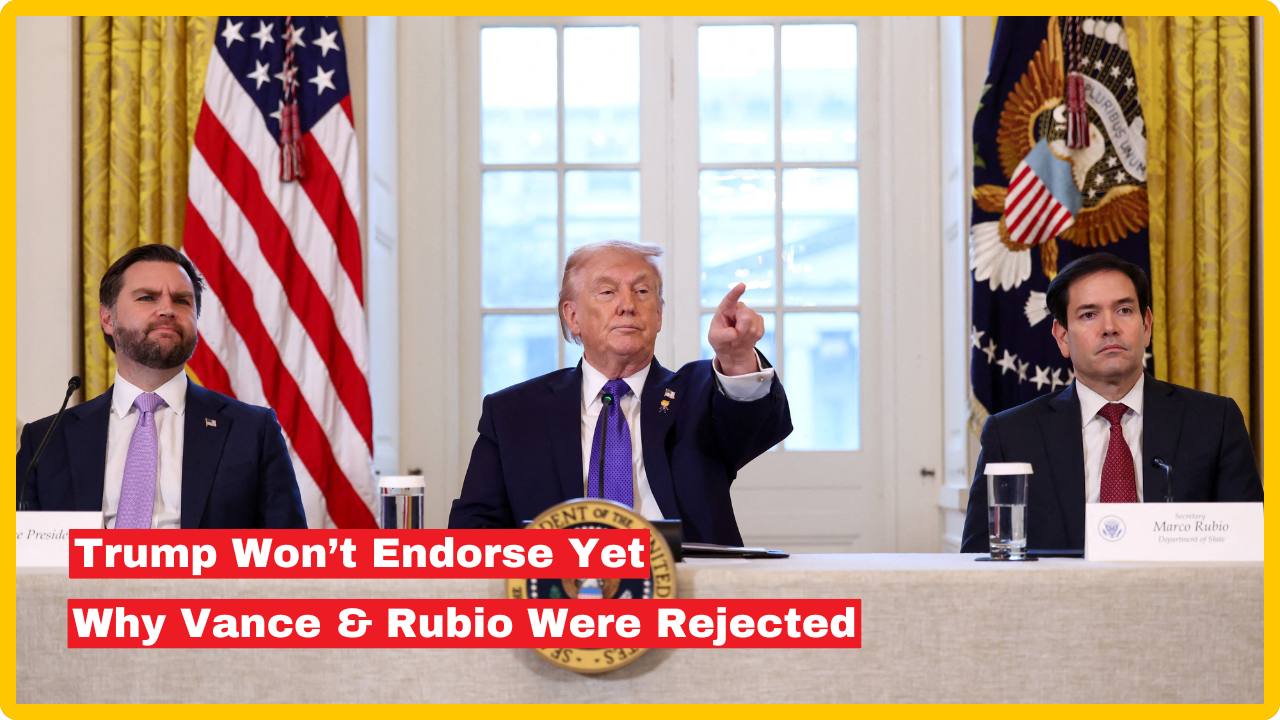
The most consequential unresolved question in American politics right now has nothing to do with the Iran war, tariffs, or the November midterms. It is this: who will President Donald Trump formally endorse for the Trump endorsement 2028 that his MAGA movement is waiting for & why is he refusing to give one? According to multiple insiders close to the president, the answer is deliberate, strategic, and deeply revealing about how Trump thinks about power, legacy, and his own political immortality.
Trump has turned the question of his successor into what advisers have described as a “parlor game” — casually but increasingly asking allies, confidants, donors, and Cabinet members a deceptively simple question: “Marco or JD?” The fact that the leader of the free world is running an informal succession poll at his Mar-a-Lago dining room and asking donors point-blank who they prefer tells you everything about how seriously he is thinking about 2028, and nothing about which way he will ultimately land.
The Parlor Game Trump Is Playing at Mar-a-Lago
In February 2026, Axios first reported the breadth of Trump’s informal successor polling operation. The president, sources said, was asking the question — “JD Vance or Marco Rubio?” — of virtually everyone in his orbit. Advisers. Donors. Cabinet members. Friends. Mar-a-Lago guests. The frequency had increased in the weeks approaching the midterms, and the consistency of his interest left little doubt: the Trump 2028 endorsement question is genuinely occupying the president’s mind, even if he has given no indication of when — or whether — he intends to provide a public answer.
Which one of you is going to be at the top of the ticket? I used to think it would be Vance-Rubio, but maybe it will be Rubio-Vance.
Donald Trump, in a private conversation with Vance and Rubio, per the Wall Street Journal
The remark — made directly to both men in a single room — captures the dynamic perfectly. Trump is simultaneously telling each man he has a path, keeping both loyal and competitive, and avoiding any commitment that would weaken his own leverage. It is a masterclass in the kind of transactional ambiguity that has defined his political style across two presidential terms.
Why Trump Won’t Make a Formal Trump Endorsement 2028
Trump insiders who spoke to multiple outlets offer a consistent explanation for why the Trump endorsement 2028 has not materialized despite the president’s obvious interest in the question: Trump does not want to look like he is losing power.
A formal endorsement carries an implied admission – that Trump’s political era is ending and the transition has begun. For a president who has built his entire brand on dominance and forward momentum, declaring a successor feels like conceding something. Advisers note explicitly that Trump wants his team focused on their current jobs, particularly in the lead-up to the November midterms, and that naming a preferred 2028 candidate would distract from that focus and generate exactly the kind of “lame duck” framing that Trump viscerally resists.
There is also the simple reality of political leverage. As long as Trump has not formally chosen between Vance and Rubio, both men have every incentive to remain maximally loyal, maximally useful, and maximally eager to please. The moment he chooses one, the other becomes a rival rather than an ally. An undecided Trump is a more powerful Trump — and he knows it.
JD Vance Vice President of the United States
- 63% GOP support in YouGov polling
- Trump’s publicly stated “probable favorite”
- Acknowledged heir apparent by Rubio himself
- Softer MAGA support than polling suggests
- Lower media visibility than Rubio
Marco Rubio
Secretary of State & NSA
- Overtaken Vance & Newsom in prediction markets
- CPAC straw poll saw major spike in April 2026
- Described as “loyal, wicked smart, a winner”
- Publicly deferred to Vance — but privately prepared
- Daily media presence through dual State/NSA role
JD Vance: The Heir Apparent With a Perception Problem
By any conventional metric, Vice President JD Vance remains the frontrunner for a potential Trump endorsement 2028. A YouGov poll from April 2026 found that 63 percent of Republican voters support Vance for a presidential run — a commanding lead over Rubio’s 42 percent. The MAGA base, when asked directly, answers without hesitation: Vance will be the 2028 nominee. Many are already more interested in who Vance might pick as his own running mate than in hearing from any other potential candidate.
Trump himself has publicly placed Vance at the top of the hierarchy. “I think most likely — in all fairness, he’s the vice president,” Trump told Fox News’s Peter Doocy when asked whether Vance was MAGA’s heir apparent. “And he would be probably favored at this point.” The public language has been consistent with private signals: Trump chose Vance as his running mate for a reason, and that reason has not disappeared.
But something has shifted in the undercurrents of Washington’s political conversation. A growing number of MAGA-adjacent voices and conservative commentators have begun expressing private skepticism about Vance – a sentiment that one analyst described as surprising precisely because it is no longer limited to the left. Vance’s lower media profile compared to Rubio, his absence from the Iran war’s most visible diplomatic moments, and concerns about his electability in a general election matchup against a Democratic heavyweight have all contributed to the quiet but growing whispers.
Marco Rubio: The Insider’s Choice Rising Fast
From “Little Marco” to the Man Prediction Markets Now Favor
The transformation of Marco Rubio’s standing within the MAGA ecosystem is one of the more remarkable political rehabilitation stories in recent Republican history. The man Trump publicly humiliated as “Little Marco” during the 2016 primary — a label that seemed to permanently define Rubio’s political ceiling — has spent the past fifteen months methodically rebuilding his standing by becoming one of the administration’s most visible and effective voices.
His dual role as both Secretary of State and National Security Adviser has placed him at the center of virtually every major foreign policy moment of Trump’s second term, from the Iran war negotiations to the Ukraine ceasefire diplomacy to the King Charles state visit. His daily media presence — the result of twin responsibilities that put him before cameras constantly — has made him uniquely visible to a president who, advisers note, “consumes news ravenously.” In Trump’s media-saturated decision-making environment, being constantly in the news is a structural advantage that Vance, as vice president, simply cannot match.
Source: YouGov / CPAC straw poll composite, April 2026
A senior White House official, speaking anonymously to Politico in April 2026, offered the clearest articulation of the pro-Rubio case circulating in Trump’s inner circle: Rubio is “loyal, wicked smart, articulate and very seasoned” — and critically, he is “a winner.” Insiders also note that Rubio has consistently avoided the kind of damaging headlines and negative news cycles that ended the tenures of other senior officials like former DHS Secretary Kristi Noem and former Attorney General Pam Bondi.
In prediction markets, Rubio has now overtaken both Vance and California Governor Gavin Newsom, sitting at approximately 20 percent probability of winning the 2028 presidential election — the highest of any candidate tracked. A shadow “draft Rubio” donor network has quietly assembled, with Republican fundraisers who favor Rubio discussing ways to further boost his political positioning ahead of 2028, according to multiple sources.
The Newsom Factor: Why Trump Would Rather Face the California Governor
Here is where the Trump endorsement 2028 story takes its most surprising turn. According to an insider claim that has been circulating in political media, Trump has privately suggested he would rather see California Governor Gavin Newsom emerge as the Democratic nominee in 2028 than face a more conventional Democratic challenger — not because Trump fears Newsom, but precisely because he believes Newsom would be the easiest Democrat to defeat.
Governor of California · Presumptive 2028 Democratic Contender
- Publicly warning of a “rigged” 2028 election
- Actively running as a de facto candidate since 2025
- Predicted by some Trump insiders as their preferred opponent
- Has overtaken most Democrats in name recognition polling
- California’s economic record seen as electoral liability
- Prediction markets place him among top 3 for 2028
Trump’s reported preference for a Newsom matchup reflects a calculated read of the political landscape: California’s ongoing struggles with homelessness, cost of living, and crime give Republicans a ready-made opposition narrative against the former San Francisco mayor turned governor. Trump insiders believe a Vance vs. Newsom or Rubio vs. Newsom general election would play strongly on the same economic populist terrain that defined both of Trump’s own victories.
Conclusion:
The Trump endorsement 2028 saga reveals something fundamental about how the 45th and 47th president operates: maximum leverage comes from maximum ambiguity. By refusing to formally choose between Vance and Rubio, Trump keeps both men maximally loyal, maximally competitive, and maximally focused on proving their worth to him through their current roles. The occasional tease — “maybe it will be Rubio-Vance” – keeps the game alive without resolving it.
And the Newsom factor adds one more layer of complexity: Trump’s calculation about who he wants to face in 2028 may ultimately influence which of his own men he decides to promote. For now, the answer to the question that dominates Washington’s political conversation remains exactly what Trump wants it to be — unresolved.
💬 Reader Conversation
Given that Trump has privately asked “Marco or JD?” of virtually everyone in his orbit without committing to an answer, do you think his deliberate refusal to give a Trump 2028 endorsement is a sign of genuine indecision — or one of the most calculated political moves of his career?
Be First to Comment