
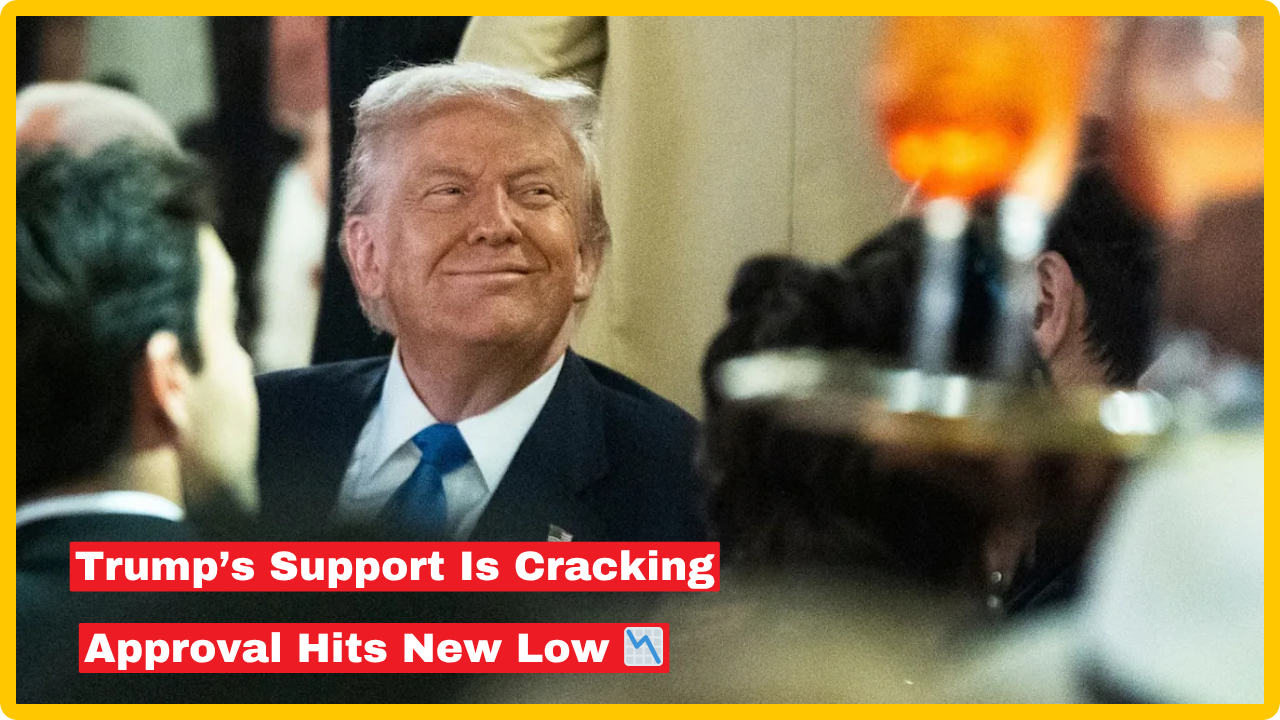
Trump approval rating 2026 midterms has hit a new second-term low in April 2026, with multiple national polls painting an increasingly grim picture for Republicans just months before the November midterm elections.
A survey from American Research Group shows Trump’s approval sinking to a record second-term low, as the president faces underwater ratings in key policy areas and even in traditionally safe GOP strongholds. With the Trump approval rating 2026 midterms conversation dominating political circles, analysts are now warning that Republicans risk losing control of Congress if the trend continues.
The Numbers That Are Alarming the GOP
The polling data coming out this spring is consistent, and it is not favorable for the White House. Trump’s overall approval has dropped from 40% in January 2026 to just 35% in April, with his net rating falling from -18 to -26 over the same period. That kind of sustained, month-over-month decline is not a blip — it is a pattern.
The NBC News Decision Desk Poll powered by SurveyMonkey recorded Trump hitting a new low, with only 37% of adults approving of his job performance and 63% disapproving — including 50% who strongly disapprove. Strong disapproval, rather than soft opposition, is typically what fuels opposition turnout in midterm elections — and that is exactly what Democrats are counting on.
Even among his own party, the enthusiasm that has long defined Trump’s political strength is showing subtle but meaningful cracks. An Economist/YouGov poll conducted April 10–13, 2026, showed that 57% of Republicans strongly approved of Trump — a one-point decline that, while within the margin of error, reflects a broader softening trend among his base. Political strategists note that strong approval, not mere passive support, is what drives primary turnout, small-dollar donations, and party discipline — all of which matter deeply in midterm cycles.
Trump’s Biggest Vulnerability
Perhaps no issue is more dangerous for Republicans heading into November than the economy — the very issue that powered Trump’s 2024 comeback. Trump’s net approval rating on prices and inflation has now fallen to -46, worsening every single month of 2026: -31 in January, -35 in February, -40 in March, and -46 in April.
CNN chief data analyst Harry Enten noted that Trump is now rated “slightly worse” on the economy than Joe Biden was at the same point in his presidency — a striking reversal for a president who made economic management a centerpiece of his political identity.
Enten went further, drawing a direct line between presidential economic approval and congressional seat losses.
“If the president’s net approval rating on the economy is negative, as it is right now for Donald Trump, the average House seat loss is 28 seats,”
he said — a figure that would easily cost Republicans their majority.
The fraying of Trump’s broader coalition beyond the Republican base is one of the most telling warning signs for the party. In the NPR/PBS News/Marist poll, just 30% of independents and voters aged 18–29 approved of Trump’s job performance, along with only 38% of Latinos — all groups that were pivotal to his 2024 reelection victory.
Veteran Republican pollster Daron Shaw, who co-directs the Fox News Poll, addressed the Independent voter problem directly.
“The approval numbers amongst Independents, I think, are what probably troubles the White House and Republican operatives across the country,”
Shaw said, adding that while independents don’t vote at the highest rates in midterms, their erosion can cost Republicans seats in both chambers.
This loss of Independent support is not just a national story — it is playing out in key swing counties and battleground states where elections are actually decided.
Bellwether Counties and Battleground Warnings
Local polling is sometimes more predictive than national surveys, and the signals from swing areas are deeply concerning for the GOP. In Bucks County, Pennsylvania — long considered one of the nation’s premier political bellwethers — Trump’s disapproval among likely voters has reached 53%, casting a cloud over Republican candidates across the region.
Pollster Ethan Smith explained:
“It’s clear that there is some backlash against Trump and MAGA Republicans generally. The survey also shows that we’re probably entering a period of Democratic enthusiasm.”
He added that high Democratic response rates to the survey itself suggest strong grassroots motivation heading into November.
Even in deeply red Iowa, prediction markets now place the GOP’s chances of winning an open Senate seat at 66%, down sharply from 81% a year ago — a shift that Enten described as foreshadowing “big problems” for Republicans nationwide.
The Generic Ballot and the House Majority at Stake
One of the clearest measures of midterm momentum is the congressional generic ballot — and it has been moving steadily against Republicans. On the generic congressional ballot, Democrats lead Republicans 50% to 43% among registered voters, a 7-point margin, and Democrats have led in every single monthly poll since May 2025, with margins ranging between +4 and +10 points.
The structural math for Republicans is unforgiving. Republicans currently hold a narrow 220–213 majority in the House, meaning a net loss of just seven seats would cost them control of the chamber. Meanwhile, 21 House Republicans won their seats in 2024 by margins of less than 8 points — exactly the kind of swing that current polling shows Democrats could achieve.
Public opinion has worsened for the president’s approval rating, which has been declining since soon after his inauguration and now hovers near historic lows, with majorities expressing dissatisfaction with Trump’s handling of almost every major issue. Half of registered US voters now say they want Democrats to control Congress.
Trump approval rating 2026 midterms:
Midterm elections have historically functioned as a referendum on the sitting president, and the pattern almost always favors the opposition party. When a president’s approval rating is below 50%, the president’s party has lost an average of 32 House seats in midterm elections. Trump entered his second term with approval briefly in positive territory, but that window closed quickly.
The comparison to 2018 is unavoidable. During Trump’s first term, a similar erosion of Independent support and a negative economic narrative helped Democrats flip 41 House seats and reclaim the majority. Democrats are hoping 2026 mirrors that wave — and the polling data increasingly suggests the conditions for it are forming.
Even in polling averages from The Economist, Trump’s approval has now sunk below any point during his first term and even below former President Joe Biden’s lowest recorded rating – a benchmark that few political observers anticipated at the start of his second term.
What Republicans Are Saying – And Doing
Despite the warning signals, the Republican National Committee is projecting confidence. RNC Chair Joe Gruters has called Trump the GOP’s “secret weapon” that will help the party “defy history” in November’s midterm elections. Fox News The White House has also pushed back on the narrative. White House spokesman Davis Ingle told Newsweek:
“The ultimate poll was November 5, 2024, when nearly 80 million Americans overwhelmingly elected President Trump.”
Still, the gap between official optimism and ground-level polling is becoming harder to ignore. Trump himself has privately acknowledged vulnerability — a rare admission for a president known for projecting unwavering confidence.
What Comes Next:-
The 2026 midterms are still months away, and political tides can shift. Economic conditions could improve, a foreign policy breakthrough could boost presidential approval, and voter enthusiasm is notoriously difficult to predict this far in advance.
However, the trend lines — approval falling every month, the economy dragging, Independents disengaging, and Democrats consistently leading the generic ballot — point to a challenging cycle for the Republican Party.
For voters watching closely, the question is no longer whether there are warning signs for Republicans, but whether anything can reverse them before November. Will Trump’s base enthusiasm be enough to overcome broad public disapproval? The answer to that question may determine which party controls Congress for the next two years.
Follow the latest polling updates and share your thoughts in the comments below – do you think Republicans can hold the House in 2026?





Be First to Comment