
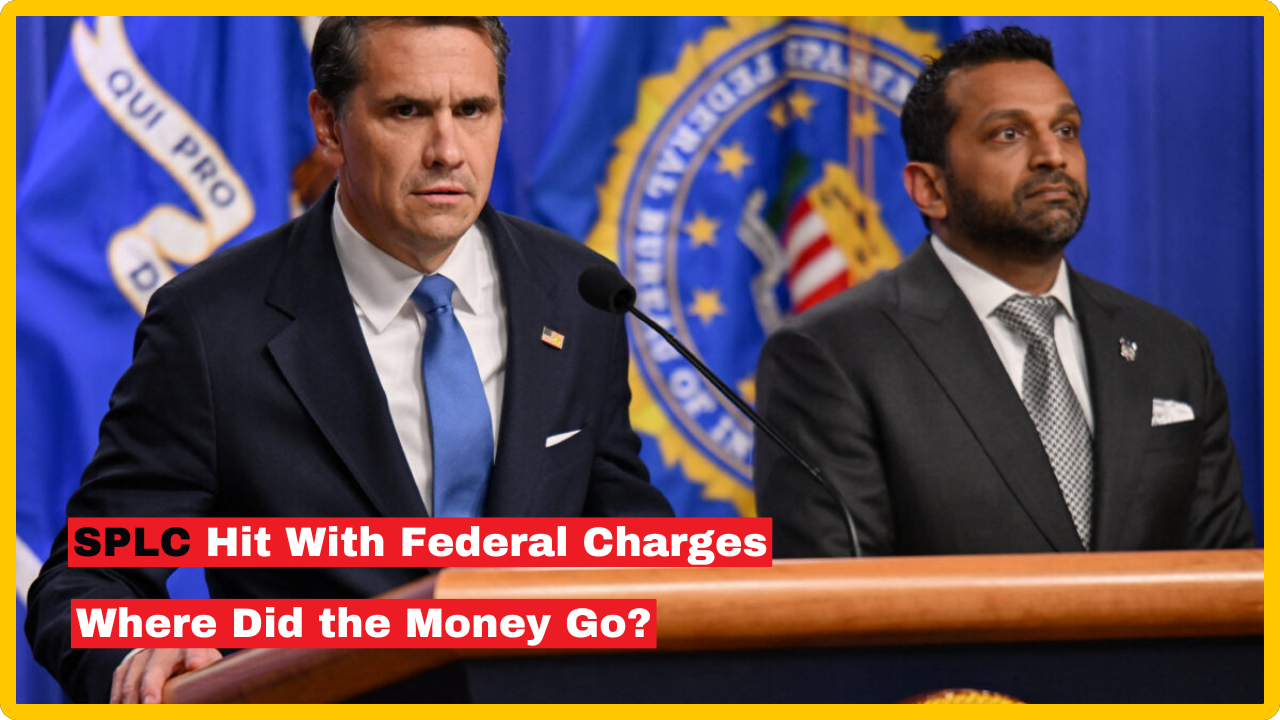
SPLC Southern Poverty Law Center Indicted on Federal Fraud Charges as One of the nation’s most prominent civil rights organizations is now at the center of a major federal criminal case. On April 21, 2026, the Justice Department announced a federal grand jury indictment against the Southern Poverty Law Center, charging the Montgomery, Alabama-based nonprofit with wire fraud, bank fraud, and conspiracy to commit money laundering. The Southern Poverty Law Center has denied all allegations and characterized the prosecution as politically motivated, setting the stage for a highly consequential legal battle.
What the Federal Indictment Alleges
A grand jury in Montgomery, Alabama returned an indictment charging the Southern Poverty Law Center with 11 counts of wire fraud, false statements to a federally insured bank, and conspiracy to commit concealment money laundering. The case was investigated by the FBI with assistance from IRS Criminal Investigation.
The core of the government’s case centers on a confidential informant program that prosecutors say operated for nearly a decade. The Justice Department alleged that the Southern Poverty Law Center used more than $3 million in donor funds to secretly pay leaders of violent extremist groups to act as confidential informants, without disclosing where that money was going.
According to Acting Attorney General Todd Blanche, between 2014 and 2023 the SPLC paid at least $3 million to eight individuals, some of whom were associated with the Ku Klux Klan, the United Klans of America, the National Socialist Party of America, the Aryan Nations-affiliated Sadistic Souls Motorcycle Club, and the American Front.
The government also alleges an elaborate effort to conceal these payments from financial institutions. The SPLC allegedly created bank accounts for fictitious entities such as “Fox Photography” and “Rare Books Warehouse” that were used to funnel donor money to informants, in a scheme designed to conceal the money’s actual purpose.
One troubling example cited by Blanche was an allegation that the SPLC was paying a member of a leadership group that planned the Unite the Right protest in Charlottesville, Virginia — the 2017 rally that resulted in one death and dozens of injuries — with payments totaling approximately $270,000 over eight years.
The United States Attorney’s Office for the Middle District of Alabama also filed two forfeiture actions to recover alleged proceeds of the organization’s fraud scheme. U.S. Department of Justice
The SPLC’s Response:
“Outraged by False Accusations”
The Southern Poverty Law Center has pushed back firmly against the charges, with its leadership calling the indictment both legally baseless and politically driven.
Bryan Fair, interim president and CEO of the SPLC, said the organization is
“outraged by the false accusations,” adding that taking on violent hate and extremist groups is “among the most dangerous work there is.”
Fair acknowledged that the group had used paid informants in the past but defended the practice. In a video posted online, Fair said the SPLC had stopped the use of paid informants but defended the method, stating that informants
“risked their lives to infiltrate and inform on the activities of our nation’s most radical and violent extremist groups” and that “there is no question that what we learned from informants saved lives.”
Beyond the legal merits, the SPLC’s leadership has argued that the prosecution is part of a broader effort to suppress civil rights advocacy. Fair called the indictment the “most severe attack” the group has faced from the Trump administration, and pointed to other recent actions including an October announcement by FBI Director Kash Patel that the bureau would sever ties with the SPLC, as well as a December hearing held by House Republicans accusing the organization of being partisan.
The SPLC says it is being unfairly targeted by the Trump administration and argues the indictment follows a pattern of political attacks, stating it is
“unsurprised to be the latest organization targeted by this administration.”
Southern Poverty Law Center | SPLC
The Southern Poverty Law Center was founded in 1971 in Montgomery, Alabama, initially focused on civil rights litigation in the South. Over the decades, it expanded its mission to tracking and reporting on hate groups across the United States, maintaining a widely referenced “Hate Map” that catalogs organizations it designates as extremist.
For years, the Southern Poverty Law Center has faced accusations from Republicans who say it has unfairly maligned conservative organizations and individuals as extremists, and the center has been publicly critical of the Trump administration’s policies on immigration, voting restrictions, education, and other social issues. It has supported several lawsuits against the administration and GOP lawmakers across the country.
The Investigation’s Unusual History
The case has a notable procedural history that both sides cite to support their narratives. Blanche claimed that the investigation into the group started years ago, but was shuttered during President Joe Biden’s term, before the Trump administration revived it. The SPLC points to this fact as evidence the prosecution is politically motivated; the Justice Department maintains it is simply pursuing a legitimate criminal matter that had been improperly shelved.
The Trump administration had already taken action against the SPLC prior to the indictment. In an interview earlier this month, FBI Director Kash Patel said the FBI had
“jettisoned all relationships with the Southern Poverty Law Center.”
Reactions From Civil Rights Community and Legal Experts
The indictment has drawn responses from across the civil rights world, with many organizations voicing alarm.
The Native American Rights Fund stated it stands in solidarity with the SPLC, saying that
“efforts to intimidate or discredit organizations that defend fundamental rights and challenge abuses of power represent a threat not only to those organizations but to the health of our democracy itself.”
The National Urban League similarly condemned the indictment, calling it a troubling escalation in what it described as efforts to weaken and delegitimize the civil rights movement.
What Happens Next
The Southern Poverty Law Center has vowed to fight the charges vigorously. As a nonprofit organization with significant legal resources and decades of litigation experience, it is expected to mount a robust defense. The case will be tried in the federal court in Montgomery, Alabama — the same city where the organization has been headquartered since its founding.
The broader significance of the case extends well beyond the Southern Poverty Law Center itself. Legal observers and civil liberties advocates are watching closely to see whether the government can sustain its burden of proof in court, and whether the prosecution will have a chilling effect on how other advocacy organizations conduct sensitive investigative operations — particularly those that require the use of confidential informants to gather intelligence on dangerous groups.
The case follows a number of other investigations into organizations critical of the Trump administration, raising questions among observers about whether law enforcement agencies have taken on a political dimension. Those concerns have been sharply denied by administration officials, who maintain the charges are grounded entirely in evidence developed over years of investigation.
Conclusion
The federal indictment of the Southern Poverty Law Center marks one of the most significant legal confrontations between a major US civil rights organization and the federal government in recent memory. Whether the allegations of fraud ultimately hold up in court — or whether this case comes to be seen as an instance of government overreach — will likely take years to fully resolve. For now, both sides have drawn firm lines: the Justice Department insists the SPLC defrauded its donors, while the SPLC insists it was doing vital and life-saving work in a dangerous field.
Should civil rights organizations that use paid informants be required to disclose that practice to donors, or does transparency risk compromising the safety of those informants?
Frequently Asked Questions (FAQ)
Q1: What exactly is the Southern Poverty Law Center charged with?
A federal grand jury indicted the Southern Poverty Law Center on 11 criminal counts, including six counts of wire fraud, four counts of making false statements to a federally insured bank, and one count of conspiracy to commit concealment money laundering. The charges center on allegations that the SPLC secretly paid over $3 million in donor funds to informants inside extremist groups without disclosing this to donors, and used fictitious shell accounts to hide the payments from banks.
Q2: How has the SPLC responded to the indictment?
The SPLC has denied all allegations, calling them “false accusations.” Its interim president and CEO Bryan Fair defended the use of paid informants as a necessary and life-saving practice, while also arguing that the prosecution is politically motivated and represents the Trump administration’s effort to silence organizations that advocate for civil rights and challenge its policies.
Q3: What is the SPLC, and why has it been politically controversial?
The Southern Poverty Law Center is a nonprofit civil rights organization founded in 1971 in Montgomery, Alabama. It is best known for tracking and designating hate groups across the US. Over the years, it has become controversial among conservatives, who argue that its “Hate Map” unfairly labels mainstream conservative organizations as extremist groups. Supporters, by contrast, say it performs essential work documenting domestic terrorism and white supremacist activity.

Be First to Comment