
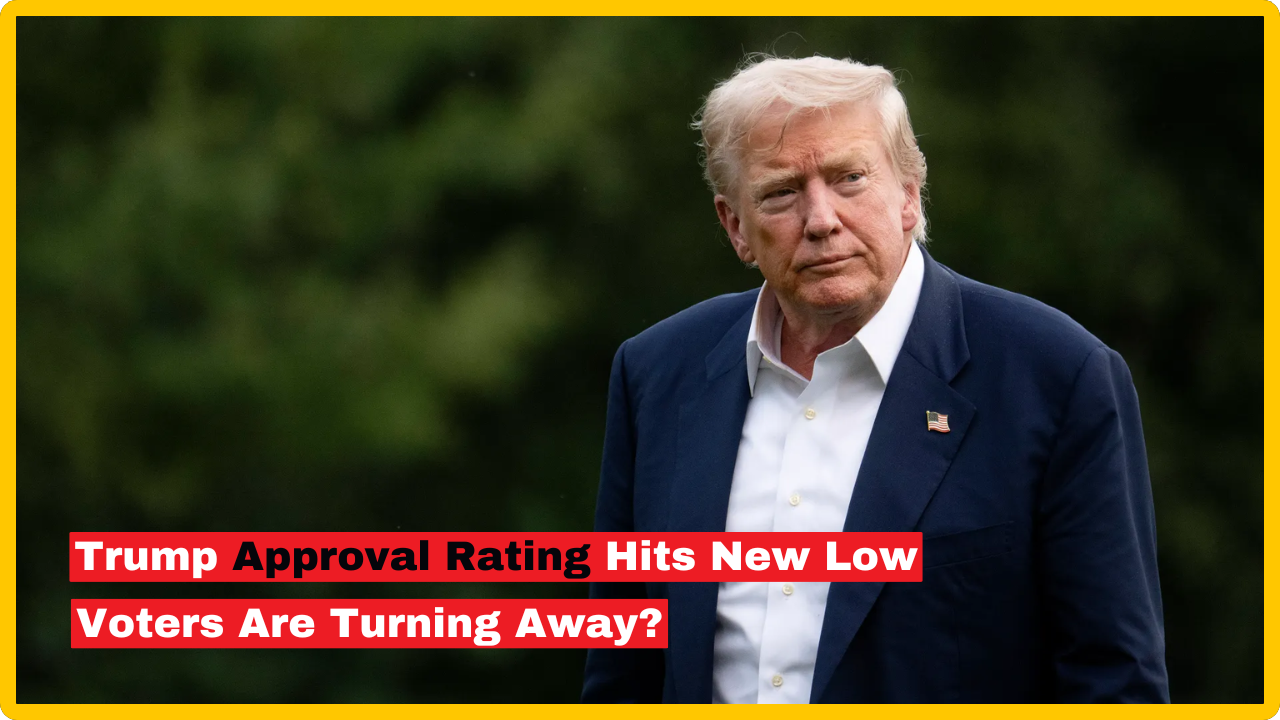
As President Donald Trump approaches the 100-day mark of his second term’s second year, the Trump approval rating 2026 picture has darkened considerably – and the data is arriving from nearly every direction at once. Multiple independent pollsters, ranging from Reuters/Ipsos and the Associated Press to CNBC and Fox News, have released surveys in the final week of April that collectively point to the same sobering conclusion: a commander-in-chief whose public support has eroded to levels not seen since the closing days of his first term, weighed down by the costs of an ongoing war with Iran, surging gasoline prices, and deepening anxiety about the economy.
According to the Silver Bulletin polling average maintained by statistician Nate Silver, the Trump approval rating today stands at approximately 39 percent, with 57.7 percent of Americans disapproving — a net approval figure of negative 18.8, matching the low point Trump hit in the aftermath of the January 6th Capitol riot in 2021.
For a president who launched his second term with a 47 percent approval rating in January 2025 – already the second lowest starting point for any president in modern polling history – the downward trajectory over the past 15 months has been steep, sustained, and now accelerating.
The Trump Approval Rating Today: What the Polls Show
The most striking data points in the current cycle come from two of the most methodologically rigorous polling organizations in the country. A Reuters/Ipsos survey conducted April 24–27, 2026, among 1,014 American adults placed Trump’s overall job approval at just 34 percent — the lowest reading of his second term to date. The same poll found that only 22 percent of respondents approved of Trump’s handling of the cost of living, a number that reflects the acute pain many Americans are feeling at the gas pump and grocery store.
A separate AP-NORC poll released the same week delivered a nearly identical verdict: overall approval at 33 percent, with support for the ongoing Iran war at 32 percent and approval of Trump’s handling of the economy at a deeply negative 30 percent. Both surveys were conducted after gas prices climbed above $4 per gallon nationally — a politically toxic threshold that no incumbent president has survived at length without suffering significant approval damage.
CNBC: Worst Numbers Across Both Terms
Perhaps the most striking data point of the week came from CNBC’s quarterly survey, which found that Trump’s overall net approval and his economic approval are now lower than at any point in either his first or second presidential term. That means his current numbers are worse than anything recorded during the COVID-19 pandemic, the January 6th period, or the turbulent inflation spike of 2022 – a remarkable statistical benchmark that the White House has not publicly addressed.
The Trump Approval Rating Graph: A Consistent Decline
Looking at the Trump approval rating graph over the arc of his second term reveals a consistent, if not always linear, downward pattern. He entered office in January 2025 at 47 percent — buoyed by the optimism that typically accompanies the start of a presidential term. That figure held relatively stable through mid-2025, hovering between 37 and 42 percent through most of the year, according to the Wikipedia compilation of second-term opinion polling. The decline accelerated sharply beginning in February 2026, when the United States launched military operations against Iran and the Strait of Hormuz was effectively closed to international shipping.
Where Trump Wins and Loses Support:-
The Trump approval rating on economic issues has become the administration’s most exposed political flank. With the average price of a gallon of gasoline now at $4.17 — up from under $3 before the Iran war began – and inflation remaining stubbornly elevated, economic disapproval has surged to record levels across nearly every survey.
The Fox News poll from January 2026 — taken before the Iran war began — already showed warning signs, with approval of Trump’s handling of the economy at 40 percent, inflation at 35 percent, and tariffs at 37 percent. Those numbers have worsened in every subsequent poll released since the war began, with the Silver Bulletin average tracking Trump’s net approval on inflation and the cost of living at negative 40 — “blowing past its previous second term low,” according to the Silver Bulletin update of April 23.
Border Security: His Lone Bright Spot
Amid the near-universal deterioration in Trump’s approval numbers, one issue continues to provide a measure of political shelter: border security. Across multiple polls, including Fox News and CNBC, approximately 51 to 52 percent of Americans continue to approve of Trump’s handling of the southern border and immigration enforcement — the only issue area in most surveys where his approval still reaches majority territory. That number has slipped from a high of 57 percent earlier in his term but remains his most durable source of public support.
The Iran War: Deeply Unpopular
The decision to go to war with Iran, while initially viewed by some Americans as a decisive show of strength, has steadily lost public backing as the conflict has dragged on and its economic costs have mounted. The AP-NORC poll found support for the war at just 32 percent. Fox News polling found majorities opposed to military intervention aimed at regime change in Iran. The combination of high gas prices, a fragile ceasefire, and a naval blockade that has disrupted global energy markets has eroded whatever initial rally-around-the-flag effect the administration may have enjoyed in the war’s opening weeks.
Trump Approval Rating by State: Erosion Everywhere
Polling aggregated through March 2026 by the Civiqs tracker and the Economist’s state-level model reveals a finding that may be most alarming for Republican strategists: the Trump approval rating by state has declined in every state in the country since his inauguration in January 2025. That includes reliably Republican states that Trump has carried in every recent election, as well as the battleground states that determined the outcome of the 2024 race.
The breadth of the decline — across all 50 states, not concentrated in blue or purple jurisdictions – suggests the disapproval is not simply a function of Democratic opposition solidifying. It reflects genuine erosion among persuadable voters and soft Republican supporters, many of whom backed Trump primarily on economic grounds and are now confronting rising living costs and an uncertain global outlook.
Trump Approval Rating Among Republicans: A Loyal but Shrinking Base
The Trump approval rating among Republicans remains the most reliable component of his coalition. Throughout the second term, self-identified Republicans have continued to approve of the president at rates typically exceeding 80 percent in most surveys — a bedrock of partisan loyalty that has defined Trump’s political resilience across both terms.
However, even within that base, there are signs of movement. Some polls have begun to register softness among Republican voters on economic questions, particularly in states where manufacturing jobs have been disrupted by tariff retaliation from trading partners and where gas prices are felt most acutely.
The CNBC survey noted that majorities disapprove of Trump’s handling of inflation and tariffs, with both numbers worsening from the prior survey — findings that suggest even friendly-leaning respondents are registering dissatisfaction with specific policy outcomes.
Trump Approval Rating Compared to Other Presidents
When the Trump approval rating compared to other presidents at equivalent points in their second terms, the picture is historically unflattering. Most two-term presidents — including Ronald Reagan, Bill Clinton, and Barack Obama — had approval ratings in the mid-to-high 40s at this stage of their second years.
George W. Bush is perhaps the closest comparison, having seen his second-term approval crater under the weight of the Iraq War and Hurricane Katrina to the low 30s. Trump’s current trajectory places him in similar territory, though the political dynamics of his coalition and the partisan polarization of the current era make direct historical comparisons inherently imprecise.
The Gallup organization, which has tracked presidential approval continuously since Harry Truman, places the long-run average approval for two-term presidents at their current point at roughly 48 percent — nine percentage points above where the Silver Bulletin average currently places Trump.
What’s Driving the Numbers: The Iran Factor
The timing and magnitude of the approval decline leaves little ambiguity about its primary driver. The Iran war, which began in late February 2026 and triggered Iran’s blockade of the Strait of Hormuz, has sent energy prices soaring globally and fueled a fresh wave of inflation in the United States. With gas prices above $4 per gallon and consumer confidence declining, economic anxiety has translated directly into presidential disapproval.
Trump has publicly maintained that time is on America’s side that the Iranian economy is collapsing under the dual pressure of U.S. airstrikes and a naval blockade – and that a favorable deal is within reach. Whether that strategic patience translates into tangible relief for American consumers before November’s midterm elections will likely determine whether the current polling trough represents the floor of Trump’s approval or the beginning of a further slide.
Conclusion
The Trump approval rating 2026 data presents a consistent and challenging portrait for the White House heading into the midterm election cycle. With overall approval at 33 to 39 percent depending on the pollster, economic approval at historic second-term lows, and the Iran war dragging on without a resolution that lowers gas prices or reopens the Strait of Hormuz, the political conditions are not favorable for the Republican Party’s congressional majority.
Border security remains Trump’s one issue of genuine public strength, but it has proven insufficient to offset the breadth of disapproval on economic and foreign policy matters. The months between now and November will test whether a deal with Iran — and the energy price relief that would follow — can restore enough public confidence to change the political landscape.
Given the Iran war’s clear impact on gas prices and Trump’s approval rating, do you think a successful ceasefire and reopening of the Strait of Hormuz would be enough to meaningfully reverse the president’s numbers before the November midterms?
Frequently Asked Questions (FAQ)
Q1: What is Trump’s approval rating today in April 2026?
According to the Silver Bulletin polling average updated on April 28, 2026, approximately 39 percent of Americans approve of Trump’s job performance, while 57.7 percent disapprove — a net approval rating of negative 18.8, which is a new second-term low. Individual polls vary: the Reuters/Ipsos survey conducted April 24–27 placed his overall approval at 34 percent, while the AP-NORC poll found it at 33 percent. These figures represent the lowest readings of Trump’s second term to date, driven primarily by economic dissatisfaction and opposition to the ongoing war with Iran.
Q2: What issues are hurting Trump’s approval rating the most in 2026?
The economy and the Iran war are the two dominant drivers of Trump’s approval decline. On economic issues, only 22 percent of Americans approve of his handling of the cost of living in Reuters/Ipsos polling, while the AP-NORC survey found his economic approval at 30 percent. CNBC’s survey found his net approval on the economy and overall at the lowest point of either of his two terms. Gas prices, which have risen above $4 per gallon following Iran’s blockade of the Strait of Hormuz, are a central source of public frustration. Support for the Iran war itself stands at just 32 percent in AP-NORC polling. Border security remains the one issue where Trump maintains net positive ratings, with approximately 51 to 52 percent approval.
Q3: How does Trump’s approval rating compare to other presidents at the same point in their second terms?
Historically, most two-term presidents have maintained approval ratings in the mid-to-high 40s at a comparable stage of their second year. The long-run Gallup average for presidents at an equivalent point is roughly 48 percent – nearly nine points above where Trump currently stands in the Silver Bulletin aggregate. The closest historical comparison is George W. Bush, whose second-term approval fell to the low 30s under the weight of the Iraq War and its domestic economic consequences. Trump entered his second term with one of the lowest inauguration-day approval ratings in modern polling history at 47 percent, leaving him with a narrower margin for decline before reaching historically unusual territory.




Be First to Comment