
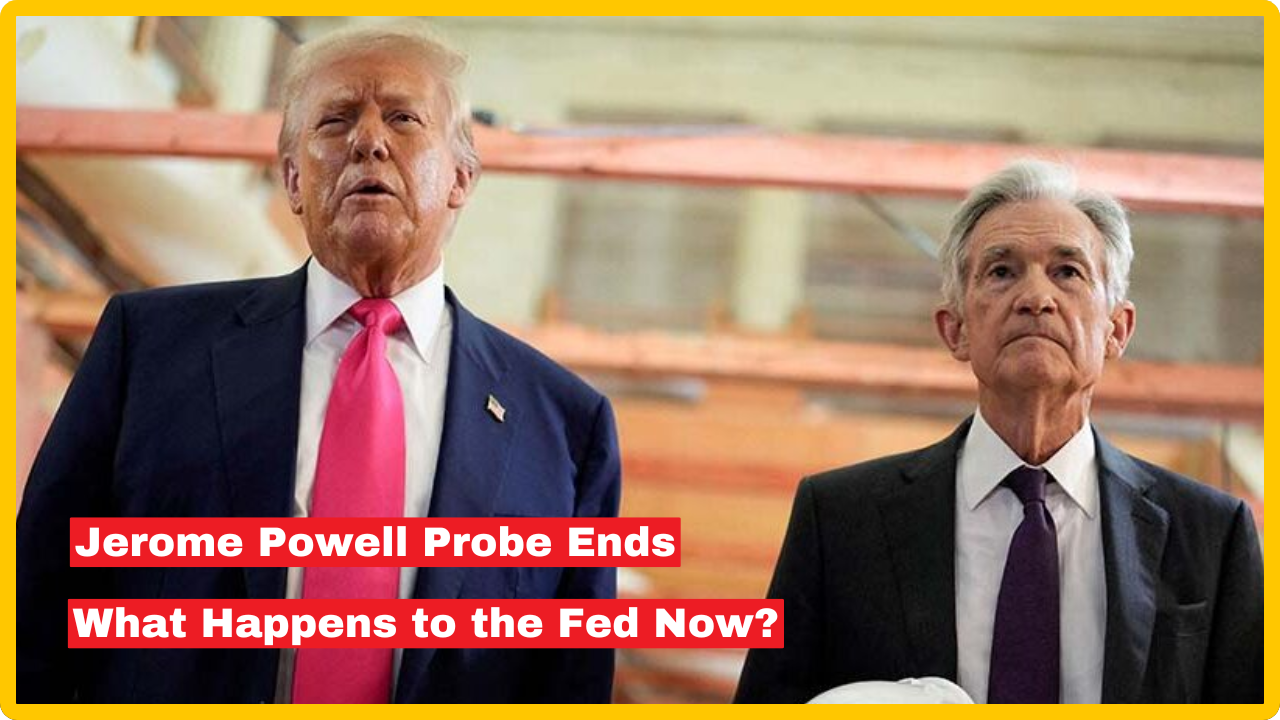
DOJ closes Federal Reserve investigation Powell as a dramatic reversal that carries significant implications for the independence of the world’s most powerful central bank, the Justice Department has formally closed its DOJ Federal Reserve investigation into Chair Jerome Powell. U.S. Attorney for the District of Columbia Jeanine Pirro announced the decision Friday morning in a post on social media, ending a probe that had sparked widespread concern about political interference in monetary policy and had derailed the Senate confirmation process for Trump’s preferred successor to Powell.
The closure of the investigation arrives just days after Powell’s nominated replacement, former Federal Reserve Governor Kevin Warsh, testified before the Senate Banking Committee and less than three weeks before Powell’s term as Fed chair is set to expire on May 15.
What Was the DOJ Federal Reserve Investigation About?
The investigation centered on a $2.5 billion renovation project for two Federal Reserve buildings that have not been renovated since they were built in the 1930s. The probe began after Powell testified about the renovations before the Senate Banking Committee in June.
The federal investigation was formally opened over Powell’s testimony before the Senate Banking Committee regarding the renovation of the Federal Reserve’s headquarters. Powell said the probe was a result of his rejecting Trump’s repeated demands to lower interest rates.
From the outset, the investigation generated fierce controversy. Powell publicly and emphatically denounced the probe, describing it as a politically motivated pressure campaign. The DOJ probe stoked fears that the Trump administration was trying to chip away at the Federal Reserve’s independence, which would pave the way for political interference in setting interest rates for the world’s largest economy.
A Court That Pushed Back
The investigation ran into a significant legal wall almost immediately. A prosecutor handling the case conceded at a closed-door court hearing in March that the government had not yet found any evidence of a crime, and a judge subsequently quashed subpoenas issued to the Federal Reserve. Judge James Boasberg said prosecutors had produced
“essentially zero evidence” to suspect Powell of a crime.
Judge Boasberg wrote in his ruling,
“There is abundant evidence that the subpoenas’ dominant (if not sole) purpose is to harass and pressure Powell either to yield to the President or to resign and make way for a Fed Chair who will.”
The judge noted that the president or administration officials had made over 100 public statements criticizing Powell and pressuring him to lower interest rates.
More recently, prosecutors made an unannounced visit to a construction site at the Fed’s headquarters but were turned away, drawing a rebuke from a defense attorney in the case who called the maneuver
“not appropriate.”
Despite all of this, Pirro had repeatedly signaled she would push forward. Just this past Wednesday, Pirro said she was committed to continuing the criminal probe, which had been crippled by the federal judge’s ruling quashing the subpoenas her office had issued to the Fed.
The Announcement: Pirro Hands Off to Inspector General
Friday’s reversal came swiftly and without the kind of extended buildup many observers expected.
In her announcement, Pirro stated that the Federal Reserve’s Inspector General had been asked to scrutinize the building cost overruns instead. “The IG has the authority to hold the Federal Reserve accountable to American taxpayers. I expect a comprehensive report in short order and am confident the outcome will assist in resolving, once and for all, the questions that led this office to issue subpoenas. Accordingly, I have directed my office to close our investigation as the IG undertakes this inquiry,” she posted on X.
Pirro did not fully close the door, however. She added,
“Note well, however, that I will not hesitate to restart a criminal investigation should the facts warrant doing so.”
The inspector general now taking on the matter is Michael Horowitz. In the investigation’s place, the Fed’s inspector general has agreed to scrutinize the significant cost overruns at the central bank’s ongoing multibillion-dollar renovation project at its Washington, DC, headquarters. After the inspector general completes his report, Pirro said her office will review it and could restart its criminal probe if warranted.
The White House also weighed in, with spokesperson Kush Desai stating that the inspector general’s “more powerful authorities best position it to get to the bottom of the matter.”
Kevin Warsh’s Stalled Confirmation:
The closure of the DOJ Federal Reserve investigation was not simply a legal or administrative decision — it was deeply entangled with a separate confirmation battle unfolding on Capitol Hill.
Senator Thom Tillis, a North Carolina Republican and Banking Committee member, had placed an effective hold on the full Senate confirming Kevin Warsh as Fed chair unless the criminal investigation of Powell was dropped. Tillis repeatedly described the probe as “bogus” and warned it was improperly interfering with financial markets.
DOJ closes Federal Reserve investigation Powell
Tillis had claimed the DOJ’s investigation was political and would improperly interfere with markets. “It’s not cute,” Tillis said during a television interview earlier this year. During Warsh’s confirmation hearing this week, Tillis told Warsh he had “extraordinary credentials” but that he could not vote to advance his nomination in the Senate until the DOJ ended its investigation.
Dropping the probe is an abrupt left turn for an administration that appeared to be doubling down on the investigation. Just this past Tuesday, Trump suggested that Powell was profiting from the renovations, saying “I can’t imagine that ‘Too Late’ is taking money on construction. I can’t. But it’s possible,” using his nickname for the head of the central bank.
Trump’s Nominee: Kevin Warsh
The move could lead to a swift confirmation vote by the Senate for Warsh, a former top Fed official whom Trump nominated in January to replace Powell, whose term as chair ends May 15.
Republicans praised Warsh during his Tuesday hearing even as Democrats questioned his independence from Trump, the lack of transparency around some of his financial holdings, and what they said was his flip-flopping on interest rates.
Democratic Criticism: “Clearing the Path”
Not everyone welcomed the announcement as a straightforward step toward institutional normalcy. Senate Democrats were quick to frame the decision as a calculated political maneuver rather than a genuine retreat from overreach.
Senator Elizabeth Warren of Massachusetts, the top Democrat on the Senate Banking Committee, dismissed Pirro’s announcement as “an attempt to clear the path” for Warsh’s confirmation. Warren stated,
“Let’s be clear what the Justice Department announced today: they threatened to restart the bogus criminal investigation into Fed Chair Powell at any time while failing to drop their ridiculous criminal probe against Governor Lisa Cook,”
referring to the DOJ’s separate action involving Fed Governor Lisa Cook, whom Trump has sought to remove.
A federal judge twice quashed DOJ subpoenas issued to Powell, stating that the investigation was aimed at pressuring Powell to yield to Trump to cut rates or resign. Democrats argued that the probe’s closure, coming immediately after Warsh’s confirmation hearing, was timed entirely for political convenience.
What This Means for the Federal Reserve’s Independence
The episode has raised profound questions about the boundaries between executive authority and the independence of the Federal Reserve — a principle that has underpinned American monetary policy for decades. The Fed’s ability to set interest rates free from political interference is considered a cornerstone of economic stability, and the DOJ investigation represented an unprecedented challenge to that norm.
The end of the investigation clears the way for Warsh to get confirmed for the role, while also removing significant uncertainty that had been clouding the future of the world’s most important central bank. Axios Whether the transition from Powell to Warsh will bring a meaningful shift in monetary policy – particularly on the interest rate question that has been at the center of Trump’s public criticism of the Fed – remains to be seen.
Conclusion
The Justice Department’s decision to close its DOJ Federal Reserve investigation into Jerome Powell marks the end of one of the most legally contentious episodes in the history of the central bank. With Pirro handing oversight of the renovation cost review to the Fed’s Inspector General, and Senator Tillis likely to clear the path for Kevin Warsh’s confirmation, the leadership transition at the Federal Reserve appears set to proceed rapidly before Powell’s term concludes on May 15. However, the broader questions raised about political pressure on an independent institution are unlikely to fade quickly.
With the DOJ investigation now closed and Kevin Warsh on the cusp of confirmation, do you think the Federal Reserve’s independence from political influence can be fully restored — or has this episode set a lasting precedent?
Frequently Asked Questions (FAQ)
Q1: Why did the Justice Department investigate Federal Reserve Chair Jerome Powell?
The DOJ investigation, led by U.S. Attorney Jeanine Pirro, focused on a $2.5 billion renovation project at the Federal Reserve’s Washington, DC, headquarters. The probe was tied to Powell’s testimony before the Senate Banking Committee about the project’s costs. However, Powell and a federal judge both argued the real purpose of the investigation was to pressure Powell into lowering interest rates as demanded by President Trump, or to compel his resignation before his term ended.
Q2: What did the federal court say about the DOJ’s investigation?
U.S. District Judge James Boasberg quashed the DOJ’s subpoenas, finding that prosecutors had presented “essentially zero evidence” of any crime. He wrote that the subpoenas appeared designed to harass and pressure Powell either to comply with Trump’s interest rate demands or to make way for a new Fed chair. The judge refused to reconsider that ruling when the DOJ sought a second look, citing a “total lack of a good-faith basis to suspect a crime.”
Q3: How does the closure of the probe affect Kevin Warsh’s confirmation?
The probe’s closure directly removes the key obstacle to Warsh’s Senate confirmation. Republican Senator Thom Tillis had placed an effective hold on Warsh’s confirmation vote, saying he could not support the nomination as long as the criminal investigation into a sitting Fed chair continued. With the DOJ now stepping back and handing the matter to the Fed’s Inspector General, Tillis is expected to withdraw his objection and allow a full Senate vote on Warsh’s nomination ahead of Powell’s term ending on May 15, 2026.

Be First to Comment