
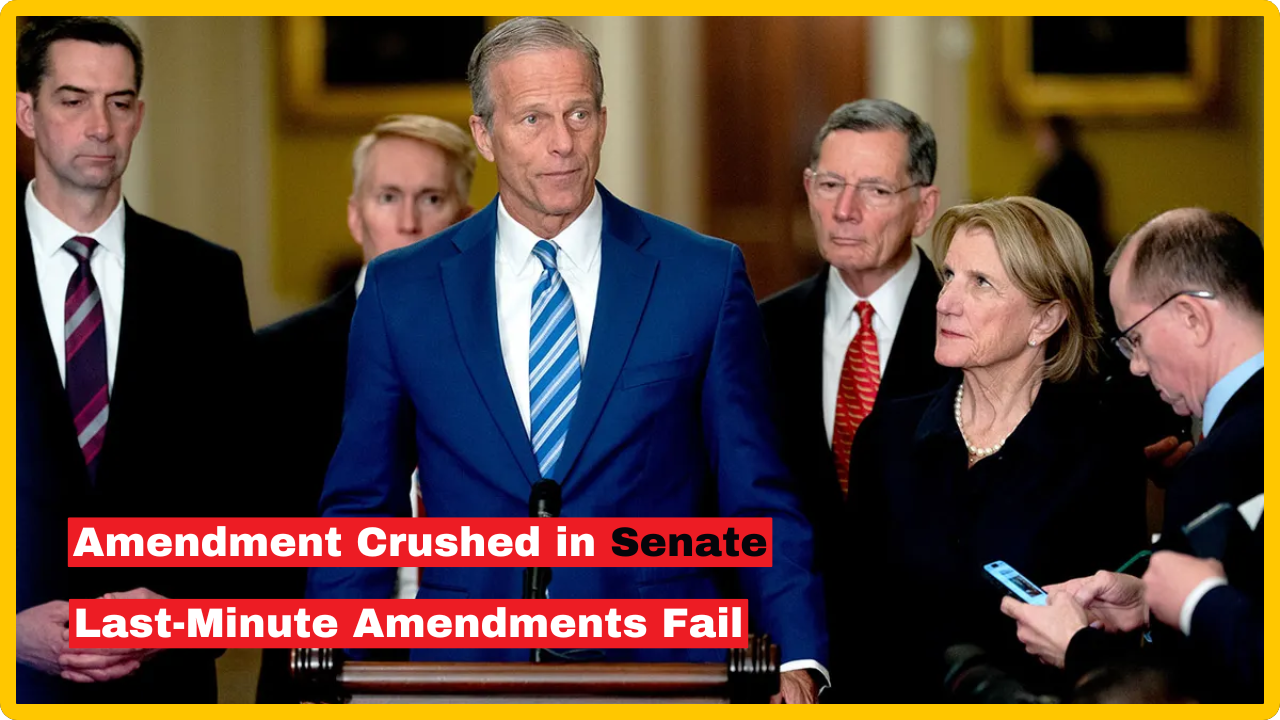
In a significant legislative moment on Capitol Hill, the Senate Republicans ICE funding vote concluded in the early hours of Thursday morning with a narrow 50–48 margin, approving a budget resolution that paves the way for approximately $70 billion in immigration enforcement funding — while decisively defeating amendments introduced by Senate Minority Leader Chuck Schumer.
The overnight session, stretching from Wednesday evening well into Thursday, featured a marathon procedural process known as a “vote-a-rama,” during which Democrats sought to force politically charged votes on issues ranging from healthcare affordability to immigration oversight.
The resolution marks a major first step for Republican lawmakers looking to fund Immigration and Customs Enforcement (ICE) and parts of Customs and Border Protection (CBP) without relying on a single Democratic vote – and without needing the 60-vote threshold typically required to advance legislation in the Senate.
What Is the Budget Resolution and Why Does It Matter?
The budget resolution passed Thursday is not yet a spending bill. Rather, it is a set of legislative instructions directing the Senate Judiciary and Homeland Security committees to draft a reconciliation bill — a type of legislation that carries direct budgetary impact and can pass the Senate with a simple majority.
The budget resolution authorizes the Senate Judiciary and Homeland Security committees to draft legislation to increase spending by up to $70 billion each, which would be used to fund Immigration and Customs Enforcement and parts of Customs and Border Protection, with the final bill’s price tag expected to be around $70 billion total.
Because compromise between the two parties is off the table, Senate Republicans turned to this budget tool called reconciliation, which would enable them to fund immigration enforcement agencies without the need for Democratic support.
Republicans have a 53-seat majority in the Senate, and although most legislation requires 60 votes to move forward, the budget reconciliation process allows Senate Republicans to advance a measure with direct budgetary consequences with only a simple majority.
The DHS Shutdown: 68 Days and Counting
The push for the Senate Republicans ICE funding vote comes against the backdrop of a record-breaking partial government shutdown that has gripped the Department of Homeland Security.
The GOP’s funding push for ICE and CBP comes amid the record-long DHS shutdown, now in its 68th day. Many federal employees across DHS, including the Coast Guard, Secret Service, Federal Emergency Management Agency and Cybersecurity and Infrastructure Security Agency have gone without pay as Congress struggles to advance a funding deal.
DHS funding became a flashpoint in Congress after two deadly shootings by federal agents in Minneapolis in January. In response, Democrats pledged to object to any funding for DHS without reforms to its immigration enforcement agencies. The department shut down on February 14 amid the stalemate.
Democrats, who had been increasingly criticized for inaction during Trump’s second term, derailed pending legislation to fund DHS, which oversees ICE. The move was a risky gambit, forcing the effective shutdown of DHS and leading to several knock-on effects, including Transportation Security Administration (TSA) staffing shortages that snarled airport traffic.
The Vote-a-Rama: Schumer’s Amendments Defeated One by One
The centerpiece of Thursday’s early morning drama was the so-called “vote-a-rama,” a procedural tactic available to the minority party when a budget resolution comes to the floor.
Vote-a-ramas can be dramatic and drawn-out affairs where senators take up a marathon of amendments ahead of a final budget vote. It is a rare chance for the party in the minority to bring legislation to the floor and is an opportunity for senators to try to undo parts of the budget resolution through objections known as budget points of order.
Senate Minority Leader Schumer used the process aggressively, framing his amendments as a contrast between Democratic priorities and Republican ones.
The first amendment, put to a vote by Schumer, sought to “create a point of order against reconciliation legislation that does not lower out-of-pocket health care costs.” Republicans voted it down and it failed 48–50, but it won the support of Sen. Susan Collins of Maine and Dan Sullivan of Alaska — both politically vulnerable, facing some of the most competitive re-election bids of any Republicans this fall.
Senate Republicans ICE funding vote
Three Republicans also supported an amendment to slash prescription drug prices, introduced by progressive Senator Bernie Sanders. Meanwhile, Senator John Kennedy, a Republican, sought to lay the groundwork to include the Trump-backed SAVE America Act in the final funding legislation. That push failed, with four Republicans voting against including Kennedy’s amendment.
Senate GOP leadership managed to keep their party together to vote down a slew of amendment votes that would have jeopardized the final measure. That includes one backed by ultraconservatives that would have included elements of President Donald Trump’s voter ID bill, which failed 48 to 50.
Two Republicans Break Ranks
While the Republican majority largely held together during the Senate Republicans ICE funding vote, two members of the GOP crossed the aisle to oppose the final budget resolution.
Republican Senators Rand Paul of Kentucky and Lisa Murkowski of Alaska joined all Democrats in voting against the measure. Sen. Paul, who chairs the Senate Homeland Security and Governmental Affairs Committee, raised issue with the breakdown of the numbers, suggesting cuts be made elsewhere, saying:
“Congress ought to fund border security, but we should be good stewards of the taxpayer dollars and fully pay for the $70 billion to secure our border.”
Schumer’s Sharp Criticism and the Political Battle Lines
Senate Democrats used the vote-a-rama not just as a procedural tool, but as a public messaging campaign ahead of the November midterm elections.
Schumer said from the Senate chamber after the measure passed:
“Tonight, Senate Republicans showed the American people where they stand — not for families struggling with the high costs of child care, groceries, gasoline, electricity, but for pumping $140 billion towards rogue agencies.”
Schumer had also leveled pointed criticism at ICE and Border Patrol directly, calling them agencies “that nobody respects in this country.” The remark drew swift backlash.
DHS Secretary Markwayne Mullin lashed out at Schumer for those comments, telling Fox News the remarks were insulting to officers and agents
“out there protecting you.”
President Trump also weighed in, demanding an apology over the comment on Thursday, referring to it as “one of the most egregious, incorrect, unpatriotic, and dangerous statements” he had ever heard from a politician.
What Happens Next: A Long Road Ahead
The adoption of the Senate budget resolution is only the beginning of what promises to be a lengthy legislative process.
The budget resolution now heads to the House, where Speaker Mike Johnson hopes his rank and file will sign off on the Senate’s resolution next week. If approved, House members may begin directing committees to craft their bill meeting the instructions in the budget resolution. If House and Senate Republicans agree on legislation, both chambers will have to pass it again — including a second vote-a-rama in the Senate.
Senate Budget Committee Chairman Lindsey Graham vowed that Republicans are going to work to “get the job done” by June 1 – the deadline publicly set by President Donald Trump for Republicans to fund the immigration enforcement agencies.
The vote also could prompt Republicans to pass a separate bill to fund the rest of DHS, ending the record months-long shutdown. House Republicans have indicated that they need assurances that ICE and CBP will be funded, and are waiting for the Senate to move forward with budget reconciliation.
Conclusion
Thursday’s 50–48 Senate vote represents a consequential but preliminary step in a deeply partisan battle over immigration enforcement funding. Senate Republicans demonstrated enough internal discipline to defeat Schumer’s amendments and advance their budget blueprint, though with notable defections from Senators Paul and Murkowski.
Democrats, for their part, showed they intend to keep applying political pressure through every procedural avenue available. With the DHS shutdown now entering its third month, the stakes for both parties — and for hundreds of thousands of federal workers — are growing by the day.
What do you think: Should Congress end the DHS shutdown before finalizing long-term ICE funding, or is the Republican reconciliation strategy the right path forward?
Frequently Asked Questions (FAQ)
Q1: What did the Senate vote on regarding ICE funding on April 23, 2026?
The Senate voted 50–48 to adopt a Republican budget resolution that sets the framework for a reconciliation bill. This bill could provide approximately $70 billion to fund ICE and parts of Border Patrol through the remainder of the Trump administration, bypassing the normal 60-vote requirement.
Q2: What is a “vote-a-rama” and how did Democrats use it?
A vote-a-rama is a marathon session during which senators can propose unlimited amendments to a budget resolution before a final vote. Democrats used it to force Republicans onto the record on issues like healthcare costs and prescription drug prices — hoping to draw political contrast ahead of November’s midterm elections. Most Democratic amendments, including Schumer’s lead amendment on healthcare, were defeated along party lines.
Q3: Why has the Department of Homeland Security been partially shut down?
DHS entered a partial shutdown on February 14, 2026, after Senate Democrats refused to approve funding for the department without major reforms to ICE and immigration enforcement agencies. The standoff was triggered by two fatal shootings by federal agents in Minneapolis in January. The shutdown has now lasted 68 days, leaving thousands of federal workers without pay.





Be First to Comment