
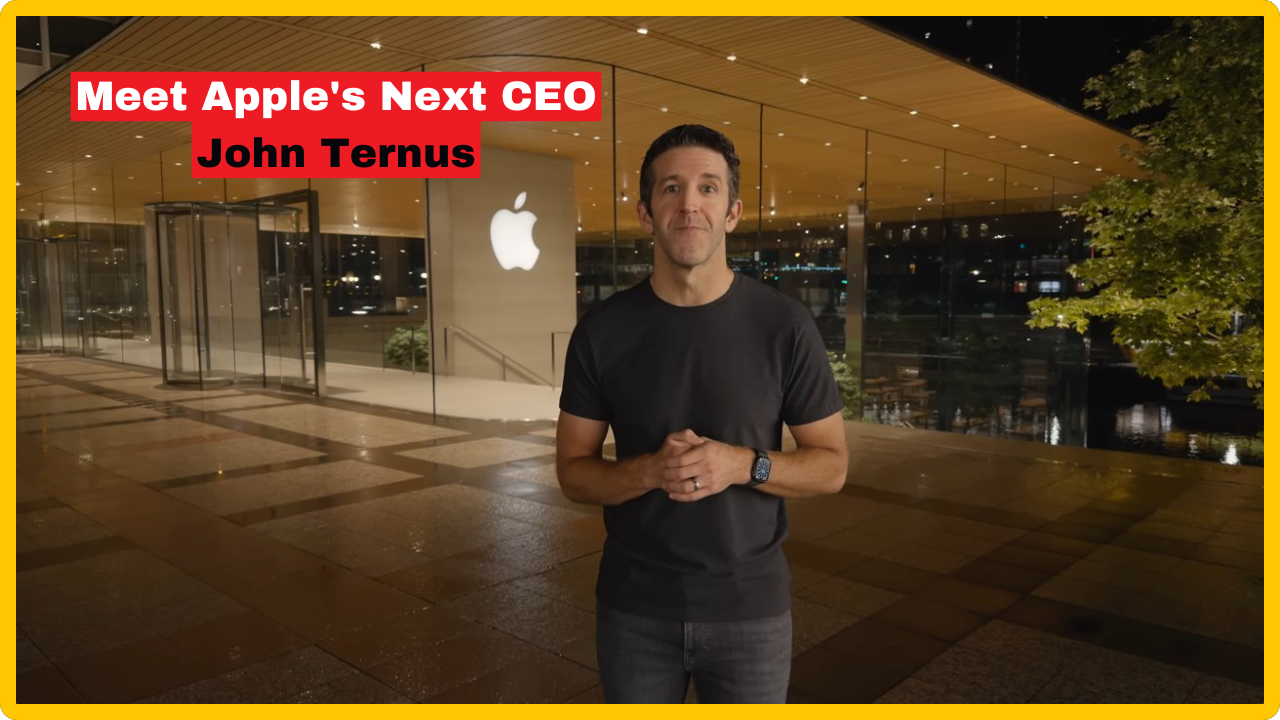
Apple officially announced on Monday, April 20, 2026, that Tim Cook is stepping down as Chief Executive Officer after 15 years at the helm, with hardware engineering chief John Ternus set to take over as the new CEO on September 1, 2026. Ternus, a 51-year-old mechanical engineer, former competitive swimmer, and 25-year Apple veteran, will become the company’s eighth CEO, while Cook transitions into the role of Executive Chairman of Apple’s Board of Directors. So John Ternus Apple CEO is Appointed.
The succession, unanimously approved by Apple’s board, marks the most significant leadership shift at the world’s most valuable technology company since Steve Jobs handed the reins to Cook in 2011.
Who Is John Ternus? Apple’s New CEO Explained
Most people outside Silicon Valley may not immediately recognize the name John Ternus — but inside Apple Park, he has been one of the most influential forces shaping the products that billions of people use every day. From the iPhone in your pocket to the AirPods in your ears, Ternus has overseen hardware engineering work on a variety of groundbreaking products across every Apple category, including multiple new product lines such as iPad and AirPods, as well as many generations of iPhone, Mac, and Apple Watch.
Ternus joined Apple in 2001 as a member of the product design team, working first on the Apple Cinema Display. By 2013, he was appointed Vice President of Hardware Engineering, and in 2021 he was promoted to Senior Vice President of Hardware Engineering. That steady, deliberate rise through Apple’s ranks tells the story of a leader who earned his position through decades of hands-on technical work rather than political maneuvering.
By 2021, when his predecessor Dan Riccio stepped aside to oversee what would become the Vision Pro, Ternus was promoted to Senior Vice President, making him the youngest member of Apple’s executive team. Apple insiders and industry observers had quietly observed his growing influence for years before it became official news.
From the Swimming Pool to the Corner Office
One of the most fascinating dimensions of John Ternus’s story is that before he was designing the world’s most iconic consumer electronics, he was competing in a very different kind of arena — the university swimming pool.
Ternus graduated from the University of Pennsylvania in 1997 with a Bachelor of Science in Engineering, majoring in mechanical engineering. But beyond his studies, he was a competitive swimmer who made his mark in the pool. A 1994 report in the Daily Pennsylvanian revealed his athletic achievement when he won both the 50-meter freestyle and the 200-meter individual medley at a university swimming competition.
John Ternus Apple CEO Appointed
While at Penn, Ternus also developed a mechanical feeding arm operable by individuals with quadriplegia using head movements as his senior project – a detail that speaks volumes about his character. Even as a student, he was driven not just by engineering elegance but by the desire to build things that genuinely help people. That same philosophy has defined his work at Apple ever since.
After graduation, he spent a brief period designing virtual-reality headsets at a small firm called Virtual Research Systems before joining Apple’s product design team in 2001. That early exposure to VR technology proved to be surprisingly relevant decades later, as Ternus went on to play a central role in Apple’s spatial computing push with the Vision Pro.
Why Ternus Was the Right Choice:-
Industry observers and Apple insiders had long viewed Ternus as the most likely candidate to inherit the leadership of one of the world’s most valuable technology companies, according to reporting from Bloomberg’s Mark Gurman. The path became even clearer after Apple’s Chief Operating Officer Jeff Williams, once considered Cook’s natural successor, stepped down from operational responsibilities in July 2025. With Williams out of the picture, attention shifted squarely onto Ternus.
The transition was approved unanimously by the Board of Directors, following what Apple described as a thoughtful, long-term succession planning process. Apple’s board chairman Arthur Levinson made clear that confidence in Ternus runs deep at the highest levels of the company.
Said Levinson:
We believe John is the best possible leader to succeed Tim and as he transitions to CEO, we know his love of Apple, his leadership, deep technical knowledge, and relentless focus on creating great products will help lead Apple to an extraordinary future.
There is also a strategic logic to the timing. At 51, Ternus mirrors Cook’s age when he became CEO in 2011, positioning him for potentially a decade or more of leadership – a longevity factor that likely appealed to Apple’s board, which prefers stability in leadership transitions.
What Leaders Are Saying:-
Tim Cook, who built Apple into a $4 trillion company over 15 years, was effusive in praising his successor. Cook stated:
John Ternus has the mind of an engineer, the soul of an innovator, and the heart to lead with integrity and with honor. He is a visionary whose contributions to Apple over 25 years are already too numerous to count, and he is without question the right person to lead Apple into the future.
Ternus himself reflected on the weight of the moment. In his own statement, Ternus said:
Having spent almost my entire career at Apple, I have been lucky to have worked under Steve Jobs and to have had Tim Cook as my mentor.
The reaction from the wider technology community was immediate. Tech analyst Carolina Milanesi noted on X:
Now Ternus will be the one to introduce the first foldable iPhone, which means the most consequential hardware moment in years belongs to a hardware engineer from day one. Hard to believe this is just a coincidence.
Apple’s Leadership History
Apple’s CEO transitions have always been pivotal moments in technology history. Steve Jobs co-founded Apple, was famously ousted in 1985, returned in 1997, and rebuilt the company into the cultural and commercial force it became with the iMac, iPod, iPhone, and iPad. When Jobs handed the reins to Tim Cook in August 2011, there was deep skepticism about whether Apple could survive without its visionary founder. Cook took the reins just six weeks before Jobs’ death from pancreatic cancer, inheriting a company that many industry watchers struggled to separate from its famed founder.
Cook proved the doubters wrong spectacularly. Apple’s market cap increased more than 20-fold on Cook’s watch, closing on Monday at $4 trillion. He expanded Apple into wearables, services, and spatial computing, turning it into a company far more diversified than the device maker Jobs left behind.
Now it falls to Ternus to carry that legacy forward. The challenges ahead are real and significant. For Ternus, perhaps the most critical aspect of his new role will be pushing Apple deeper into artificial intelligence, where it has lagged behind many of its megacap peers. Apple has faced criticism from investors and technologists for a perceived lack of cutting-edge AI technology, and that criticism grew after Apple delayed an upgrade to its Siri voice assistant.
Beyond the products themselves, Ternus has made durability and repairability a major focal point, and Apple credits him with introducing new materials and manufacturing techniques that have reduced the carbon footprint of Apple’s products, including a new recycled aluminum compound used across multiple product lines.
Organizational Changes at Apple
The transition goes beyond simply swapping one name for another at the top. Johny Srouji, SVP of Hardware Technologies, will replace Ternus in overseeing the company’s hardware efforts, stepping into a newly created role as Chief Hardware Officer. Arthur Levinson, who has served as Apple’s non-executive chairman for the past 15 years, will become lead independent director, also effective September 1. Ternus will join Apple’s board of directors on the same date, completing a clean and structured transition of power.
What Comes Next for Apple
The appointment of John Ternus as Apple’s next CEO signals both continuity and a new chapter. He is a product person at heart — someone who has spent over two decades in the trenches of hardware engineering, building the devices that define Apple’s identity. As the company faces mounting pressure to lead in artificial intelligence, advance spatial computing, and deliver the first foldable iPhone, Ternus brings the technical credibility and institutional knowledge to navigate those challenges from a position of genuine authority.
Tim Cook leaves behind a company in outstanding financial health. Whether Ternus can match or exceed that legacy remains to be written. But if his record at Apple is any guide — steady, disciplined, deeply technical, and always focused on the product — the world’s most valuable company is in capable hands.
What do you think? Can a hardware engineer lead Apple into the AI era? Share your thoughts in the comments below.





Be First to Comment