
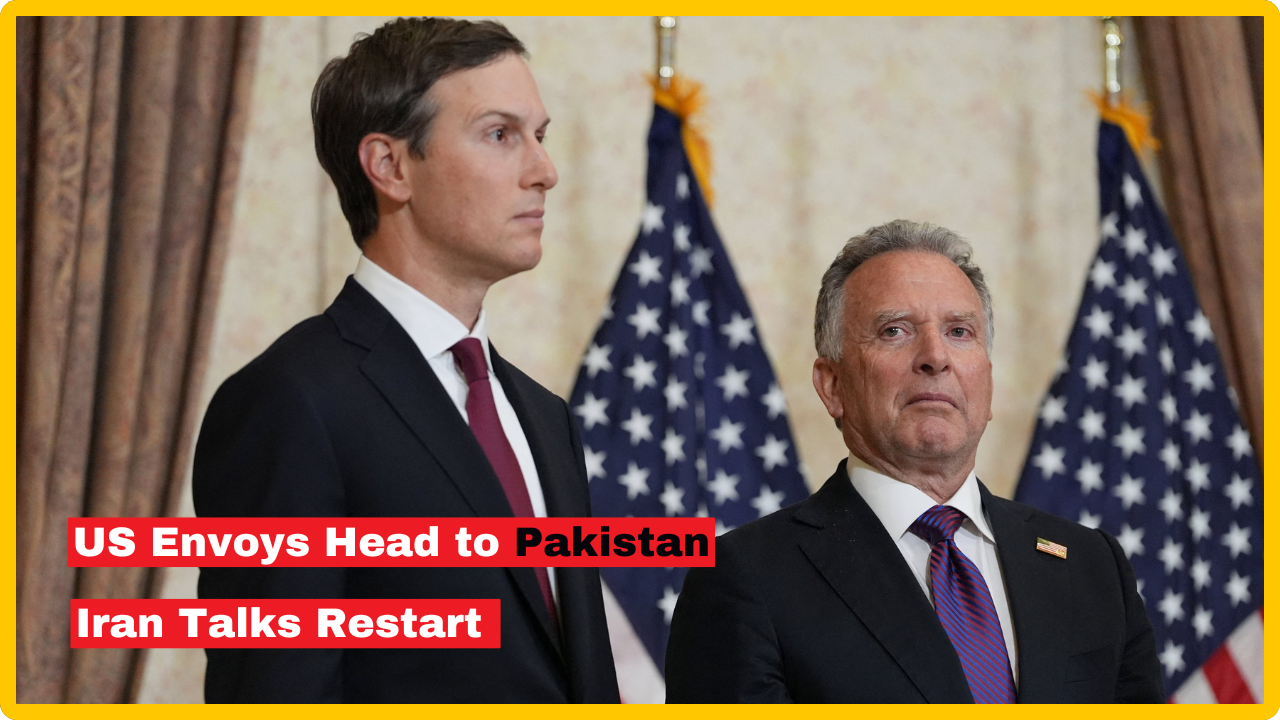
White House Confirms Pakistan Mission as Diplomatic Pressure Mounts in us iran talks as one of the most consequential diplomatic moves of the ongoing U.S.–Iran standoff, President Donald Trump is dispatching two of his closest advisers to South Asia in an effort to break a widening military and diplomatic impasse.
The White House confirmed Friday that special envoy Steve Witkoff and Jared Kushner are traveling to Islamabad on Saturday for Witkoff Kushner Iran talks Pakistan – a fresh round of negotiations with Iranian Foreign Minister Abbas Araghchi, mediated by Pakistani officials who have emerged as key intermediaries in the weeks-long conflict.
The talks come as much of the world is on edge over a war that has snarled crucial energy exports through the Strait of Hormuz, clouded the global economic picture, and left thousands dead across the Middle East.
How the U.S.–Iran Conflict Reached This Point
To fully understand the significance of the Witkoff Kushner Iran talks in Pakistan, it is important to trace the arc of events that brought Washington and Tehran to this moment.
In late March, Trump repeatedly threatened to target Iran’s civilian energy infrastructure if Iran did not agree to allow ships to pass through the Strait of Hormuz without interference. He then extended the threat to Kharg Island – the terminal for nearly all of Iran’s oil exports — and to desalination plants, before setting a deadline of April 7.
On April 7–8, Trump announced on truth social that he had agreed to a two-week ceasefire brokered by Pakistan. Moments later, Iranian officials confirmed that Supreme Leader Khamenei had approved the ceasefire after a last-minute nudge by China.
However, the ceasefire was fragile from the start. After the ceasefire announcement, Trump said the pause on U.S. strikes was subject to the “complete, immediate, and safe opening of the Strait of Hormuz,” while Iran described the U.S. counter-blockade — targeting ships seeking to access Iranian ports from April 13 — as a potential
“prelude to a violation of the ceasefire.”
Following the failure of the Islamabad Talks in mid-April, the U.S. Navy began a blockade of Iranian ports from April 13. The situation has been described as a “dual blockade,” with the U.S. Navy blockading Iran and Iran simultaneously blockading the Gulf.
Iran’s Foreign Minister Arrives in Islamabad
Iranian Foreign Minister Abbas Araghchi arrived in Islamabad late Friday. Earlier on social media, he wrote that he was traveling to Pakistan on a trip focused on
“bilateral matters and regional developments.”
Iranian state media provided further details about the trip, saying Araghchi will present Iran’s “considerations regarding ending the imposed war” during his visit to Pakistan. In Oman, discussions will focus on regional issues and the war, while in Russia, talks will cover bilateral, regional, and international developments.
Araghchi arrived in Islamabad on Friday night for talks with Pakistani Prime Minister Shehbaz Sharif, Foreign Minister Ishaq Dar, and Field Marshal Asim Munir. A Pakistani official told Axios that the meeting with Araghchi will focus on relaunching negotiations with the Trump administration.
However, there remains some uncertainty about the exact timing and format of direct engagement. Iranian state media denied that any meeting had been scheduled. Two sources said the meeting between the U.S. envoys and Araghchi could take place on Monday, after Kushner and Witkoff hold separate bilateral talks with the Pakistani mediators.
The White House Statement: Diplomacy Still on the Table
White House Press Secretary Karoline Leavitt addressed reporters Friday, offering a measured but optimistic tone about the planned mission.
“The Iranians want to talk. They want to talk in person and the president is always willing to give diplomacy a chance,” Leavitt told reporters. “We hope progress will be made and we hope that positive development will come from this meeting. We have certainly seen some progress from the Iranian side in the last few days.”
Leavitt confirmed that special envoy Witkoff and Jared Kushner will be off to Pakistan to engage in
“direct talks, intermediated by the Pakistanis who have been incredible friends and mediators throughout this entire process with representatives from the Iranian delegation.”
JD Vance Steps Back, Remains on Standby
Earlier in the week, there had been reports that Vice President JD Vance might personally travel to Pakistan for the talks. Vance will not be attending the talks, but Leavitt said he will be standing by and consulting President Trump alongside Secretary of State Marco Rubio.
Depending on the outcome of Witkoff and Kushner’s visit,
“Everyone will be on standby to fly to Pakistan if necessary,” Leavitt said.
Pakistan’s Critical Role as Mediator
Pakistan’s emergence as a central diplomatic broker in the U.S.–Iran conflict has been one of the defining geopolitical developments of 2026. Islamabad brokered the original ceasefire in early April and hosted the first round of direct negotiations between American and Iranian officials.
Direct negotiations took place in Islamabad on April 11–12 between U.S. Vice President JD Vance and Iranian parliament speaker Mohammad Bagher Ghalibaf – the highest-level direct engagement between the United States and Iran since the 1979 Iranian Revolution. That round of talks failed to produce a binding agreement, making the upcoming Witkoff Kushner Iran talks in Pakistan all the more significant.
Issues under discussion include freedom of navigation through the Strait of Hormuz, Iran’s nuclear and ballistic missile program, reconstruction and sanctions, and a long-term peace agreement.
The Stakes: A Fragile Ceasefire and a Blocked Strait
The pressure to achieve diplomatic progress could not be higher. The Department of Homeland Security has faced a record-breaking partial shutdown. Meanwhile, the war has left Iran’s military infrastructure extensively damaged, and regional energy production has been significantly disrupted.
Defense Secretary Pete Hegseth has not softened the administration’s military posture. Hegseth said Iran still has time to “choose wisely,” but warned that if Tehran doesn’t make a deal with the U.S., its economy will “collapse under the unrelenting pressure” of a U.S. naval blockade that will remain in place
“as long as it takes.”
Meanwhile, the situation in Lebanon adds another layer of instability to the negotiations. The news of the Pakistan talks came the same day that Israel’s military said it attacked southern Lebanon, targeting sites belonging to the Iran-backed militant group Hezbollah. Hezbollah fired rockets into Israel in response.
Israeli Prime Minister Benjamin Netanyahu said Israel will continue striking “any threat” in Lebanon, blaming Hezbollah for trying to disrupt the peace process.
What the Witkoff Kushner Iran Talks Could Achieve from US Iran Talks:-
The planned trip is described as an effort to break the stalemate and build momentum for a deal before Trump goes back to exploring military options.
Senate Budget Committee Chairman Lindsey Graham has separately vowed that Republicans are working toward a June 1 deadline set publicly by President Trump – suggesting the administration is operating under self-imposed timelines to show concrete results on multiple foreign policy fronts simultaneously.
The key unresolved issues remain substantial. Iran has previously issued a counter-proposal that includes an end to U.S.-Israeli attacks on Iran and pro-Iranian forces in Lebanon and Iraq, security guarantees to prevent future Israeli and U.S. aggression, war reparations, and international recognition of Iranian sovereignty over the Strait of Hormuz. Wikipedia The U.S. has not accepted these terms.
Conclusion
The deployment of Steve Witkoff and Jared Kushner to Islamabad marks a pivotal moment in U.S.–Iran diplomacy. With a fragile ceasefire holding, a naval blockade in place, and global energy markets still unsettled, the outcome of these talks could set the trajectory for the months ahead. Pakistan’s role as a trusted intermediary gives both sides a face-saving channel for dialogue, but deep disagreements over the Strait of Hormuz, sanctions, and Lebanon remain unresolved. The world will be watching Islamabad closely this weekend.
With both the U.S. and Iran maintaining firm public positions, do you think direct diplomacy through Pakistani intermediaries can produce a lasting agreement — or is another escalation still likely?
FAQ’s
Q1: Why are Witkoff and Kushner being sent to Pakistan instead of meeting Iran directly?
Pakistan has been serving as a key mediator throughout the U.S. Iran conflict 2026. Islamabad brokered the original ceasefire in early April and hosted previous rounds of high-level talks. Meeting in Pakistan allows both sides to engage through a trusted neutral party, which can facilitate communication while giving both governments diplomatic flexibility if talks break down.
Q2: What is Iran’s position on the planned talks in Pakistan?
Iranian Foreign Minister Araghchi arrived in Islamabad on Friday, but Iranian state media initially denied that any meeting with American officials had been formally scheduled. Araghchi publicly stated his trip was focused on “bilateral matters and regional developments,” while Iranian state outlets said he would convey Iran’s considerations on ending the war. The exact format and timeline of any direct engagement with U.S. envoys remained uncertain as of Friday evening.
Q3: What are the main issues the U.S. and Iran are trying to resolve?
The core issues under negotiation include freedom of navigation through the Strait of Hormuz, the status of Iran’s nuclear and ballistic missile programs, the lifting or easing of U.S. sanctions, war reparations, and the broader question of a long-term peace framework for the region. The situation in Lebanon – where Iran-backed Hezbollah remains active – has also complicated any potential agreement.



Be First to Comment