
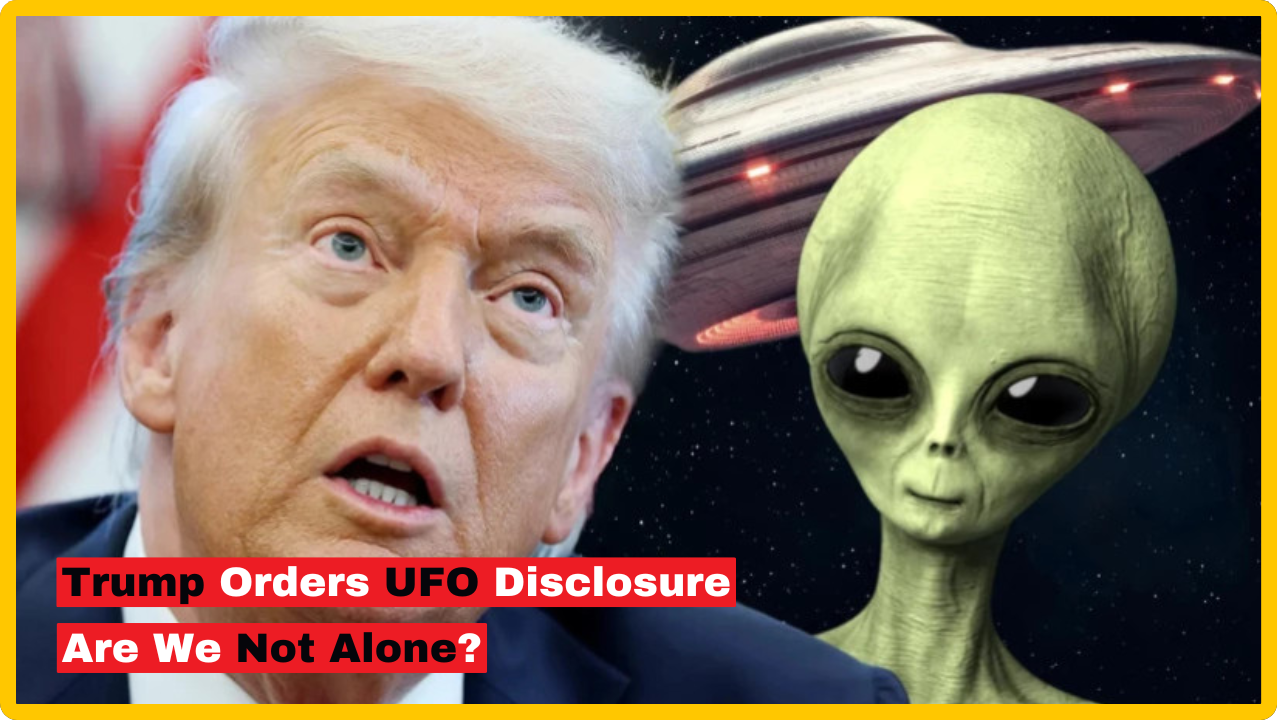
It started with a social media post. It has since escalated into congressional subpoena threats, classified video standoffs, secret pastoral briefings, and a White House spokesperson sending an alien emoji to journalists. The Trump UFO disclosure saga — building for months and now approaching what the president himself has promised will be an imminent public release — is simultaneously one of the most genuinely unprecedented transparency initiatives in the history of American government and one of the most expertly managed spectacles of anticipation the Trump White House has yet produced.
Here is everything known about the Trump UFO files, the executive order that started the process, what the Pentagon has and has not released, what Congress is demanding, and why the Trump UFO disclosure may ultimately deliver far less — or far more — than the public has been led to expect.
Trump UFO Executive Order: How the Process Officially Began
A Truth Social Post That Changed Everything
The formal starting gun for the current Trump UFO disclosure push was fired on February 18, 2026, when the White House posted on social media — and simultaneously distributed through official White House channels — a directive that read, in part: “Based on the tremendous interest shown, I will be directing the Secretary of War, and other relevant Departments and Agencies, to begin the process of identifying and releasing Government files related to alien and extraterrestrial life, unidentified aerial phenomena (UAP), and unidentified flying objects (UFOs), and any and all other information connected to these highly complex, but extremely interesting and important, matters.”
The Trump UFO Truth Social post — and its simultaneously released official White House version — represented a significant escalation from the more informal comments Trump had made on the subject in the weeks prior. It came directly in the wake of a viral podcast moment in which former President Barack Obama appeared to state that aliens are “real but I haven’t seen them” — a comment that Obama’s office subsequently clarified was a statement about the statistical likelihood of life elsewhere in the universe rather than a claim of personal knowledge.
Trump, asked about Obama’s comments on Air Force One, replied characteristically: “Well, I don’t know if they’re real or not.” He then added that Obama had revealed classified information in his remarks — a claim that amplified rather than resolved the public’s curiosity.
The Trump UFO executive order framing gave the process official legal force. Under Executive Order 13526, originally issued by President Obama, the president has broad authority to personally declassify documents.
The directive instructed the Pentagon, the Office of the Director of National Intelligence, and other relevant agencies to identify and prepare government files on UAPs and alien-related matters for release. It was, on paper, the most sweeping federal commitment to Trump UFO transparency in the nation’s history.
Trump UFO Files: What the Pentagon Is Working On
The operational home of the government’s Trump UFO files consolidation effort is the Pentagon’s All-domain Anomaly Resolution Office, known as AARO, which has been the federal government’s central UAP investigation unit since its establishment in 2022. As of February 2026, AARO’s caseload had exceeded 2,000 reported incidents — a figure that itself reflects the dramatic expansion of reporting encouraged by recent congressional legislation requiring military personnel to report UAP encounters without fear of professional retaliation.
Defense Secretary Pete Hegseth publicly affirmed the administration’s commitment to the process during a stop on his “Arsenal of Freedom” tour in Colorado in late February. “We’re going to be in full compliance with that executive order, and eager to provide that for the president,” Hegseth said — the first time the Defense Secretary had publicly addressed the Trump UFO disclosure effort directly. AARO, Hegseth confirmed, is
“working in close coordination with the White House and across federal agencies to consolidate existing UAP records collections and facilitate the expeditious release of never-before-seen UAP information.”
But the process immediately encountered its first significant institutional friction. Representative Anna Paulina Luna, Republican of Florida and chair of the House Oversight Task Force on the Declassification of Federal Secrets, sent the Pentagon a letter in March demanding the release of 46 specific classified videos from AARO’s investigation into UAPs by April 14.
The deadline passed without the videos being released. Luna responded on NewsNation by stating she was considering using subpoena authority to force the material out. “The continued lack of transparency surrounding these anomalies and the potential national security threat they pose is troubling,” she wrote.
On social media, Luna posted a winking emoji above a clip of Trump’s subsequent remarks at Turning Point USA in Phoenix — remarks in which the president told the crowd: “This process is well underway and we found many very interesting documents, I must say, and the first releases will begin very, very soon.”
Trump UFO Release: What the President Has Said — and When
The most substantive Trump UFO release preview came on April 17, 2026, during Trump’s appearance at a Turning Point USA event in Phoenix, Arizona — held, notably, at a megachurch. The day before the event, Trump had been in Las Vegas, not far from Area 51, the legendary Nevada test facility that has fueled UFO speculation for decades.
Speaking to the Phoenix crowd, Trump connected the Trump UFO process directly to Defense Secretary Hegseth, using his informal “Secretary of War” nickname for the Pentagon chief. “I recently directed the Secretary of War to begin releasing government files relating to UFOs and unexplained aerial phenomena,” he said. “I figured this was a good crowd for this because I know you people — you’re really into that. I don’t know if I am.”
The self-deprecating qualifier — “I don’t know if I am” — captured Trump’s consistently ambiguous personal position on the underlying question of whether the phenomena are extraterrestrial in origin. Unlike Vice President JD Vance, who has described himself as “obsessed” with the Trump UFO files and has made direct reference to his plans to investigate Area 51, Trump has carefully avoided staking out a personal position on whether any of the classified material involves genuine non-human intelligence. He has, however, confirmed that he believes the material is genuinely “interesting” — a term he has used across multiple settings without further specification.
The Office of the Director of National Intelligence separately confirmed on social media that files “related to alien and extraterrestrial life, UAPs, and UFOs” will “soon” be declassified — the most specific official timeline language to emerge from any government agency beyond the White House itself.
Trump UFO Declassified: The Precedent — and the Problem
The track record of Trump’s major declassification initiatives provides both encouragement and caution for those hoping the Trump UFO declassified release will be genuinely revelatory. In the first week of his second term, Trump ordered the release of investigative files related to the assassinations of President John F. Kennedy, Senator Robert F. Kennedy, and Martin Luther King Jr. — a move celebrated by transparency advocates and Kennedy family members.
The actual material released, however, revealed relatively little beyond what was already in the public record, prompting disappointment among those who had expected definitive answers to long-standing historical questions.
A similar pattern played out with the Epstein files — a drawn-out and ultimately partial release that satisfied neither the public’s appetite for transparency nor the legal advocates who had spent years fighting for disclosure. Greg Eghigian, a Penn State University historian who has written a book on the history of UFO sightings, offered a measured assessment:
“There is almost no satisfaction that is possible for many of the really die-hard folks. So in a sense, I think disappointment can almost be guaranteed to be expected no matter what comes out of this.”
Former Deputy Assistant Secretary of Defense for Intelligence Christopher Mellon, one of Washington’s most prominent advocates for UAP transparency, offered a more procedural concern. Declassification requires security-cleared personnel to individually review and process documents — a specialized and scarce workforce that risks being “massively backlogged” if asked to process a large volume of material quickly.
Mellon said:
“I would try to temper expectations a bit. I think it’s going to be a fairly long, and probably a bit of a slow process,”
Trump UFO Aliens: What Congress Believes — And What It Has Been Told
The congressional dimension of the Trump UFO aliens conversation has become one of the most remarkable features of the current disclosure environment. Multiple sitting lawmakers have made public statements over the past year that would have been career-ending for most politicians a decade ago.
Representative Anna Paulina Luna told podcaster Joe Rogan that she has personally seen “evidence of interdimensional beings” and referenced the Jewish Book of Enoch — written approximately 100 to 300 years before the birth of Jesus — as an ancient text describing what she characterized as entities consistent with modern UAP phenomena. She called these entities “interdimensional beings” rather than extraterrestrial aliens, a theological and ontological distinction that carries significant implications for how the disclosure might be framed publicly.
Former Florida Congressman Matt Gaetz claimed to have been briefed by a US Army official about alleged alien-human hybrid programs involving captured entities from downed craft. Representative Tim Burchett of Tennessee, who serves on the House Oversight subcommittee, said he had been briefed on one piece of information that would “set the Earth on fire” if made public. He added, in a message posted after Trump’s Phoenix speech: “Thank you for keeping your word to me @realDonaldTrump.”
Vice President JD Vance took a notably different theological position. While describing himself as “obsessed” with the Trump UFO files, Vance invoked his Christian faith and suggested that sightings reported to be alien in nature are actually the work of spiritual demons — a perspective that reflects an emerging theological debate within evangelical Christianity about how to interpret UAP phenomena.
Trump UFO Disclosure Polymarket: What Prediction Markets Say
“Will Trump Release UFO Files Before July 2026?”
The Trump UFO disclosure Polymarket question — whether the administration will deliver a substantive release of UAP files before a specific deadline — has become one of the more actively traded prediction markets on topics related to the Trump administration.
As of early May, contracts on whether a major Trump UFO file release would occur before July 2026 were trading at elevated probabilities reflecting the administration’s escalating public commitments, while skeptics pointed to the pattern of missed internal deadlines and bureaucratic friction as evidence for caution.
Prediction markets are not scientific polls, and they carry their own biases and limitations. But they offer a real-time reflection of informed public sentiment about the administration’s likelihood of following through on one of its more unusual promises — and on this question, the consensus leaned toward belief that something will be released, while remaining divided on whether it will be substantively significant.
Conclusion
The Trump UFO disclosure process is real, officially underway, and — by the administration’s own repeated promises — about to produce its first major public releases. Whether those releases will confirm the existence of non-human intelligence, reveal advanced aerial technology of unknown origin, or — as has happened with most previous government UFO disclosures — produce a carefully curated set of documents that answer some questions while raising dozens more, remains the defining uncertainty of one of the strangest and most consequential stories in contemporary American politics.
What is already clear is that the combination of a presidential executive order, a Pentagon committed to compliance, a Congress threatening subpoenas, and a public whose appetite for answers has never been greater has created conditions unlike any that have preceded a government UFO release in the nation’s history.
Based on Trump’s track record with the JFK files and other major declassification initiatives, do you believe the Trump UFO file release will finally deliver definitive answers about unidentified aerial phenomena — or will it follow the familiar pattern of generating enormous anticipation before producing disappointment?
Frequently Asked Questions (FAQ)
Q1: What is the Trump UFO executive order and what did it direct the government to do?
On February 18, 2026, the White House issued a directive — simultaneously posted on Truth Social and distributed through official channels — instructing the Pentagon, the Office of the Director of National Intelligence, and other relevant federal agencies to “begin the process of identifying and releasing Government files related to alien and extraterrestrial life, unidentified aerial phenomena (UAP), and unidentified flying objects (UFOs), and any and all other information connected to these highly complex, but extremely interesting and important, matters.”
Defense Secretary Pete Hegseth publicly confirmed the Pentagon’s compliance with the directive in February, stating that AARO — the Pentagon’s All-domain Anomaly Resolution Office — was working across federal agencies to consolidate existing UAP records and facilitate the release of “never-before-seen UAP information.” The president has broad authority to declassify documents under existing executive order frameworks, though the practical process requires security-cleared personnel to individually review material before it can be publicly released.
Q2: What specific UFO files is Congress demanding, and why hasn’t the Pentagon released them yet
Representative Anna Paulina Luna, chair of the House Oversight Task Force on the Declassification of Federal Secrets, sent the Pentagon a formal letter in March 2026 demanding the release of 46 specific classified videos from AARO’s UAP investigation by April 14. When that deadline passed without any release, Luna stated she was considering using subpoena authority to compel disclosure.
The Pentagon has attributed the delay to the complexity of the declassification review process — a time-consuming procedure that requires trained security personnel to individually assess each document or video for national security implications before release. Experts including former Deputy Assistant Secretary of Defense Christopher Mellon have warned that any large-scale declassification effort risks becoming “massively backlogged” given the limited number of security-cleared reviewers available for the work.
Q3: What has Trump personally said about whether UFOs or aliens are real?
Trump has been notably careful to avoid staking out a personal position on whether UAPs represent genuine non-human intelligence or extraterrestrial life. When asked on Air Force One about former President Obama’s viral podcast statement that aliens are “real but I haven’t seen them,” Trump replied:
“Well, I don’t know if they’re real or not.”
At his April 17 Turning Point USA speech in Phoenix, he told the crowd that he did not know whether he personally believed in the phenomena, even while promising that “very interesting” documents had been found and would be released “very, very soon.” Trump has also said that Obama revealed classified information in his remarks — implying there is classified information to be revealed, without specifying its content. The president has consistently positioned himself as the leader who will deliver transparency on the topic without personally vouching for any specific conclusion about what the files contain.





Be First to Comment