
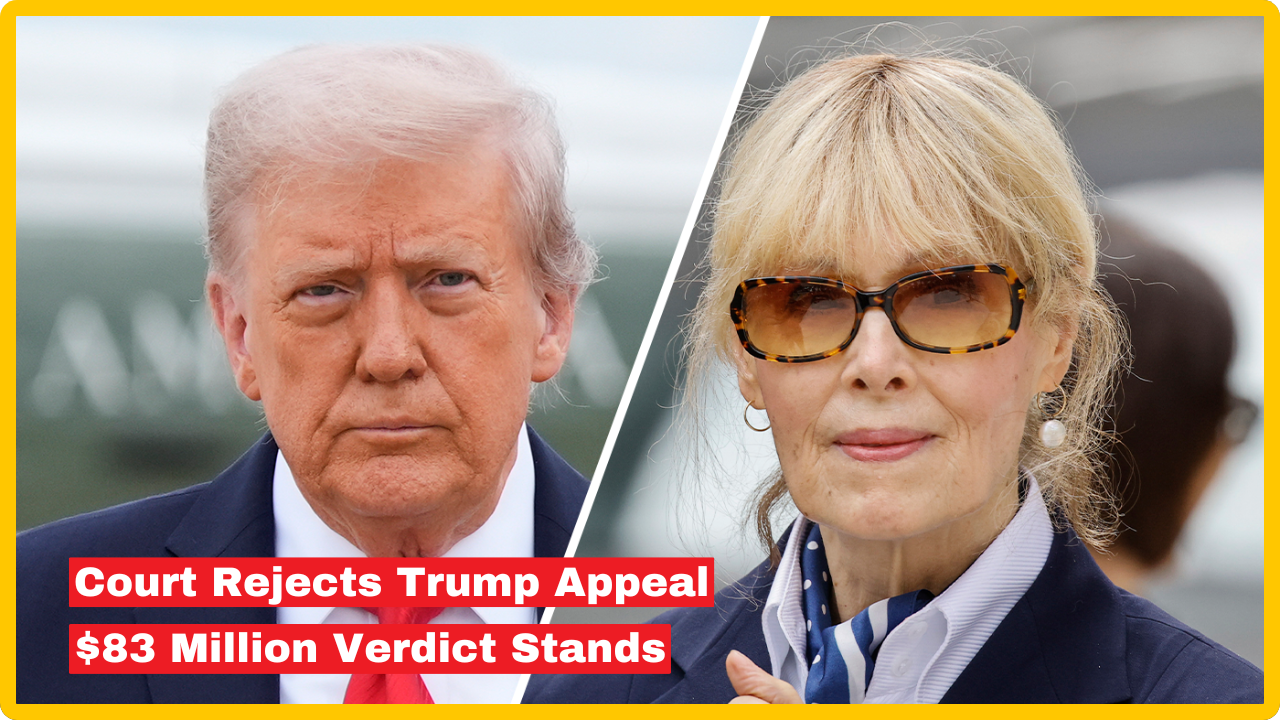
In the latest development of a legal battle that has stretched across seven years, multiple courtrooms, and two presidential terms, a divided federal appeals court in Manhattan has declined to grant President Donald Trump’s request for a full bench rehearing of the Trump E. Jean Carroll defamation appeal stemming from the $83 million verdict rendered against him. The decision by the Second U.S. Circuit Court of Appeals, issued Wednesday, marks yet another judicial setback for the president in a case that has become one of the most closely watched defamation disputes in American legal history – and it now clears the path for Trump to seek relief at the United States Supreme Court.
The ruling was not unanimous. Five judges on the court voted against granting the rare en banc rehearing that Trump had sought, while three voted in favor. The split underscores the genuine legal complexity of the immunity and procedural questions the case has raised — but for Carroll and her legal team, the outcome represents one more step toward what they describe as a long-overdue reckoning.
Why Trump Sought a Full Bench Hearing
To understand the significance of Wednesday’s ruling, it helps to understand the procedural mechanism Trump’s legal team pursued. When a federal appellate case is initially decided, it is typically heard by a three-judge panel drawn from the full roster of active circuit judges. A party dissatisfied with a panel’s ruling can petition the court for an “en banc” rehearing — meaning a hearing before all active judges on the circuit, not just the three who decided the original appeal. Such hearings are rare, reserved for cases presenting exceptionally significant legal questions, and granted at the court’s discretion.
Trump had sought en banc review after a three-judge panel of the Second Circuit rejected his appeal in September 2025. That panel’s ruling upheld the $83 million jury verdict that found Trump had defamed Carroll by attacking her credibility and character in response to her public accusations of sexual assault. Wednesday’s 5-3 vote to deny en banc review means the panel’s September decision stands as the circuit’s final word — unless the Supreme Court agrees to take up the case.
Judge Denny Chin, writing for the majority, noted pointedly that Wednesday’s ruling marked the fourth time the Second Circuit had denied a request for full-bench review in this case — a statistic that speaks to the persistence and determination with which Trump’s legal team has pursued every available avenue of challenge.
The Carroll Cases: A Six-Year Legal Chronicle
The Trump E. Jean Carroll defamation appeal is one branch of a two-pronged legal conflict that traces its origins to 2019, when Carroll, a longtime advice columnist for Elle magazine, publicly accused Trump of sexually assaulting her in a Bergdorf Goodman department store dressing room in New York City in the mid-1990s.
Trump responded immediately and forcefully, calling Carroll a liar, characterizing her account as a fabrication designed to boost sales of a book she had recently published, and dismissing the allegations as a “hoax” and a “con job.” He also made remarks suggesting Carroll was not physically attractive enough to be a target of his attention — comments that became central to the defamation claims that followed.
The first Carroll trial, conducted in 2023, produced a verdict finding Trump liable for sexual abuse – not rape, on a technical definitional question – and for defamation over statements he made after leaving office in January 2021. That jury awarded Carroll $5 million in damages. Trump subsequently appealed that verdict to the Supreme Court, which had not yet decided whether to hear the case as of Wednesday.
The second trial, held in early 2024, addressed the defamation claims arising from Trump’s statements during his first term in office, made in 2022 in response to Carroll’s allegations. That jury awarded Carroll $83 million in damages — a figure that reflected the jury’s assessment of both compensatory and punitive damages for what it characterized as a sustained and deliberate campaign to destroy Carroll’s reputation and credibility.
Trump’s Core Argument: Presidential Immunity
The legal theory at the center of the Trump E. Jean Carroll defamation appeal is both legally significant and politically charged. Trump’s attorneys argued that his 2022 statements about Carroll — which he made in response to questions from reporters while serving as president — were made within the scope of his official duties and should therefore receive the protections afforded to the executive branch under federal law.
Specifically, Trump’s team contended that the United States Department of Justice should have been substituted as the defendant in the case — a maneuver that would have been legally significant because the federal government cannot be sued for defamation, which would have effectively ended the litigation. The argument rested on the attorney general’s certification that Trump was acting within the scope of his office or employment when the statements were made.
The three-judge panel that heard the case in September rejected this argument on two independent grounds: first, that Trump had waived his right to assert immunity by failing to raise it properly at the trial level; and second, that even if he had not waived it, the Supreme Court’s landmark 2024 decision on presidential immunity did not extend to cover statements of the kind Trump made about Carroll, which the panel characterized as personal attacks unconnected to the exercise of any presidential function.
The Dissent: Three Judges See It Differently
Three circuit judges – Steven J. Menashi, Michael H. Park, and Debra Ann Livingston – dissented from Wednesday’s refusal to grant en banc review. Judge Menashi authored the dissenting opinion, and its language was striking in its intensity.
The dissenters agreed with Trump’s underlying argument that the Justice Department should have been substituted as the defendant, reasoning that a president’s responses to press questions about allegations made against him personally are necessarily made in the context of his presidential role. They also argued that Trump should have been permitted to assert presidential immunity and that the $83 million damage award was “grossly excessive” under applicable legal standards — a constitutional concern separate from the immunity question.
“Put together, these proceedings represent a manifest miscarriage of justice,” Menashi wrote — language that Trump’s legal team has already signaled it intends to cite in any petition to the Supreme Court.
Judge Chin, in the majority opinion, took direct issue with how the dissent characterized the record. He noted that Trump had made repeated statements across many years attacking Carroll’s credibility and appearance, and that the trial record reflected a sustained pattern of conduct that went well beyond a single presidential response to a public accusation. He also flagged Trump’s own statement, made during the trial itself, that he would continue to defame Carroll “a thousand times” — a remark the majority treated as evidence of deliberate and ongoing intent.
Carroll’s Attorney: “Eager for This to Be Over”
Carroll has not commented publicly on every twist in the litigation, but her longtime attorney, Roberta Kaplan, issued a statement Wednesday that captured the emotional weight of a legal battle now entering its seventh year.
Kaplan said:
“E. Jean Carroll is eager for this case, originally filed in 2019, to be over so that she can finally obtain justice,”
The statement reflects the particular burden that prolonged defamation litigation places on plaintiffs – who, even when they prevail at trial, must continue to fight through years of appeals before any judgment becomes enforceable and any damages are actually paid.
What Comes Next: The Supreme Court
With the Second Circuit’s final decision now on the record, the next procedural step in the Trump E. Jean Carroll defamation appeal belongs to Trump’s legal team. They have 90 days from Wednesday’s ruling to file a petition for certiorari to the United States Supreme Court — a formal request asking the high court to review the case.
The Supreme Court accepts only a small fraction of the cases it is asked to hear, generally reserving its docket for matters involving unresolved legal questions of national significance or conflicts between different federal circuit courts on the same legal issue.
The immunity question raised in the Carroll case — specifically, whether a sitting president’s responses to press questions about personal accusations constitute official presidential conduct immune from civil liability – has not previously been resolved by the Supreme Court in this specific context, which gives the petition a plausible basis for consideration.
The high court is also currently holding Trump’s separately filed petition regarding the $5 million Carroll verdict from the first trial, without yet having decided whether to grant review. The two cases together present the Supreme Court with a comprehensive body of Carroll-related litigation that may ultimately require the justices to address the immunity questions raised by Trump’s legal team.
Conclusion
Wednesday’s ruling in the Trump E. Jean Carroll defamation appeal closes one procedural chapter while opening another. With the Second Circuit having now denied full-bench review and affirmed the $83 million verdict for the fourth time at the appellate level, the case moves toward what may be its most consequential moment yet: a decision by the United States Supreme Court on whether to take it up.
The questions at the heart of the case — about the scope of presidential immunity, the boundaries of official conduct, and the rights of individuals to seek redress when a sitting president attacks their reputation — are as legally significant as they are politically charged.
Given that this case has now survived four rounds of appellate review in the Second Circuit and the $83 million verdict has been upheld each time, do you believe the Supreme Court should take up the presidential immunity question raised by Trump’s legal team — or should the verdict simply be allowed to stand?
Frequently Asked Questions (FAQ)
Q1: What did the Second Circuit Court of Appeals decide on April 29, 2026?
The Second U.S. Circuit Court of Appeals, in a split 5-3 vote, denied President Trump’s request for an en banc rehearing of his appeal of the $83 million defamation verdict won by E. Jean Carroll. An en banc hearing would have placed the case before the full roster of active circuit judges rather than the three-judge panel that initially rejected Trump’s appeal in September 2025.
By declining to grant that rehearing, the court allowed the September panel decision to stand as the circuit’s final ruling. The decision marks the fourth time the Second Circuit has denied en banc review in this case and opens the door for Trump to petition the United States Supreme Court.
Q2: What are the two separate E. Jean Carroll cases against Trump, and what are their current statuses?
The two Carroll cases arise from different sets of events and statements. The first case, which produced a $5 million verdict in 2023, addressed both the original sexual abuse allegation – which a jury found Trump liable for, though not on the technical definition of rape — and defamation claims based on statements Trump made after his first term ended in January 2021.
Trump appealed that verdict and subsequently asked the Supreme Court to hear the case; as of Wednesday, the high court had not yet decided whether to do so. The second case, which resulted in the $83 million verdict in 2024, addressed defamation claims arising from statements Trump made in 2022, while serving as president, denying Carroll’s accusations and attacking her credibility. It is the appeal of this $83 million verdict that the Second Circuit declined to rehear en banc on Wednesday.
Q3: What is Trump’s presidential immunity argument and why did courts reject it?
Trump’s central argument in the $83 million case is that his 2022 statements about Carroll — made in response to reporters’ questions while he was serving as president — were made within the scope of his official duties and should therefore be shielded from civil liability under federal law. His legal team sought to have the Department of Justice substituted as the defendant, which would have ended the case because the federal government cannot be sued for defamation.
The three-judge panel that rejected this argument in September 2025 found, first, that Trump had waived his right to assert immunity by not raising it properly during the original trial proceedings and, second, that even if he had not waived it, the Supreme Court’s 2024 presidential immunity decision did not cover the kind of personal, reputation-attacking statements Trump made about Carroll, which the court found bore no connection to any legitimate exercise of presidential power.



Be First to Comment