
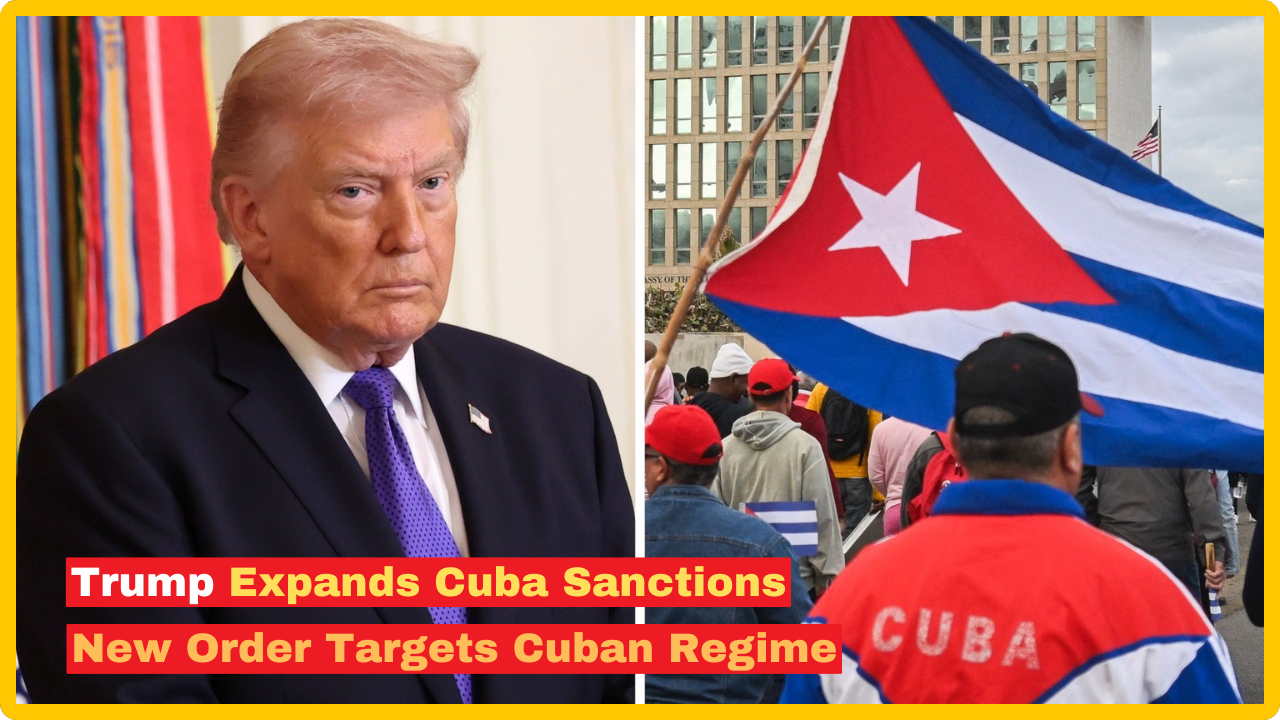
President Donald Trump signed a broad new executive order on Friday, May 1, expanding and intensifying Trump Cuba sanctions targeting the communist government in Havana – the latest and most aggressive step in a months-long escalating pressure campaign aimed at one of America’s closest and most persistently adversarial neighbors.
The order, signed at the White House and confirmed by two senior administration officials, broadens the existing sanctions architecture under the International Emergency Economic Powers Act to encompass a sweeping new set of targets: individuals, entities, and affiliates that support Cuba’s security apparatus; those complicit in government corruption or serious human rights violations; and foreign financial institutions that have conducted or facilitated transactions with anyone already sanctioned under the order.
The action comes at a moment of acute crisis for the Cuban state – an island simultaneously gripped by nationwide energy blackouts, fuel shortages, food insecurity, and the most significant diplomatic and economic isolation it has faced since the height of the Cold War.
What the Executive Order Does: A Four-Front Escalation
The core of Trump’s new executive order on Cuba targets individuals and entities that prop up the Cuban government’s security and repressive machinery. According to the White House fact sheet accompanying the order, sanctions now apply to any person, entity, or affiliate that supports the Cuban regime’s security apparatus, is complicit in government corruption or serious human rights violations, or serves as an agent, official, or material supporter of the Cuban government itself.
The breadth of that definition is intentionally wide. It covers members of Cuba’s military, intelligence, and internal security forces, as well as the business entities – many of which are controlled by the military holding company GAESA – that fund their operations. The Cuba Restricted List, already expanded significantly under the Trump administration in 2025, now encompasses dozens of military-affiliated hotels, airlines, and import-export companies with which American persons and businesses are prohibited from engaging in any direct financial transactions.
Secondary Sanctions: Foreign Banks in the Crosshairs
Perhaps the most consequential innovation in Friday’s executive order is its explicit authorization of secondary sanctions – penalties directed not at Cubans but at foreign financial institutions that have conducted or facilitated transactions with persons or entities sanctioned under the order.
The order’s definition of “foreign financial institution” is expansive. It encompasses depository institutions, banks, savings banks, money services businesses, operators of credit card systems, trust companies, insurance companies, securities brokers and dealers, investment companies, forward contract and foreign exchange merchants, securities and commodities exchanges, clearing corporations, and dealers in precious metals, stones, or jewels — as well as their holding companies, affiliates, and subsidiaries.
This secondary sanctions mechanism is specifically designed to close off the international financial channels through which Cuba has attempted to circumvent American economic pressure. By threatening foreign banks in Europe, Latin America, and Asia with loss of access to the American financial system if they do business with sanctioned Cuban entities, Washington is attempting to make it prohibitively costly for any third-country institution to serve as Havana’s financial lifeline.
The Escalating Pressure Campaign: A Timeline
Friday’s executive order is the latest but not the first step in what has been a carefully sequenced escalation of Trump Cuba sanctions and related pressure since the beginning of the administration’s second term in January 2025.
The opening move came in June 2025, when Trump signed a National Security Presidential Memorandum establishing the framework for a new Cuba policy centered on promoting human rights, fostering a private sector independent of government control, and advancing American national security interests. That memorandum instructed federal agencies to adjust existing regulations governing transactions with Cuba, with the effect of tightening travel restrictions and remittance flows to the island.
The escalation shifted into a higher gear on January 29, 2026, when Trump signed an executive order declaring Cuba’s government to constitute “an unusual and extraordinary threat” to American national security and foreign policy — formal language that invokes the National Emergencies Act and the full suite of powers available under IEEPA. That order established a mechanism to impose tariffs on goods imported from any foreign country that directly or indirectly sells or provides oil to Cuba — a novel and aggressive use of emergency tariff powers that is currently under judicial review.
The oil pressure has had severe and immediate consequences. Following the Trump administration’s capture of Venezuelan President Nicolás Maduro in early January 2026, Washington halted Venezuelan oil exports to Cuba — cutting off the island’s primary oil supplier, a relationship that had sustained the Cuban state since the early 2000s. Trump subsequently threatened tariffs on any other country that sent crude to Cuba, prompting Mexico, the next most significant supplier, to halt its own shipments. The combined effect has been catastrophic: fuel shortages have contributed to three major national-level blackouts, and multiple foreign airlines have suspended flights to Cuba because of the inability to guarantee fuel availability for return trips.
The National Security Rationale: Iran, Hezbollah, and Intelligence Facilities
The White House framing of Friday’s Trump Cuba sanctions executive order is explicitly couched in national security rather than purely economic terms. The administration’s fact sheet describes Cuba as a country that has aligned itself with nations and actors hostile to the United States, hosted foreign adversary facilities focused on collecting sensitive intelligence, maintained close ties to Iran — itself at war with the United States — and provided safe haven for transnational terrorist groups including Hezbollah.
“Cuba provides a permissive environment for hostile foreign intelligence, military, and terrorist operations less than 100 miles from the American homeland,”
one official stated in remarks accompanying the announcement. The administration also cited Cuba’s role in driving migration toward the United States, noting that more than 850,000 Cuban migrants arrived in America between 2022 and the fall of 2024 — a figure the White House characterized as a consequence of the regime’s economic mismanagement and political repression rather than of American sanctions.
The Cuban Government’s Response and the Bilateral Impasse
“Cuba Is Next” — and Havana Knows It
Cuba’s government has long rejected Washington’s characterizations of its conduct, insisting that its socialist economic model is non-negotiable and that American sanctions — not its own governance failures — are responsible for the population’s suffering. Cuban President Miguel Díaz-Canel, who has sought to present himself as a pragmatist willing to permit limited private enterprise and expanded internet access, confirmed in March that Cuban officials had been meeting with American counterparts to explore “potential solutions for bilateral differences” — an acknowledgment of back-channel engagement that suggested Havana is not entirely closed to negotiation.
Trump, for his part, has publicly declared that “Cuba is next” in the sequence of regime changes his administration has pursued — following the capture of Maduro in Venezuela and the death of Iran’s Supreme Leader during the US-Israeli war against Tehran. He has not specified the mechanism or timeline for any Cuba-focused action beyond the current sanctions escalation, but the statement has been widely interpreted in Havana and across Latin America as a direct warning.
The United States has long maintained a set of established demands on Cuba: opening the state-run economy to genuine private competition, paying reparations for properties expropriated by Fidel Castro’s government following the 1959 revolution, and holding free and fair multiparty elections. Cuba has consistently described all three demands as violations of its sovereignty and its revolutionary identity. That fundamental impasse has persisted across more than six decades of American administrations.
Humanitarian Concerns: Who Pays the Price
Blackouts, Food Shortages, and Medicine Gaps
While the administration frames the Trump Cuba sanctions escalation as targeting a regime rather than a population, critics including former American officials, humanitarian organizations, and Cuban religious groups have raised sustained concerns about the real-world effects on ordinary Cubans.
Cuba was already experiencing an economic crisis characterized by significant food, medicine, and fuel shortages before the oil cutoff took effect. The blackouts that followed the loss of Venezuelan and Mexican oil have now become a daily feature of Cuban life in many provinces, shutting down hospitals, water treatment plants, and food storage facilities. The humanitarian toll has been compounded by the fact that the restrictions on remittances — money sent by Cuban Americans to family members on the island — have reduced one of the most direct channels through which ordinary Cubans previously supplemented their income.
Experts note that while the administration’s position is that maximum economic pressure will force the Cuban government to make a deal, history offers mixed evidence for that theory. Cuba has demonstrated a remarkable capacity to sustain political authority through decades of severe privation — partly through repression, partly through ideological mobilization, and partly through the narrative that external pressure validates the revolutionary project.
Conclusion
Friday’s Trump Cuba sanctions executive order represents the most sweeping expansion of American economic pressure on Havana in a generation. By extending sanctions to foreign financial institutions and explicitly authorizing secondary sanctions, the Trump administration is attempting to close off the international workarounds that have historically allowed Cuba to soften the impact of American restrictions. Whether this approach produces the political change the administration seeks — or deepens the humanitarian suffering of a population already enduring blackouts, fuel shortages, and food insecurity — remains the defining question of a policy that has now escalated far beyond anything the United States has attempted toward Cuba in decades.
Given Cuba’s demonstrated history of surviving decades of American sanctions without changing its political system, do you think the Trump administration’s escalating maximum pressure campaign — including cutting off oil, sanctioning foreign banks, and declaring a national emergency — will ultimately succeed in producing meaningful change in Havana?
Frequently Asked Questions (FAQ)
Q1: What do Trump’s new Cuba sanctions actually do, and who do they target?
The executive order signed on May 1, 2026, broadly expands existing American sanctions on Cuba under the International Emergency Economic Powers Act. The new order imposes sanctions on individuals, entities, and affiliates that support Cuba’s security apparatus, are complicit in government corruption or serious human rights violations, or serve as agents, officials, or material supporters of the Cuban government.
Critically, it also authorizes secondary sanctions – penalties against foreign financial institutions, including banks, investment companies, money services businesses, and insurance companies in other countries, if those institutions conduct or facilitate transactions with persons or entities sanctioned under the order. This secondary sanctions mechanism is designed to cut off Cuba’s international financial lifelines by making it prohibitively risky for third-country banks to serve the Cuban state.
Q2: How does the new executive order fit into the administration’s broader Cuba policy?
Trump’s executive order is the third major escalation of Trump’s Cuba policy since his second term began. In June 2025, a National Security Presidential Memorandum tightened travel and remittance rules. In January 2026, a separate executive order declared Cuba’s government an “unusual and extraordinary threat” to American national security and established a tariff mechanism targeting countries that supply oil to Cuba.
Following the capture of Venezuelan President Nicolás Maduro, the administration cut off Venezuela’s oil exports to Cuba – the island’s primary energy supply – and subsequently threatened tariffs on Mexico, Cuba’s next-largest oil supplier, prompting Mexico to halt its own shipments. The resulting fuel crisis has produced three national-level blackouts, severe food and medicine shortages, and the suspension of flights to Cuba by multiple foreign airlines.
Q3: Are there concerns about the humanitarian impact of these sanctions on ordinary Cubans?
Yes. Former American officials, humanitarian organizations, Cuban religious groups, and international development experts have repeatedly raised concerns about the impact of escalating sanctions on the Cuban civilian population. Cuba was already experiencing serious shortages of food, medicine, and fuel before the oil cutoff took effect. The daily blackouts that followed have affected hospitals, water treatment infrastructure, and food storage systems, disproportionately harming people with medical needs and those in poverty.
Critics of the administration’s approach argue that maximum economic pressure has historically strengthened rather than undermined the Cuban government’s narrative that external aggression – rather than domestic misgovernance — is responsible for the island’s suffering. The administration maintains that its sanctions target the regime and its supporters, not the Cuban people, and that political and economic change is necessary to relieve the underlying conditions producing both migration and humanitarian hardship.
Be First to Comment