
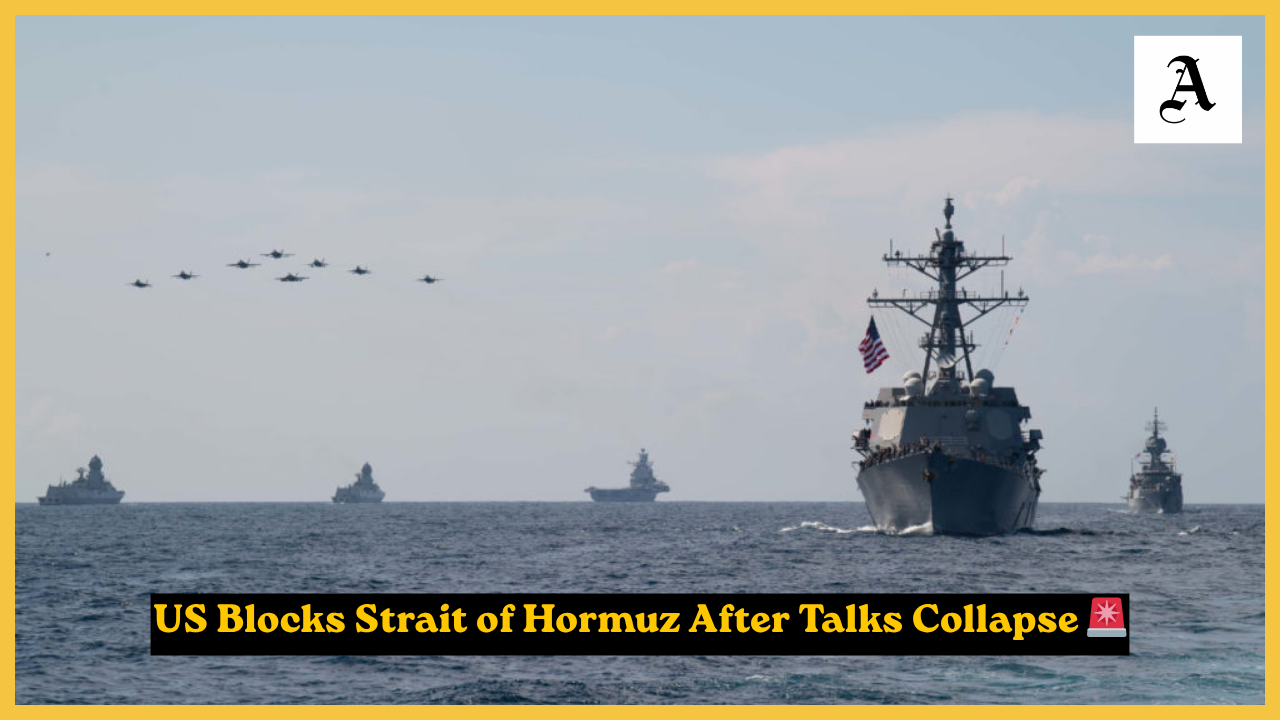
The United States military announced Sunday it will begin blockading ships entering or leaving Strait of Hormuz, dramatically raising the stakes in the six-week US-Iran war after historic face-to-face peace negotiations in Islamabad broke down without a deal. President Donald Trump declared the move “effective immediately” following more than 21 hours of gruelling talks that ultimately foundered over Iran’s nuclear ambitions and its insistence on controlling one of the world’s most critical energy chokepoints.
A War Six Weeks in the Making
The current conflict began on February 28, when the United States and Israel launched coordinated air strikes against Iran. Since then, Iran has effectively sealed the Strait of Hormuz – a narrow waterway between the Persian Gulf and the Gulf of Oman through which approximately one-fifth of the world’s daily oil supply passes. The closure has sent oil prices surging past $100 per barrel at points, rattled global financial markets, and stranded hundreds of tankers in the Persian Gulf waiting to move their cargo.
A fragile two-week ceasefire was agreed last Tuesday, raising cautious hopes that diplomacy could bring the conflict to a close. That ceasefire allowed three supertankers fully laden with oil to transit the strait on Saturday — the first vessels to exit the Gulf since the fighting began. Hundreds more remained waiting. The Islamabad talks were billed as a rare opportunity: the first direct, face-to-face negotiations between American and Iranian officials since hostilities began, hosted by Pakistan as a neutral mediator.
What Happened in Islamabad
Vice President JD Vance led the US delegation to the Pakistani capital, where negotiators from both sides sat across from each other for over 21 hours across the weekend. Pakistan’s foreign minister, Ishaq Dar, described the atmosphere as “intense and constructive.” Behind closed doors, both delegations reportedly developed a measure of mutual respect during the marathon sessions.
However, agreement proved elusive on the issues that mattered most. Iran came to the table with a sweeping list of demands: full control over the Strait of Hormuz and the right to collect tolls from passing vessels, payment of war reparations, release of approximately $6 billion in frozen assets held abroad, an end to Israeli military operations against Hezbollah in Lebanon, and ironclad guarantees around its nuclear program. Tehran maintained, as it has consistently, that its nuclear activities are entirely civilian in nature and that it has every right to enrich uranium for peaceful purposes.
The United States had one overriding demand: an unambiguous Iranian commitment to abandon any pursuit of a nuclear weapon. Vance, speaking to reporters after departing Islamabad, was blunt. “The simple fact is that we need to see an affirmative commitment that they will not seek a nuclear weapon,” he said, adding that Iran had chosen not to accept American terms.
Trump, posting on his Truth Social platform, offered his own summary: “The meeting went well, most points were agreed to, but the only point that really mattered — NUCLEAR — was not.”
The Blockade Announced
Within hours of the talks’ collapse, Trump announced the naval blockade on social media. CENTCOM confirmed the operation would begin at 10 a.m. ET on Monday, with the blockade targeting vessels entering or leaving Iranian ports specifically. Ships not bound for Iran would be permitted to pass freely through the strait, CENTCOM clarified, stating the operation would “not impede freedom of navigation” for non-Iranian traffic.
Trump went further, instructing the US Navy to intercept any vessel in international waters that had paid Iran a toll for strait passage, and to begin clearing mines that, he alleged, Iran had planted in the waterway. The US Justice Department also threatened criminal prosecution for anyone purchasing sanctioned Iranian oil, with Acting Attorney General Todd Blanche stating the department would “vigorously prosecute anyone who buys or sells sanctioned Iranian oil.”
Trump’s language was combative. He called Iran’s toll scheme “world extortion” and warned that any Iranian forces firing on US ships or civilian vessels would be, in his words, dealt with severely.
Iran’s Response
Tehran did not back down. The Islamic Revolutionary Guard Corps warned that any military vessels approaching the strait would face a “strong response.” Iranian parliament deputy speaker Ali Nikzad stated that in six weeks of war, the US had “learned that the victorious side is determined by the will of nations and superiority on the battlefield, not by rhetoric on social media.”
Iranian lawmaker Mahmoud Nabavian, who was part of the negotiating team in Pakistan, was direct about the strait: it would not be reopened on American terms. “The world will experience a new form of management in the Strait of Hormuz,” he said.
Parliament speaker Ghalibaf made his point through a photograph rather than a press statement, posting a picture of petrol station prices near the White House with a pointed message to American consumers — implying that the blockade would send fuel costs far beyond their already elevated levels.
Global Impact and Economic Fallout
Energy analysts were alarmed by the development. Karen Young, a senior scholar at Columbia University’s Center on Global Energy Policy, warned that the blockade would deepen an already severe supply crisis. She noted a shortage of roughly 7 million barrels of crude oil and 4 million barrels of refined product per day was already affecting global markets, and that prices were likely to remain elevated well into the end of 2026 — even after any eventual resolution — because damaged oil infrastructure would take time to repair and reopen.
The UK government, despite being mentioned by Trump as a potential partner in the blockade, distanced itself from the operation. A government spokesperson said London supported freedom of navigation and the opening of the strait, but made clear it would not participate in a naval blockade.
What Comes Next
The status of the two-week ceasefire remains uncertain. Pakistan said it remains committed to facilitating further dialogue and hopes both parties will return to the table. Vance, for his part, did not close the door entirely on diplomacy, describing the American position as a “best and final offer” that Tehran could still choose to accept.
Analysts note that both sides believe they hold leverage. Iran views its control of the strait as its most powerful bargaining chip. Washington, by contrast, believes that six weeks of war have severely weakened Iran and that the moment to press for terms is now.
The coming days will determine whether the Hormuz standoff becomes a path back to negotiations — or a flashpoint for a broader and far more dangerous escalation.
GO to HOMEPAGE
Be First to Comment