
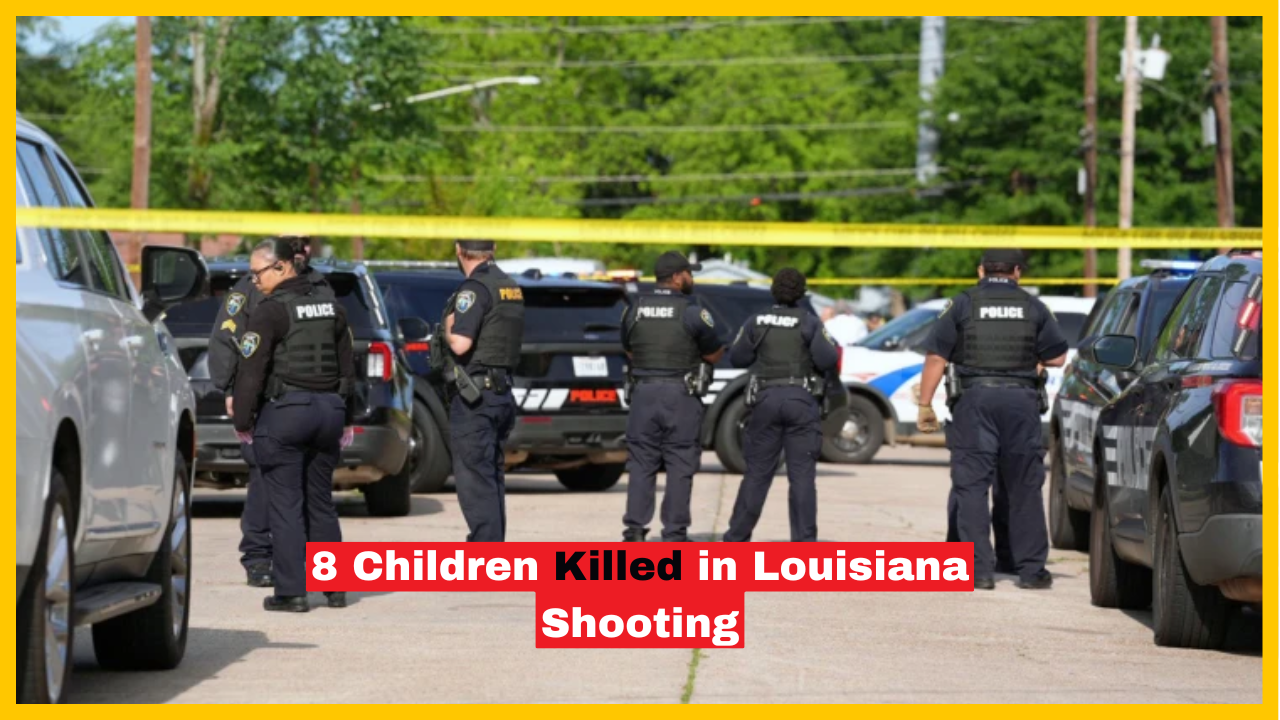
A devastating mass Louisiana shooting in Shreveport, Louisiana, on Sunday, April 19, 2026, claimed the lives of eight children and left two women injured, shocking the entire nation. The incident took place around 6 a.m. near the intersection of W. 79th Street and Linwood Avenue in the Cedar Grove neighborhood, when an adult male opened fire during what police described as a domestic disturbance. Authorities confirmed that ten people were shot in total, making this the deadliest mass shooting in the United States in more than two years.
The Shooting: What Happened in Cedar Grove
The quiet Cedar Grove neighborhood in northwestern Shreveport was shattered in the early morning hours of April 19, 2026, when gunfire erupted across multiple residences in what investigators believe was a domestic violence attack of catastrophic proportions.
The victims ranged in age from just 18 months to approximately 14 years old. Of the ten people shot, the only survivors were two adult women — one of whom sustained life-threatening injuries after being struck in the head. The other woman is believed to have had a personal relationship with the suspect.
Police Corporal Chris Bordelon described it as “a rather extensive crime scene spanning between two residences,” and confirmed that a third location was also being combed by investigators. The spread of the crime scene across multiple homes added to the complexity of the investigation and reflected the severity of what unfolded that morning.
Authorities also confirmed that the suspected shooter is believed to be the biological father of some of the children who were killed. This detail added a deeply painful layer to an already horrific tragedy, as the victims were not strangers but members of the gunman’s own family.
The Suspect and Police Chase
Following the shootings, the suspect did not remain at the scene. After the shooting, the suspect attempted to flee, carjacking a vehicle before leading law enforcement on a high-speed pursuit through Shreveport and into neighboring Bossier Parish.
The chase came to an end when Shreveport police officers fired at the suspect, and the adult male was pronounced dead at the scene. Investigators noted it remained unclear at that point whether the suspect died from a police bullet or from a self-inflicted gunshot wound, and the Louisiana State Police were called in to investigate the officer-involved portion of the incident.
State police confirmed that no law enforcement officers were harmed during the pursuit or the subsequent confrontation in Bossier City.
Official Statements:-
The Louisiana shooting drew swift and emotional responses from local, state, and national leaders.
Shreveport Mayor Tom Arceneaux called it “maybe the worst tragic situation we’ve ever had in Shreveport,” underscoring just how unprecedented this event was for the city.
Shreveport Police Chief Wayne Smith said, “I just don’t know what to say, my heart is just taken aback. I cannot begin to imagine how such an event could occur.”
Louisiana State Senator Sam L. Jenkins, Jr. raised serious concerns about domestic violence tracking in the state. Jenkins told local station KTAL that his “deepest concern” was whether the suspect had a prior history of domestic violence, and whether enough was being done to monitor and provide treatment to individuals with such histories. “Maybe events like this would be less occurring if we began to make that an important part of the follow up,” he said.
U.S. House Speaker Mike Johnson, a Shreveport native, described the event as a “heartbreaking tragedy” and confirmed his team was in contact with local police.
Louisiana Attorney General Liz Murrill also released a statement expressing sadness over what she called “the senseless loss of life,” and confirmed that multiple law enforcement agencies were actively involved in the investigation.
How Does Violence Like This Happen?
Retired Supervisory FBI Agent Jason Pack explained that domestic violence of this magnitude does not emerge overnight. According to Pack, such attacks follow what behavioral experts refer to as a “pathway to violence” — a gradual process that typically begins with a personal grievance such as a custody dispute, a breakup, or a perceived humiliation.
Pack described how offenders in familicide cases stop trying to resolve their grievances and instead fixate on them, ultimately building a distorted narrative in which they see themselves as the victim. Understanding these warning signs, experts argue, is critical to preventing future tragedies.
Domestic Violence and Gun Violence in America
The Shreveport Louisiana shooting is part of a deeply troubling pattern of domestic violence and gun-related tragedies in the United States. Domestic disputes that escalate into mass violence are not new, but incidents involving the killing of multiple children are extraordinarily rare and carry an especially devastating impact on communities.
Shreveport Councilman Grayson Boucher highlighted just how severely this single act affected the city’s overall crime statistics, stating that the shooting more than doubled Shreveport’s homicide total for the year in one incident. He also noted that over 30% of crimes and murders in Shreveport are domestic in nature.
Nationally, the Gun Violence Archive had recorded at least 119 mass shootings across the United States in 2026 prior to this incident, resulting in 117 deaths — including 79 children — and over 458 injured. The Shreveport shooting now adds to that grim national tally in a significant way.
Shreveport, a city of roughly 180,000 people located about 200 miles east of Dallas along the Texas-Louisiana border, has faced longstanding struggles with poverty and crime. Cedar Grove, the neighborhood where the shooting took place, is a working-class community that has dealt with elevated crime rates for years. Sunday’s massacre, however, is unlike anything in the city’s recent memory.
Community Mourning and Next Steps
The Shreveport City Council released a formal statement extending condolences to the families affected and expressing prayers for those injured, while also thanking first responders who acted quickly under extraordinarily difficult circumstances.
Council Member Dr. Alan Jackson, Jr. described Sunday as “one of the saddest days in the history of Shreveport,” adding that the community was hurting deeply and calling for divine strength in the aftermath.
Louisiana State Police have asked anyone with photographs, video footage, or information related to the incident to come forward and share it with investigators. The investigation across all three crime scenes remains active and ongoing, and authorities are expected to release more details, including the official identity of the suspect, in the coming days.
Community leaders have signaled that discussions around domestic violence prevention, mental health resources, and public safety policy will be a major focus in Shreveport in the weeks ahead. A press conference was scheduled for Monday morning to address the public further.
Conclusion: A Nation Must Reflect
The Louisiana shooting that took the lives of eight young children in Shreveport is a sobering reminder of the real and deadly consequences of unchecked domestic violence. From a toddler of 18 months to a teenager of 14 years, each child lost represented a future cut short in an act of senseless violence. As investigators continue their work and the community begins the long process of grieving and healing, one urgent question remains at the forefront: What more can be done – by communities, legislators, and mental health systems — to identify dangerous individuals before tragedy strikes?
If you or someone you know is experiencing domestic violence, please contact the National Domestic Violence Hotline at 1-800-799-7233 (available 24/7).


Be First to Comment