
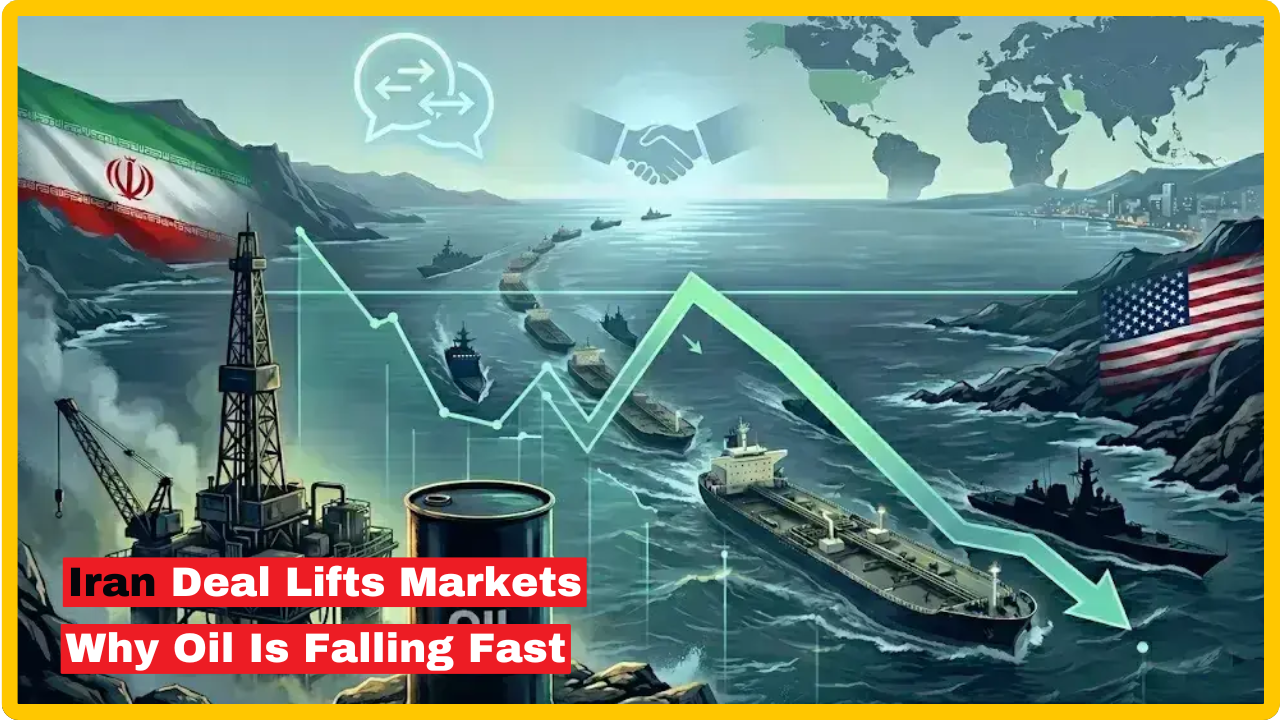
For the second consecutive day, global oil markets recorded a significant oil price drop today — and the reason is the same one that has driven every major directional move in crude prices since late February: the war between the United States, Israel, and Iran. Brent crude, the international benchmark, fell toward $108 a barrel on Tuesday and continued its slide into Wednesday, after President Donald Trump posted on Truth Social that “Great Progress” had been made toward a final agreement to end the conflict.
West Texas Intermediate, the US benchmark, retreated toward $100. For consumers, economists, and traders watching the oil price drop news with varying degrees of relief, the question is no longer just why oil is dropping — it is whether this time the decline will hold.
The answer to that question depends almost entirely on what happens in the coming days in the narrow waterway that has defined this war’s economic impact on the entire planet: the Strait of Hormuz.
Oil Price Drop Today: The Numbers in Context
From $72 to $120 and Back — The War’s Full Price Arc
To understand the significance of the current oil price drop today, it helps to trace the full arc of what crude markets have experienced since the war began on February 28, 2026.
When the United States and Israel launched Operation Epic Fury against Iran, Brent crude was trading at approximately $72 a barrel — already elevated from pre-election levels but well within the range that had characterized the energy market for much of 2024 and early 2025. What followed was, by any historical measure, the most violent oil price shock since the 1973 Arab oil embargo.
In March 2026 alone, Brent crude surged 51 percent — one of the largest single-month price jumps ever recorded in the 160-year history of petroleum markets. At its peak, Brent briefly touched nearly $120 a barrel as fears mounted that Iran’s closure of the Strait of Hormuz — through which roughly 20 percent of the world’s traded oil and a significant share of global liquefied natural gas had previously flowed — could produce a sustained and potentially catastrophic disruption to global energy supply. “This is still the largest oil supply shock in the history of the oil market,” one energy economist stated in April, warning that without a sustained restoration of flows, prices might need to rise further to curb demand.
The first major oil price drop news came on April 8, when Trump announced a two-week ceasefire with Iran. On that day alone, the price of a barrel of US crude plunged 16.4 percent to settle at $94.41, while Brent tumbled 13.3 percent to $94.75. The Dow Jones Industrial Average surged 1,325 points — its single largest one-day percentage gain since April 2025. The S&P 500 closed up 2.5 percent, and the Nasdaq Composite ended higher by 2.8 percent.
But that relief proved premature. The ceasefire was extended but remained fragile. Project Freedom — the US military’s attempt to escort commercial ships through the Strait of Hormuz launched on May 4 — triggered a fresh exchange of fire between US and Iranian forces, missile attacks on the UAE, and a South Korean cargo ship set ablaze in the strait. Oil prices, which had reclaimed the $108 level, remained stubbornly elevated relative to pre-war levels as shipping companies including Hapag-Lloyd continued to declare the strait effectively impassable for commercial traffic.
Oil Price Drop News Now: Trump’s “Great Progress” and a Paused Project Freedom
Why Oil Is Dropping Again This Week
The latest chapter in the oil price drop story opened Tuesday, May 5, when Trump posted on Truth Social that “Great Progress” had been made on a final deal to end the Iran war. He simultaneously announced that the United States would pause its Project Freedom merchant ship escort operation — the operation that had triggered May 4’s dramatic military exchanges — while keeping its naval blockade of Iranian ports in place.
The combination of those two signals — diplomatic optimism and a tactical military de-escalation — produced a second consecutive day of oil price drop movement, pushing Brent back toward $108 and WTI toward $100. Oil fell a second day on the back of the progress reports, demonstrating just how sensitively energy markets are tracking every diplomatic headline from the Pakistan-mediated talks between Washington and Tehran.
The reason for the oil price drop today why question being asked by traders, consumers, and economists across the world is straightforward: if a final agreement to end the war can be reached, the Strait of Hormuz — which accounts for the passage of approximately 20 million barrels of oil per day in normal conditions — would reopen to commercial traffic. The resulting flood of previously stranded oil into global markets would push prices sharply lower.
Goldman Sachs analysts have estimated that total global oil stocks, including crude and refined products, stood at approximately 101 days of demand as of early May 2026 — a figure that could fall to 98 days by the end of the month if the strait remains closed, raising the risk of regional product scarcity in markets including South Africa, India, Thailand, and Taiwan.
Oil Price Drop After Trump: A Familiar Market Pattern
One of the defining characteristics of the oil price drop after Trump announcements throughout this conflict has been the market’s growing sophistication about distinguishing between genuine diplomatic progress and what some traders have bluntly labeled “Trump Always Chickens Out” — an acronym that gained wide currency in financial markets after Trump repeatedly set deadlines for Iran to open the Strait of Hormuz and then extended them without consequence.
The pattern has created a distinctive market dynamic. When Trump signals progress on a deal, oil falls and stocks rise. When Iranian officials pour cold water on his characterizations — as they did after several previous announcements — oil bounces back. The volatility has been extraordinary: Brent crude recorded its biggest single-day decline in decades on the ceasefire announcement and has subsequently swung by 4 to 6 percent on individual trading days as headlines shifted.
“Is it just kicking the can down the road, moving the goalposts, or whatever metaphor we’d like, only to have tempers flare and bombs drop again?”
one senior economic strategist asked publicly after April’s ceasefire announcement — a question that remains equally valid today as Trump claims fresh progress in May.
The market has not fully believed any single announcement. Even after the April 8 ceasefire produced the biggest single-day oil price drop since the war began, Brent remained approximately $35 above its pre-war level of $72 a barrel — a persistent risk premium that reflects the market’s rational assessment that the underlying conflict is not resolved.
Oil Price Drop Reason: Three Structural Factors Still Keeping Prices Elevated
Even as daily oil price drop movements generate market optimism, energy economists have consistently noted three structural factors that will prevent a rapid return to pre-war oil price levels even after a deal is reached.
First, Iran’s oil production and export infrastructure has sustained significant damage from US and Israeli airstrikes over the past ten weeks. Oil refineries, processing facilities, and export terminals across Iran have been struck repeatedly, and the physical restoration of those facilities — even after a political agreement is reached — will take months or years.
Second, sea mines laid by Iran throughout the Strait of Hormuz will require extensive demining operations before commercial shipping companies will feel comfortable routing fully loaded supertankers through the passage without military escort. Mine clearance is a slow, painstaking, and highly specialized operation, and insurers may require it to be completed — not merely declared underway — before they restore normal coverage for vessels transiting the waterway.
Third, the global shipping industry has spent more than two months reorganizing its routing around the closure of the Strait of Hormuz — rerouting vessels around the Cape of Good Hope and establishing new supply relationships across alternative energy corridors. Unwinding those arrangements and restoring the pre-war routing equilibrium will add further time and cost to any market recovery, even in an optimistic diplomatic scenario.
The oil price drop reason today is hope. The reason a complete and rapid price recovery remains unlikely is infrastructure — physical, logistical, and financial.
What an Oil Price Drop Means for American Consumers
For ordinary Americans, the most tangible measure of the Iran war’s economic toll has been the price of a gallon of gasoline. Since the war began on February 28, unleaded gas prices rose more than $1.20 per gallon nationally — from $2.94 before the war to $4.16 at their peak, according to GasBuddy tracking data. That increase has been one of the primary drivers of Trump’s declining approval ratings, with multiple polls from April 2026 showing economic disapproval at historic highs.
When the April 8 ceasefire triggered the first major oil price drop, GasBuddy analyst Patrick De Haan predicted that pump prices would begin to ease, potentially falling one to three cents per day at the weekend. The ceasefire’s subsequent fragility meant those gains were partially reversed at the pump before consumers could fully feel them.
If the current diplomatic progress produces a more durable agreement — one that includes the reopening of the Strait of Hormuz and a lifting of the US naval blockade of Iranian ports — the relief at the gas pump could be significant. But energy economists caution that the translation from a crude oil price drop to lower prices at the gas station takes days to weeks, depending on the pace of price changes through the refining and distribution chain.
The Federal Reserve has been watching the oil price trajectory closely. Fed officials warned in their March meeting minutes that a “protracted conflict in the Middle East could lead to a further softening in labor market conditions, which could warrant additional rate cuts.” Conversely, markets are now pricing approximately a 24 percent chance that the Fed could resume rate cuts in 2026 if oil prices stabilize at meaningfully lower levels — a potential additional economic benefit of any lasting peace agreement.
Conclusion
The oil price drop today — now extending into a second consecutive session — reflects genuine and growing market optimism that the 67-day-old Iran war may be approaching a diplomatic resolution. Trump’s “Great Progress” claim, combined with the pause of Project Freedom’s most militarily provocative elements, has given traders a reason to price in a reduced risk of further escalation.
But the persistence of the US naval blockade, the ongoing fragility of the ceasefire, and the documented structural damage to Iran’s energy infrastructure all counsel caution against expecting a rapid return to pre-war oil prices even if an agreement is reached. As the Pakistan-mediated talks continue and both sides signal a willingness to find a path to peace, global energy markets remain in a uniquely sensitive and historically consequential moment.
Given that oil prices have already fallen significantly from their $120 peak on ceasefire hopes — only to bounce back multiple times when those hopes faded — do you think the current “great progress” claim will translate into a lasting deal that finally brings oil prices back below $80, or is the market once again getting ahead of reality?
Frequently Asked Questions (FAQ)
Q1: Why is the oil price dropping today, and what is the main reason behind the fall?
The oil price drop today is primarily driven by reports of diplomatic progress toward ending the US-Iran war that began on February 28, 2026. President Trump posted on Truth Social that “Great Progress” has been made on a final agreement to end the conflict, and the United States announced it would pause the most militarily aggressive elements of Project Freedom — its operation to escort commercial ships through the Strait of Hormuz — while keeping its naval blockade of Iranian ports in place.
The market is interpreting these signals as evidence that a deal to reopen the strait may be imminent, which would dramatically increase global oil supply by allowing the approximately 20 million barrels of oil that normally transit the Strait of Hormuz daily to resume flowing. Brent crude fell toward $108 a barrel for the second consecutive day on this news, while WTI retreated toward $100.
Q2: How much have oil prices risen and fallen since the Iran war began, and where do they stand now?
The Iran war triggered the largest oil price shock in the history of petroleum markets. When the war began on February 28, 2026, Brent crude was trading at approximately $72 a barrel. In March alone, Brent surged 51 percent — one of the largest single-month price jumps ever recorded — reaching a peak of nearly $120 a barrel at its highest. The announcement of an initial two-week ceasefire on April 8 triggered the single largest daily oil price drop in decades, with Brent falling 13.3 percent in one session to $94.75.
Subsequent diplomatic uncertainty and the May 4 exchanges of fire in the strait pushed prices back up toward $108 to $112. As of May 6, fresh diplomatic progress is pushing Brent back toward $108, though prices remain approximately $36 above pre-war levels — a persistent risk premium reflecting continuing uncertainty about the conflict’s outcome.
Q3: What would a final Iran war deal mean for oil prices and US gas prices?
A durable final agreement that includes the reopening of the Strait of Hormuz and the lifting of the US naval blockade of Iranian ports would be expected to produce a significant and sustained oil price drop. Energy economists estimate that a full restoration of pre-war shipping flows through the strait could push Brent crude back toward the $80 to $90 range over the medium term, though the precise trajectory would depend on the pace of physical mine-clearance operations in the waterway, the restoration of damaged Iranian oil infrastructure, and the speed with which global shipping companies restore normal routing through the Persian Gulf.
For American consumers, relief at the gas pump would follow — with analysts estimating pump prices could fall by one to three cents per day in the initial period after an agreement, potentially bringing the national average gasoline price — currently at approximately $4.16 per gallon — back below $3.50 over several weeks. The Federal Reserve has also signaled it is watching oil prices closely, with markets now pricing in nearly a 24 percent chance of resumed interest rate cuts in 2026 if energy prices stabilize at lower levels.





Be First to Comment