
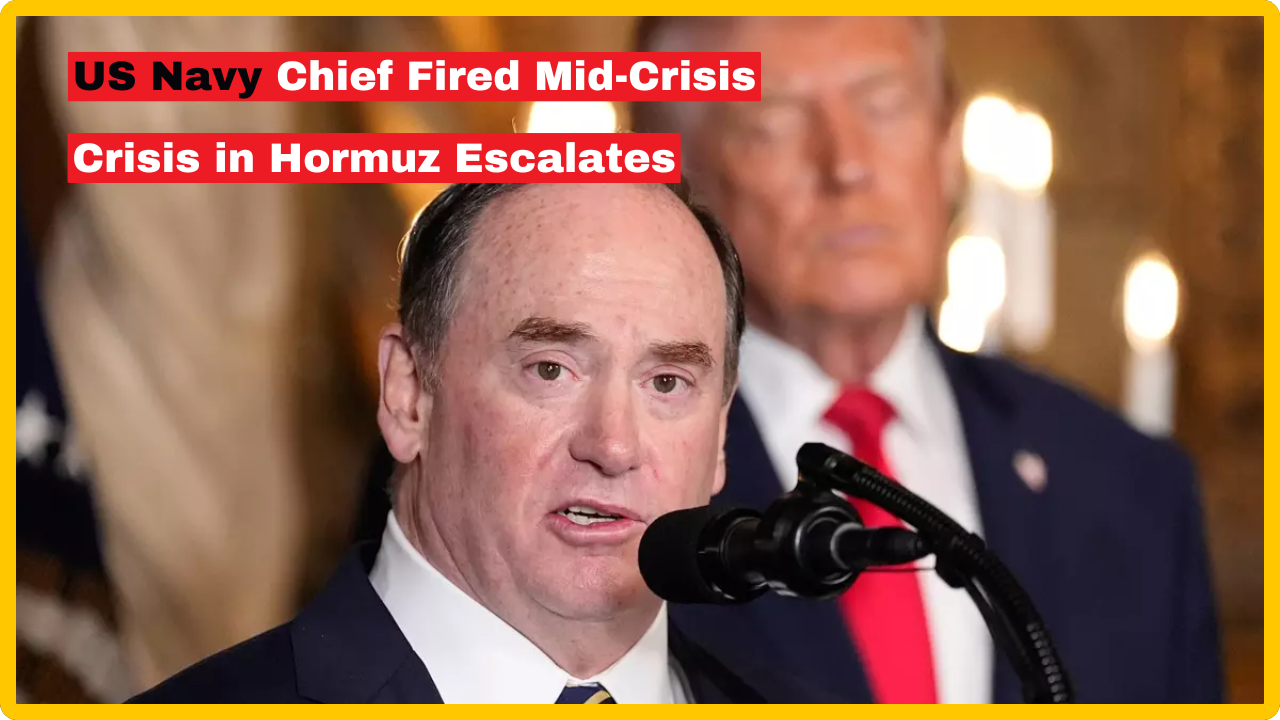
In a sudden and unexplained leadership shakeup, Navy Secretary Fired and the Pentagon announced Wednesday that Navy Secretary John C. Phelan has been removed from his post effective immediately – a move that comes as the United States Navy maintains an aggressive naval blockade of the Strait of Hormuz during a fragile ceasefire with Iran. The abrupt dismissal signals deepening tensions within the Pentagon’s civilian leadership at one of the most operationally demanding moments for the US Navy in recent history.
Phelan’s Sudden Departure: What We Know
There was no immediate explanation provided for Phelan’s sudden departure, which came as the US Navy enforces a high-stakes blockade of Iranian ports near the Strait of Hormuz. Chief Pentagon Spokesman Sean Parnell confirmed the news in a terse statement posted on X, saying that Phelan was departing “effective immediately” and that the Department wished him well in his future endeavors. No cause was stated publicly.
Phelan, a businessman and investor with no prior military service, was sworn in as the 79th Secretary of the Navy on March 25, 2025, after being nominated by President Donald Trump. He had served in the role for just over a year. Phelan and his wife had previously fundraised millions of dollars for President Trump’s campaign before he was confirmed as Navy Secretary in 2025.
Despite his loyalty to the administration, reporting from multiple outlets indicates that his exit was not entirely voluntary. Multiple sources told CNN there was tension for months between Phelan and Defense Secretary Pete Hegseth, who believed Phelan was moving too slowly on implementing shipbuilding reforms and was also frustrated by Phelan’s direct communication with Trump, which Hegseth viewed as an attempt to bypass him.
Deputy Defense Secretary Steve Feinberg also wanted to take control of major responsibilities for shipbuilding and Navy acquisitions, a job that would typically fall within Phelan’s purview. The combination of bureaucratic friction and competing priorities within the Pentagon’s civilian leadership appears to have set the stage for his removal.
Hung Cao Steps In as Acting Navy Secretary
Replacing Phelan – at least in an acting capacity – is Undersecretary Hung Cao, a figure with deep military roots and strong ties to the Trump administration. Hung Cao is a 25-year Navy combat veteran who ran unsuccessful campaigns for the US Senate and House in Virginia.
Cao was sworn in as Under Secretary of the Navy on October 3, 2025, serving as the Department of the Navy’s Chief Operating Officer and Chief Management Officer, overseeing nearly one million Navy, Marine Corps, and civilian personnel and an annual budget exceeding $250 billion.
His personal story is remarkable. Fifty years after arriving in Guam as a Vietnamese refugee, Cao returned as the Department of War’s Senior Defense Official of Guam. The son of a high-ranking South Vietnamese official, Cao came to the United States as a refugee after the end of the Vietnam War, attended Annapolis, and commissioned as a special operations officer in 1996, serving in deployments overseas during the wars in Iraq and Afghanistan.
Cao is an outspoken opponent of diversity, equity and inclusion (DEI) initiatives and is aligned well with Defense Secretary Pete Hegseth’s policies for the defense establishment. He also has strong ties to the White House, having campaigned with the president in the 2024 election cycle. maritime-executive His appointment as acting Secretary of the Navy is seen by analysts as consistent with the administration’s preference for ideologically aligned leadership within the military establishment.
Navy Secretary Fired Amid US Blockade of Strait of Hormuz
The timing of Phelan’s firing cannot be separated from the intense military situation unfolding in the Persian Gulf. The US Navy is currently enforcing a blockade of Iranian ports along the Strait of Hormuz – one of the world’s most strategically vital waterways — as part of a broader pressure campaign against Tehran.
Thus far, US forces have redirected 29 vessels to return to port and have also boarded two ships as part of the enforcement effort. Earlier this week, the US Navy seized an Iranian-flagged cargo ship in the Gulf of Oman after it attempted to bypass the blockade, with Trump stating that the ship was stopped after a guided missile destroyer damaged its engine room.
Pentagon officials also briefed lawmakers this week on an intelligence assessment that found it could take up to six months to fully clear the Strait of Hormuz of mines after the war with Iran ends. That projection underscores just how complex and prolonged the military situation in the region may become, regardless of the ceasefire’s current status.
A Pattern of Pentagon Leadership Turnover
Phelan’s removal is not an isolated incident within the Department of Defense. The reported ouster comes less than three weeks after Defense Secretary Pete Hegseth asked Army Chief of Staff Randy George to step down and retire — just over a month after the US launched military operations against Iran — an act widely considered highly unusual and which drew significant criticism.
The pattern of leadership changes at the Pentagon raises questions about continuity of command during an active military operation. The Strait of Hormuz blockade represents one of the most consequential naval missions the US has undertaken in decades, and critics have argued that this is precisely the wrong moment to be rotating senior civilian leadership.
Phelan is leaving during a busy time for the Navy, which has three aircraft carriers deployed in or heading to the Middle East, while the Trump administration says all the armed forces are poised to resume combat operations against Iran should the ceasefire expire.
What Comes Next
With Hung Cao now at the helm in an acting capacity, the Navy faces a demanding set of immediate challenges: maintaining the operational tempo of the Strait of Hormuz blockade, managing diplomatic friction around ship seizures, and navigating the broader question of whether the current ceasefire with Iran can hold.
The Trump administration’s hardline stance on Iran has led to heightened military activity in the Persian Gulf, and the blockade of the Strait of Hormuz — a critical chokepoint for global oil supplies — has already caused significant disruptions to shipping lanes and contributed to rising tensions between the two nations.
Cao’s military background and operational experience may lend him credibility in managing the Navy through this critical period, though his confirmation as a permanent secretary would still require Senate approval. In the interim, the acting secretary will be expected to maintain alignment with both Defense Secretary Hegseth’s directives and the White House’s strategic posture on Iran.
Conclusion
The abrupt removal of Navy Secretary John Phelan on April 22, 2026 – with no public explanation — reflects the considerable turbulence within the Trump administration’s Pentagon leadership at a pivotal moment in US-Iran relations. As the US Navy continues to enforce its blockade of the Strait of Hormuz, Acting Secretary Hung Cao inherits an enormous operational and diplomatic challenge. Whether this leadership transition introduces instability or renewed focus into the Navy’s chain of command remains to be seen in the days ahead.
What do you think — does frequent leadership turnover at the Pentagon strengthen or weaken US military effectiveness during an active conflict?
Frequently Asked Questions (FAQ)
Q1: Why was Navy Secretary John Phelan fired?
No official reason was provided by the Pentagon. However, multiple sources indicate there were months of internal tension between Phelan and Defense Secretary Pete Hegseth over the pace of shipbuilding reforms and Phelan’s practice of communicating directly with President Trump, which Hegseth viewed as bypassing his authority.
Q2: Who is Hung Cao and what is his background?
Hung Cao is a retired US Navy Captain with 25 years of service, including combat deployments during the wars in Iraq and Afghanistan. He is a Vietnamese refugee who came to the United States in 1975, attended the US Naval Academy, and later ran – unsuccessfully — for US Senate and House seats in Virginia. He was confirmed as Undersecretary of the Navy in October 2025 and now serves as acting Secretary.
Q3: What is the US doing in the Strait of Hormuz, and why does it matter?
The US Navy is currently enforcing a naval blockade of Iranian ports near the Strait of Hormuz as part of its pressure campaign against Iran during an ongoing ceasefire. The strait is one of the world’s most critical oil shipping routes, and the blockade has already redirected dozens of vessels and led to the boarding of two ships. An intelligence assessment shared with lawmakers suggests clearing the waterway of mines could take up to six months after any conflict ends, highlighting the long-term significance of the operation.




Be First to Comment