
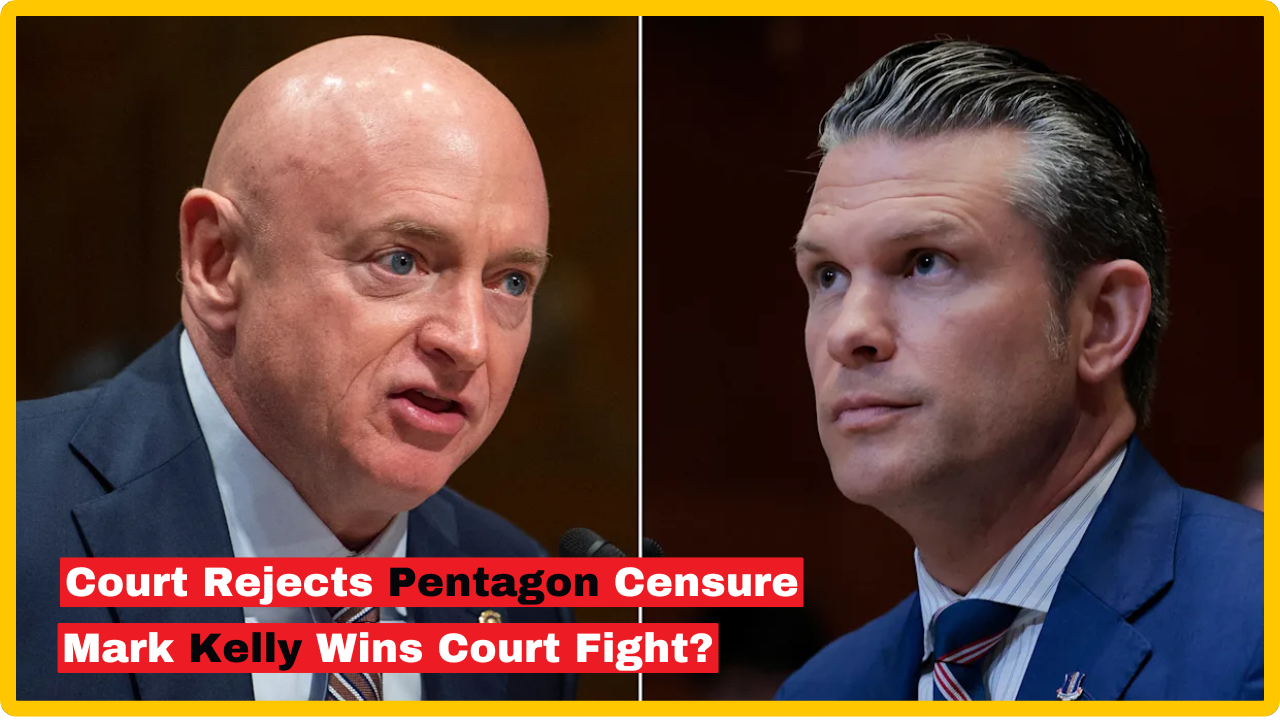
The Mark Kelly Pentagon lawsuit that began with a 90-second social media video and escalated into a full-scale constitutional confrontation between the executive and legislative branches of the United States government reached the federal appeals court Thursday — and by the time oral arguments concluded, it was clear that a majority of the three-judge DC Circuit panel was deeply uncomfortable with the government’s position.
Defense Secretary Pete Hegseth’s effort to punish Democratic Senator Mark Kelly of Arizona — a retired Navy captain, decorated astronaut, and combat veteran — by issuing a formal censure and reducing his military retirement pay has already been blocked once by a district court judge. On Thursday, the US Court of Appeals for the District of Columbia Circuit appeared poised to keep it blocked, with two of the panel’s three judges spending more than 90 minutes throwing pointed and sustained skepticism at the Justice Department’s arguments.
What began as a Mark Kelly Pentagon dispute over a social media post has become a defining test of whether the First Amendment protects retired military officers who speak publicly on matters of constitutional principle.
The Mark Kelly Pentagon Censure Lawsuit: From Video to Courtroom
To understand the full scope of the Mark Kelly Pentagon lawsuit, it is essential to revisit the event that set it all in motion. In November 2025, Kelly — along with five other Democratic members of Congress who share backgrounds in military service or national security – appeared in a 90-second video first posted on the social media account of Senator Elissa Slotkin of Michigan. The video carried a direct and deliberate message to active-duty service members: do not obey orders that violate the law or the Constitution.
The lawmakers did not identify any specific unlawful order that had been issued or was anticipated. They did not call for organized disobedience, insubordination, or any form of military resistance. The principle they articulated — that a service member’s duty does not extend to compliance with illegal commands — is not a fringe position.
It is the foundational doctrine of military law, taught to every cadet at the United States Naval Academy at Annapolis, at West Point, and at every other American military institution. It is embedded in the Uniform Code of Military Justice. It was affirmed as a matter of international law at the Nuremberg trials following World War II.
President Trump and Hegseth responded to the video with unmistakable fury. Both attacked Kelly publicly and repeatedly. On January 5, 2026, Hegseth issued a formal letter of censure against the senator and announced the Pentagon would pursue administrative action to reduce Kelly’s last military rank — a step that would directly lower the retirement pay he draws as a retired Navy captain. It was the opening salvo of the Mark Kelly Pentagon censure lawsuit dispute that now sits before the DC Circuit.
The Mark Kelly Pentagon Lawsuit Ruling: Judge Leon’s February Decision
The Mark Kelly Pentagon lawsuit ruling at the district court level was both substantively sweeping and rhetorically memorable. US District Judge Richard Leon — a George W. Bush appointee whose political alignment gave his ruling particular bipartisan resonance — issued his February 12, 2026 decision in terms that left no ambiguity about his assessment of the administration’s position.
Leon found that the Pentagon had not only violated Kelly’s First Amendment free speech rights but had done so in a way that “threatened the constitutional liberties of millions of military retirees” who, like Kelly, remain technically subject to military jurisdiction after leaving active service. The judge prohibited the Pentagon from implementing or enforcing any punishment against Kelly while the lawsuit remained pending – a protective order that gave Kelly’s legal position immediate practical force.
When the government argued in its submissions that Kelly was attempting to exempt himself from military justice obligations, Judge Leon deployed a dismissive colloquialism that became one of the most widely quoted lines of any judicial ruling in recent months: “Horsefeathers!” He continued: “To say the least, our retired veterans deserve more respect from their Government, and our Constitution demands they receive it!”
The Justice Department filed a notice of appeal within weeks of Leon’s ruling, escalating the Mark Kelly Pentagon dispute to the DC Circuit — and setting the stage for Thursday’s pivotal oral argument.
The Mark Kelly Pentagon Investigation and Probe: What Hegseth Claimed
A “Pattern of Conduct” — Or a Single Video?
Central to the Mark Kelly Pentagon investigation and probe that preceded the censure was a foundational disagreement about what, exactly, Kelly had done wrong. Hegseth and the Justice Department argued in their submissions that Kelly’s punishment was not based on a single video but on what they characterized as a broader “pattern and totality of conduct” that demonstrated ongoing inappropriate influence over active-duty service members.
The government’s legal theory rested on two pillars. First, that retired officers remain part of the armed forces, are subject to recall to active duty, and maintain the ability to influence currently serving members — justifications offered for why the Pentagon retains jurisdiction over their public speech. Second, that speech encouraging disobedience to orders — even framed as applying only to unlawful orders — crosses a line that the First Amendment does not protect in the military context.
Kelly’s legal team pushed back sharply on both pillars. Regarding the “pattern of conduct” framing, attorney Benjamin Mizer pointed directly to the text of the censure letter Hegseth had issued: “The censure letter says on its face that it’s targeting the Senator for his public statements.” If the document ordering punishment explicitly cites protected speech as the justification, Mizer argued, it is difficult to reframe that as discipline based on something other than speech.
Regarding the First Amendment question itself, Kelly’s lawyers characterized the Pentagon’s position as one that would allow the Department of Defense to punish any retired veteran for any public statement it dislikes — a theory with sweeping and dangerous implications for the free expression rights of millions of Americans who have served.
Thursday’s DC Circuit Hearing: Judges Pillard and Pan Signal Their Skepticism
“You’re Saying They Have to Give Up Their Retired Status?”
The oral argument before the DC Circuit panel on May 7 lasted more than 90 minutes — an unusually extended session that itself reflected the judges’ engagement with the case’s complexity. Two of the panel’s three judges, Obama appointee Nina Pillard and Biden appointee Florence Pan, were the most active questioners, and both directed their sharpest inquiries at the government.
Judge Pillard went straight to the substance of what Kelly had actually said in the November video. “That is something that is taught at Annapolis to every cadet,” she noted — a comment that directly undermined the government’s attempt to characterize Kelly’s remarks as improper or dangerous. If the Naval Academy teaches future officers the same principle Kelly articulated, it becomes constitutionally difficult to argue that a retired captain violated military norms by saying it publicly.
Judge Pan was equally pointed. “These are people who served their country — many put their lives on the line,” she said, addressing Justice Department lawyer John Bailey. “You’re saying that they have to give up their retired status in order to say something that is a textbook example — taught at West Point and the Naval Academy — that you can disobey illegal orders?” Bailey’s response — that the Constitution does not protect speech by retired military officers who urge disobedience, and that this was about a pattern of conduct rather than a single statement — appeared to satisfy neither judge.
Kelly Speaks Outside the Courthouse
“A Day in Court for the First Amendment Rights of Millions”
After the hearing concluded, Senator Mark Kelly addressed reporters assembled outside the courthouse in downtown Washington. His remarks framed the case in terms that deliberately extended its significance beyond his personal situation.
“This was a day in court not just for me, but for the First Amendment rights of millions of us,” Kelly said. He then summarized what he characterized as the administration’s core argument in its most stark form: “The administration argued in court that every time a retired veteran says something the Department of Defense doesn’t like, they can punish him. Every time a retired veteran says something that the Department of Defense doesn’t like, they can be punished. People who have done the most for their country would not be free to express what they stand for.”
The Pentagon and White House did not immediately respond to requests for comment following the hearing.
Mark Kelly Pentagon Allegations and Misconduct Probe: The Wider Context
A Senator, a Soldier, and a Constitutional Question
The Mark Kelly Pentagon allegations and misconduct probe framing pushed by the administration has been consistently disputed by Kelly’s legal team and by independent legal analysts, who have characterized the case as straightforwardly about the executive branch retaliating against a political critic who happens to be a retired military officer. The Mark Kelly Pentagon misconduct probe narrative has circulated widely in conservative media, but the district court’s February ruling — from a Republican-appointed judge — found it legally unpersuasive.
What the case ultimately raises is a question that goes far beyond Kelly himself. The American military produces thousands of public voices who speak regularly on policy matters after leaving service — retired generals, admirals, intelligence officers, and others who have contributed substantially to public debate. The government’s theory, if accepted, would give the Pentagon authority to discipline any of those voices when their speech displeases the current Defense Secretary.
Conclusion:-
The Mark Kelly Pentagon lawsuit dispute has evolved from a social media video into one of the most significant First Amendment cases involving civil-military relations in recent American history. With the DC Circuit panel appearing strongly inclined to reject Hegseth’s appeal and maintain the district court’s block on Kelly’s punishment, the administration faces the prospect of a second consecutive judicial defeat on a case it chose to escalate at every stage.
Whether the administration will seek further review — including at the Supreme Court — if the DC Circuit rules against it remains an open question. But for now, the courts appear to be holding a clear line: that the First Amendment protects even retired military officers who say publicly what every cadet is taught at Annapolis and West Point.
Given that the principle of refusing illegal orders is explicitly taught at every American military academy, do you believe the Pentagon has any legitimate constitutional basis to punish a retired senator for publicly reminding service members of that same principle — or does this case represent an unprecedented and dangerous use of military authority to silence political speech?
Frequently Asked Questions (FAQ)
Q1: What is the Mark Kelly Pentagon censure lawsuit about, and what punishment did Hegseth impose?
The Mark Kelly Pentagon censure lawsuit centers on Defense Secretary Pete Hegseth’s January 5, 2026 decision to issue a formal letter of censure against Senator Mark Kelly of Arizona and announce administrative action to reduce Kelly’s last military rank — which would directly lower his retirement pay as a retired Navy captain. The punishment was triggered by a 90-second social media video Kelly recorded in November 2025, alongside five other Democratic lawmakers with military or intelligence backgrounds, urging active-duty service members to refuse orders that violate the law or the Constitution.
Kelly sued to block the punishment in federal court, and US District Judge Richard Leon — a George W. Bush appointee — ruled in Kelly’s favor in February 2026, finding that the Pentagon had violated Kelly’s First Amendment rights and prohibited enforcement of the punishment while the lawsuit proceeds. The Justice Department then appealed to the DC Circuit, leading to Thursday’s oral argument.
Q2: What happened at the DC Circuit hearing on May 7, 2026, and what did the judges say?
The DC Circuit panel of three judges heard more than 90 minutes of oral argument on May 7, 2026. Two of the three judges — Obama appointee Nina Pillard and Biden appointee Florence Pan — spent the session in sustained and pointed skepticism of the government’s position. Judge Pillard noted that the principle Kelly articulated in his video — that service members may refuse illegal orders —
“is something that is taught at Annapolis to every cadet.”
Judge Pan asked the government’s lawyer directly whether the administration’s position meant that retired veterans must give up their retired status in order to publicly affirm a principle taught at West Point and the Naval Academy. The government’s lawyer, Justice Department attorney John Bailey, argued that the case was about a pattern of conduct rather than a single statement, and that the Constitution does not protect speech by retired military officers urging disobedience – arguments that appeared to satisfy neither of the two more active questioners on the panel.
Q3: What are the broader stakes of the Mark Kelly Pentagon dispute for military retirees and free speech?
The stakes of the Mark Kelly Pentagon dispute extend well beyond Kelly’s personal retirement pay and censure. District Court Judge Leon’s February ruling explicitly noted that the government’s theory of military jurisdiction over retired officers’ public speech “threatened the constitutional liberties of millions of military retirees.” The American military produces a large and active community of public voices — retired generals, admirals, and intelligence officers who regularly speak, write, and testify on matters of national security and policy.
If the DC Circuit or a higher court were to accept the government’s position that the Pentagon can discipline retired officers for public statements that the Defense Secretary dislikes, those millions of veterans would face a stark choice between exercising their First Amendment rights and protecting their retired status and benefits. That is precisely the constitutional line that Kelly’s legal team — and apparently the majority of the DC Circuit panel — appears unwilling to allow the government to cross.




Be First to Comment