
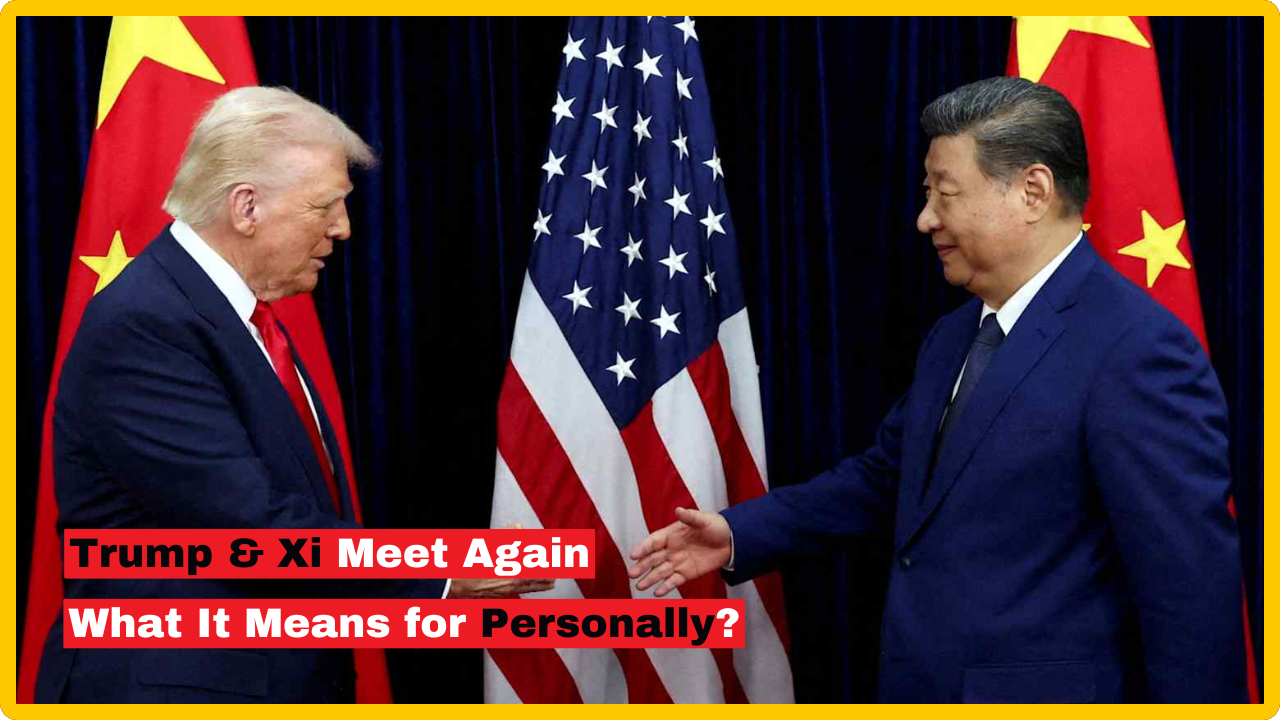
When Air Force One touches down in Beijing on May 14, 2026, Donald Trump will become the first sitting American president to set foot in China since his own first term in 2017 – and the Trump Xi summit will immediately become the most consequential diplomatic encounter of the year. The two-day meeting between Trump and Chinese President Xi Jinping arrives at a moment of extraordinary global fragility:
the Iran war has spiked oil prices to $108 a barrel and disrupted global energy supply chains; a bitter US-China trade war has run through multiple truces, retaliations, and partial resolutions; and the world’s two largest economies are locked in an accelerating competition over the technologies and critical minerals that will define the next half-century.
“Virtually everyone has a stake in the outcome of this meeting,”
one senior fellow at the Peterson Institute for International Economics observed this week — a statement that is not an exaggeration. From Singapore to Brussels, Seoul to Taipei, governments and businesses around the world are watching the Trump Xi summit with a mixture of hope and anxiety, aware that decisions made in two days of closed-door negotiations in Beijing could reshape the rules of global trade, energy, and security for years to come.
The Agenda: Five Issues, Each Capable of Moving Markets
The Trump Xi summit agenda is sprawling by any historical measure. Trade and tariffs have been the dominant public framing of the US-China relationship since 2018, and they remain central here. The two countries reached a trade truce at the Busan summit in October 2025 that reduced American tariffs on Chinese imports from 57 percent to 47 percent — a step Trump rated “12 out of 10.”
But Chinese exports to the United States have continued to fall, dropping 11 percent year-on-year in early 2026, and the fundamental imbalance — a US goods trade deficit with China running at approximately $1.2 trillion annually — has not been resolved. The administration is expected to push for a bilateral “Board of Trade” mechanism to institutionalize and rebalance trade flows, replacing the current ad hoc tariff framework with something more durable and predictable.
Rare earth minerals and critical supply chains have emerged as perhaps the most structurally significant issue on the agenda, and the one where China holds the most leverage. When Trump pushed tariffs to record levels in April and October of 2025, Beijing’s most powerful response was not counter-tariffs but restrictions on rare earth exports — the minerals essential to electric vehicles, defense systems, semiconductors, and virtually every advanced technology product manufactured anywhere in the world.
Trump Xi Summit 2026:
China’s decision to suspend exports of rare earths and ban semiconductors from its domestic supplier Nexperia China sent shockwaves through global automakers and defense contractors from Tokyo to Stuttgart. Easing those controls would be felt across every country with a modern manufacturing base — not just in the United States. The US is expected to push hard for a formal agreement on continued rare earth access, alongside a potential Chinese purchase of approximately 500 Boeing aircraft and sustained agricultural imports.
The Iran war — and with it the fate of the Strait of Hormuz — has elevated itself to the top of the Trump Xi summit agenda in ways that few analysts anticipated when the meeting was first scheduled. China’s substantial commercial and strategic ties to Iran, formalized through a 25-year partnership agreement signed in 2021, give Beijing unique influence over Tehran’s decision-making. Chinese Foreign Minister Wang Yi hosted Iranian Foreign Minister Abbas Araghchi in Beijing just days before the summit — a visit that sent oil prices lower and stock markets higher on hopes that China’s intervention could help broker a Hormuz deal.
Treasury Secretary Scott Bessent has confirmed that Iran will be a central topic in the Trump-Xi meetings. Any Chinese commitment to actively push Iran toward reopening the Strait of Hormuz would represent one of the most immediately market-moving outcomes of the entire summit — potentially delivering the fastest oil price relief available to either economy.
What It Means for the World?
Taiwan will hover over every conversation in Beijing, even if it never dominates the official agenda. China’s top diplomat Wang Yi described Taiwan as “the biggest point of risk” in the bilateral relationship in a call with Secretary of State Marco Rubio on April 30. Xi is widely expected to press Trump for explicit commitments to restrict American arms sales to Taiwan and to soften longstanding US declaratory language on the cross-strait relationship.
Taiwan is watching with acute anxiety: the island is particularly worried that Trump’s confidence in his personal relationship with Xi will lead him to make concessions that undermine the security framework on which its de facto independence rests.
Artificial intelligence has emerged as the fifth major dimension of the Trump Xi summit agenda — a reflection of how rapidly the technology competition between the two countries has accelerated. Both sides are backpedaling somewhat on recent confrontation around US sanctions and technology restrictions, and analysts note that both Washington and Beijing recognize a mutual interest in some form of cooperation on AI safety, given the shared risks of advanced AI systems operating without adequate guardrails. How far that cooperation will extend — and whether it is compatible with the US commitment to maintaining technological leadership — is one of the more uncertain variables going into the summit.
What the Rest of the World Is Watching For
From Southeast Asia to Europe to Taiwan
The global audience for the Trump Xi summit is not passive. Every country in Asia, every major European economy, and virtually every major energy-importing nation has direct material interests in the summit’s outcome — and many are worried about outcomes they cannot influence.
Southeast Asian governments are watching particularly closely for any dramatic shift in US tariffs on Chinese goods relative to the rates applied to their own exports. Since the trade war began, many Southeast Asian countries had benefited from trade diversion as manufacturers moved production out of China to avoid American tariffs.
A major US-China tariff reduction that made Chinese goods more competitive again would directly threaten those gains. “Any cooperation between the US and China on reopening the Strait of Hormuz could offer near-term relief in oil prices, and on the energy crunch overall,” one global markets analyst noted — a priority shared by virtually every energy-importing economy from India to Japan to Germany.
European governments are watching the rare earth question most anxiously of all. China’s suspension of rare earth and magnet exports affected every major European automaker — BMW, Mercedes-Benz, Volkswagen, Stellantis — as well as defense contractors and renewable energy manufacturers across the continent. Any agreement that eases those restrictions would flow through the entire global supply chain for electric vehicles, wind turbines, and defense systems.
Taiwan will be watching for changes in US declaratory policy — specifically, whether Trump uses the Beijing summit to signal a softer line on Taiwan independence or agrees to constrain American arms sales. The island is particularly concerned about private Trump-Xi exchanges that occur without other officials present, limiting the ability of senior advisers to brief the president in advance on the nuances of commitments he might be asked to make.
Who Enters With the Upper Hand?
Xi’s Confidence and the Limits of Trump’s Leverage
Multiple independent analyses from the Council on Foreign Relations, the Center for Strategic and International Studies, and the Brookings Institution converge on a sobering assessment: China enters the Trump Xi summit with more strategic confidence than many Western observers have acknowledged.
Xi has spent years telling Chinese officials that “the East is rising and the West is declining.” That narrative was reinforced last year when Trump’s unprecedented tariff escalation — which pushed duties past 140 percent — was ultimately reversed not because of Chinese concessions but because Beijing’s rare earth leverage forced Washington to pull back. The structural reality is that China’s economy has absorbed the trade war’s blows more effectively than anticipated, with exports growing 21.8 percent year-on-year in early 2026 as Beijing diversified its trade relationships away from the United States.
That said, CSIS analysts note that China’s eagerness to hold the summit signals its own anxieties. Beijing’s massive commercial investments in Iran, its exposure to Strait of Hormuz disruption, and its concerns about continued US-led technology restrictions all give it strong incentives to seek stability — not just on its own terms.
Expectations on both sides are being carefully calibrated downward in the days before the meeting.
“Outside observers should have low expectations,”
Brookings experts advised. The most likely outcomes are announcements of Chinese commercial purchases of American products — Boeing aircraft, agricultural goods — combined with incremental progress on trade mechanisms and the Iranian situation, rather than the kind of transformative bilateral reset that each leader’s domestic audiences might hope for.
Conclusion
The Trump Xi summit of May 14–15, 2026 is not simply a bilateral meeting between two heads of government — it is a convening of the two most powerful actors in the global system at a moment when that system is under more simultaneous pressure than at any point since World War II. The Iran war, the trade war, the technology war, the Taiwan question, and the race for rare earth dominance are all on the table at once. The rest of the world — watching from Singapore, Brussels, Taipei, Seoul, and beyond — cannot vote on the outcome. But it will live with it.
Given that China enters the Beijing summit with significant leverage over rare earths, the Iran situation, and global supply chains, do you think the Trump Xi summit will deliver meaningful and lasting progress — or will it produce a carefully choreographed set of announcements that paper over the fundamental tensions between the world’s two largest powers?
Frequently Asked Questions (FAQ)
Q1: When is the Trump Xi summit taking place and what is on the agenda?
The Trump Xi summit is scheduled for May 14–15, 2026, in Beijing — the first visit to China by a sitting American president since Trump’s own first-term trip in November 2017. The agenda is expansive and covers at least five major issue areas: trade and tariffs, including a potential “Board of Trade” mechanism to institutionalize bilateral trade flows; rare earth and critical mineral access, where China holds significant leverage through its control of global supply chains; the Iran war and the Strait of Hormuz, where China’s influence over Tehran may be critical to any ceasefire deal;
Taiwan, where Xi is expected to press for US commitments on arms sales and declaratory policy; and artificial intelligence, where both sides have signaled interest in some form of cooperation on safety alongside their ongoing technology competition. Large-scale commercial deals — including a possible Chinese purchase of approximately 500 Boeing aircraft and continued agricultural imports — are also expected to be announced.
Q2: What does the Trump Xi summit mean for global oil prices and the Iran war?
The Iran war’s disruption of the Strait of Hormuz has been the single largest driver of elevated global oil prices since late February 2026, with Brent crude remaining near $108 a barrel despite the fragile ceasefire announced in April. China’s unique leverage over Iran — rooted in a 25-year strategic partnership agreement signed in 2021 and decades of deep commercial ties — makes Beijing a potential key broker for any lasting resolution. Chinese Foreign Minister Wang Yi hosted Iranian Foreign Minister Araghchi in Beijing just before the summit, a visit that briefly pushed oil prices lower on hopes of a diplomatic breakthrough.
Treasury Secretary Bessent has confirmed Iran will be a central topic in the Trump-Xi meetings. Analysts at CSIS have noted that China’s positioning of itself as having “already weighed in with Iran to reopen the Strait of Hormuz” signals that Beijing sees this as an area where it can demonstrate strategic value — and extract concessions from Washington in return.
Q3: Why are other countries — particularly in Asia and Europe — watching the Trump Xi summit so closely?
The Trump Xi summit’s potential outcomes touch virtually every major economy on the planet. Southeast Asian governments are concerned that a significant US-China tariff reduction would undercut the trade diversion benefits they have gained by positioning themselves as manufacturing alternatives to China. European governments are most focused on rare earth and critical mineral access, as China’s recent export restrictions on rare earths and magnets directly disrupted automotive, defense, and renewable energy supply chains across the continent.
Taiwan is watching anxiously for any changes in US declaratory policy on the cross-strait relationship or any private Trump-Xi understandings about American arms sales that could erode the security framework on which the island’s de facto independence depends. Energy-importing economies from India to Japan to South Korea are watching for any deal that helps reopen the Strait of Hormuz, which would directly reduce the energy costs that have been weighing on their economies since February.
Be First to Comment