
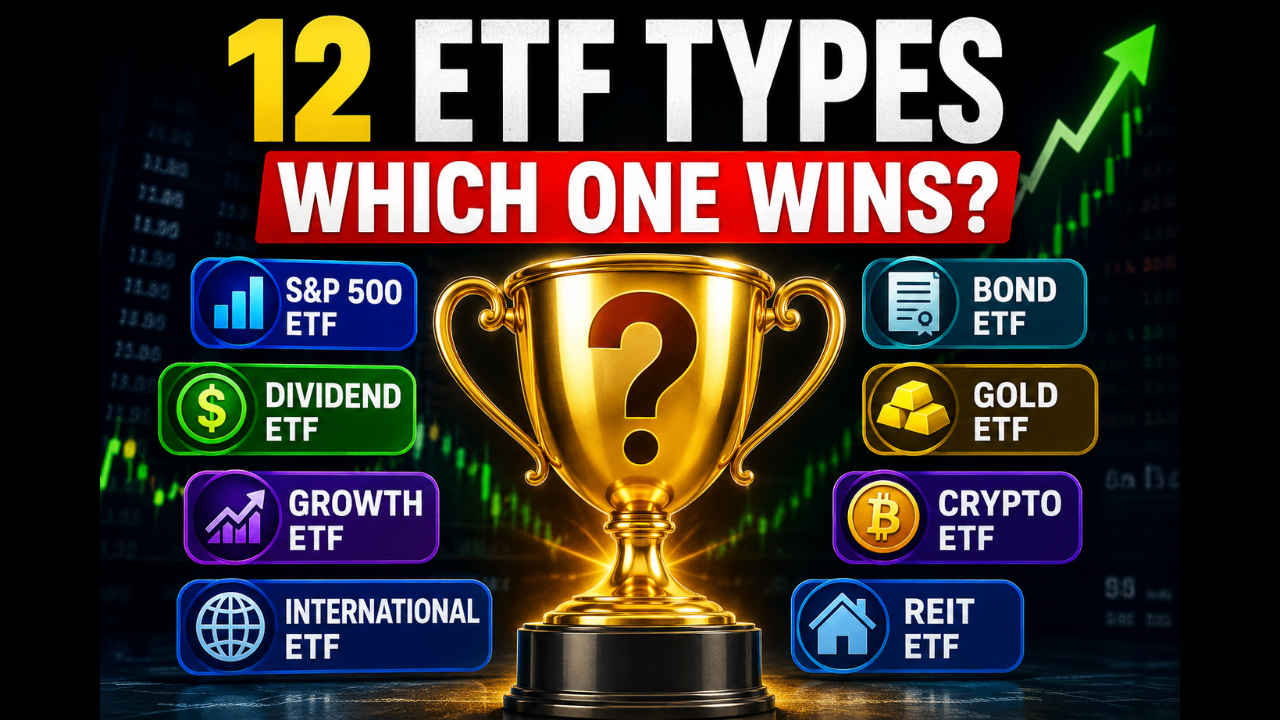
The Ultimate Guide to ETFs: Every Type Explained
What is an ETF, how do ETFs work, and which type is right for you? Everything you need to know — all in one place.
📋 Table of Contents
- What Is an ETF? (The Simple Explanation)
- How Do ETFs Work? Step-by-Step
- The Complete List of ETF Types (All 17 Categories)
- ETF vs Mutual Fund vs Index Fund: Full Comparison
- Benefits of Investing in ETFs
- Risks of ETFs You Must Know
- How to Buy an ETF: Step-by-Step for Beginners
- How to Choose the Right ETF for You
- Best ETF Platforms and Brokers (2025)
- Frequently Asked Questions (FAQ)
- Conclusion
Over $10 trillion is now invested in Exchange-Traded Funds globally — and that number keeps climbing. Once considered a niche instrument for institutional traders, ETFs have become the go-to investment vehicle for everyone from first-time savers to seasoned portfolio managers. So what is an ETF, and why does it matter for you?
An ETF, or Exchange-Traded Fund, is a basket of securities — stocks, bonds, commodities, or other assets — that trades on a stock exchange just like a single share of company stock. Think of it as a pre-packed grocery bag: instead of picking and buying each item separately, you get a curated selection in one convenient purchase.
In this complete guide, you will discover exactly what is an ETF, how ETFs work, every major type of ETF explained with real-world examples, and how to choose and buy the right ETF for your goals. Whether you are a total beginner or an experienced investor looking to sharpen your knowledge, this is the only ETF guide you will ever need.
1. What Is an ETF? (The Simple Explanation)
If you have ever wished you could own a small piece of hundreds of companies at once — without spending a fortune or spending hours researching each one — then ETFs were made for you.
An Exchange-Traded Fund (ETF) is a type of investment fund that holds a collection of underlying assets — such as stocks, bonds, commodities, or currencies — and issues shares that trade on a stock exchange throughout the trading day, just like individual stocks. The price of an ETF share rises and falls as the market moves, reflecting the combined value of everything inside the fund.
How ETFs Differ from Stocks and Mutual Funds
A stock represents ownership in a single company. If that company struggles, your investment suffers. An ETF spreads your investment across many companies or assets simultaneously, reducing concentration risk.
A mutual fund also holds many assets, but it is priced only once a day — after the market closes — and is typically managed by a professional fund manager who actively picks investments. An ETF, by contrast, is usually passively managed and tracks an index, keeping costs dramatically lower.
Key ETF Terms You Need to Know
- Net Asset Value (NAV): The per-share value of all the assets inside the ETF, calculated at the end of each trading day. It represents the theoretical fair value of one ETF share.
- Expense Ratio: The annual fee charged by the ETF provider, expressed as a percentage. A 0.03% expense ratio means you pay just $0.30 per year on a $1,000 investment.
- Intraday Trading: Unlike mutual funds, ETFs can be bought and sold at any point during market hours — a major flexibility advantage.
- Bid-Ask Spread: The small gap between what buyers will pay and what sellers are asking. For popular ETFs, this spread is typically very narrow.
- Premium and Discount to NAV: If market demand pushes an ETF’s price above its NAV, it trades at a premium. Below NAV = discount. For major ETFs, this difference is usually negligible.
2. How Do ETFs Work? Step-by-Step
Understanding how ETFs work behind the scenes helps you make smarter investment decisions. The process is more elegant than most people realise.
Step 1 — The ETF Provider Designs the Fund
A financial company (like BlackRock, Vanguard, or State Street) decides what the ETF will track — for example, the S&P 500 index. They define the rules: which securities to hold, in what proportions, and how often to rebalance.
Step 2 — Authorized Participants (APs) Create Shares
Large financial institutions called Authorized Participants (APs) — typically major banks or broker-dealers — can create or redeem ETF shares in bulk through a unique creation and redemption mechanism.
To create new ETF shares, an AP assembles a large basket of the underlying securities (say, all 500 stocks in the S&P 500 in the correct proportions) and delivers them to the ETF provider. In return, the AP receives a large block of ETF shares — called a creation unit — which they can then sell on the open market.
To redeem shares, the AP does the reverse: they hand ETF shares back to the provider and receive the underlying securities. This mechanism keeps the ETF’s market price closely aligned with its NAV and makes ETFs highly tax-efficient.
Step 3 — You Buy and Sell on the Exchange
Once ETF shares are in the market, you can buy and sell them through any standard brokerage account during market hours, just as you would for a stock — using a market order, limit order, or stop order.
How ETF Prices Are Determined
The ETF’s market price is driven by supply and demand throughout the trading day. The creation/redemption mechanism acts as a powerful price-correction tool. If the ETF trades at a significant premium, APs have a profit incentive to create more shares (pushing the price back down). If it trades at a discount, APs buy cheap ETF shares and redeem them for the underlying securities. The result: ETF prices stay very close to NAV, most of the time.
3. The Complete List of ETF Types — All 17 Categories Explained
The ETF universe is vast and diverse. Here is a comprehensive breakdown of every major type of ETF you will encounter, with real-world examples and an honest look at the pros and cons of each.
1 Stock ETFs (Equity ETFs)
What It Is
Stock ETFs hold a collection of company shares and are the most popular type of ETF. A single stock ETF can give you exposure to dozens, hundreds, or even thousands of companies at once — making them the foundation of most long-term investment portfolios.
How It Works
The ETF buys and holds shares of multiple companies according to a predefined set of rules — usually tracking a stock market index. As the prices of the underlying stocks move, the ETF’s price moves with them. Dividends collected from holdings are distributed to ETF shareholders or reinvested.
Who It’s Best For
Long-term investors seeking broad equity exposure with low costs and high diversification. Ideal for beginners building their first portfolio as well as experienced investors looking for core holdings.
✅ Pros
- Instant diversification across hundreds of companies
- Very low expense ratios (as low as 0.03%)
- Easy intraday trading and dollar-cost averaging
❌ Cons
- Subject to full market risk — falls with the market
- No ability to outperform the index with a passive ETF
- Sector-concentrated funds amplify industry downturns
2 Index ETFs
What It Is
An index ETF replicates the performance of a specific market index — such as the S&P 500, FTSE 100, or MSCI World. Rather than trying to beat the market, the goal is to match it as closely as possible. This is the cornerstone of passive investing.
How It Works
The fund purchases the same securities in the same proportions as the target index. As the index rebalances, the ETF adjusts. The difference between the ETF’s returns and the index’s returns is called tracking error, which good index ETFs minimise to near zero.
Who It’s Best For
Passive investors who believe in long-term wealth building through market returns. They form the backbone of robo-advisors and are widely recommended by financial economists.
✅ Pros
- Extremely low expense ratios
- Transparent — you always know what you own
- Decades of evidence support passive index investing
❌ Cons
- By design, you will never beat the index
- Exposed to full market downturns
- Index methodology changes can occasionally create tracking error
3 Bond ETFs (Fixed Income ETFs)
What It Is
Bond ETFs hold a portfolio of bonds — debt securities issued by governments, municipalities, or corporations. They let investors access the bond market without the complexity of buying individual bonds, which often require large minimum investments.
How It Works
The ETF holds bonds with various maturities and credit ratings. As interest rates rise, bond prices generally fall, so the ETF’s NAV fluctuates. Many bond ETFs pay monthly income distributions to shareholders.
Who It’s Best For
Conservative investors, retirees, or anyone balancing a stock-heavy portfolio with lower-risk, income-generating assets.
✅ Pros
- Regular income (monthly distributions for most)
- Lower volatility compared to stock ETFs
- Access to thousands of bonds in one trade
❌ Cons
- Returns generally lower than stock ETFs long-term
- Rising interest rates reduce bond prices and ETF NAV
- Credit risk remains for corporate bond ETFs
4 Commodity ETFs (Gold, Oil, Silver)
What It Is
Commodity ETFs provide exposure to physical commodities — gold, silver, oil, natural gas, agricultural products — without requiring you to store anything physically. They offer a convenient way to add real asset exposure to your portfolio.
How It Works
Physical commodity ETFs actually hold the commodity (gold in vaults). Futures-based ETFs use futures contracts to track prices. Physical ETFs track spot prices more accurately; futures-based ETFs can suffer from contango decay — where rolling over expiring futures contracts erodes returns.
Who It’s Best For
Investors looking to hedge against inflation, diversify beyond stocks and bonds, or speculate on commodity price movements. Gold ETFs are popular as safe-haven investments.
✅ Pros
- Inflation hedge — commodities often rise with inflation
- Portfolio diversification with low correlation to stocks
- No storage or delivery headaches
❌ Cons
- Futures-based ETFs may suffer contango decay
- Commodity prices can be highly volatile
- No income (dividends) from commodity holdings
5 Crypto ETFs (Bitcoin ETF, Ethereum ETF)
What It Is
Crypto ETFs provide exposure to cryptocurrencies — most prominently Bitcoin and Ethereum — through a traditional brokerage account. The approval of spot Bitcoin ETFs in the U.S. in January 2024 was a landmark moment for the investment industry.
How It Works
Spot crypto ETFs hold the actual cryptocurrency, with the ETF share price directly tracking Bitcoin or Ethereum. Investors buy and sell crypto ETF shares just like any other ETF on a standard stock exchange — no crypto wallet required.
Who It’s Best For
Investors who want cryptocurrency exposure but prefer the regulatory oversight and familiarity of traditional brokerage accounts. Also useful for retirement accounts where holding crypto directly is not possible.
✅ Pros
- No crypto wallet or private key management required
- Available in standard brokerage and retirement accounts
- Regulated and subject to investor protections
❌ Cons
- Crypto is extremely volatile — large price swings are common
- Management fees higher than most other ETF categories
- Regulatory risk remains an ongoing concern
6 Sector & Industry ETFs (Tech, Healthcare, Energy)
What It Is
Sector ETFs concentrate their holdings within a specific segment of the economy — technology, healthcare, energy, financials, consumer staples, and more. They allow you to overweight a particular part of the market you believe will outperform.
How It Works
The fund owns only the companies operating in one industry, typically tracking a sector-specific index. The ETF rebalances periodically as companies grow, shrink, or change their primary business focus.
Who It’s Best For
Active investors and traders with a specific macroeconomic thesis — for example, believing healthcare will outperform as the population ages, or that renewable energy will surge with new government policies.
✅ Pros
- Targeted exposure to high-conviction themes
- More diversified than individual stocks within the sector
- Useful for tactical asset allocation
❌ Cons
- Higher concentration risk than broad market ETFs
- A sector downturn can significantly hurt the ETF
- Requires more macroeconomic research to use effectively
7 Dividend ETFs
What It Is
Dividend ETFs focus specifically on companies known for paying regular dividends — portions of profits distributed to shareholders. These ETFs are designed to generate a steady stream of income, making them particularly attractive in retirement or for income-focused investors.
How It Works
The ETF selects stocks based on dividend criteria — such as high yield, consistent dividend growth history (Dividend Aristocrats, Dividend Kings), or both. Dividends collected are distributed to ETF shareholders quarterly or monthly.
Who It’s Best For
Income investors, retirees, and anyone who wants their portfolio to generate regular cash flow rather than relying purely on price appreciation.
✅ Pros
- Regular income payments (quarterly or monthly)
- Dividend-paying companies tend to be financially stable
- Partial inflation protection as dividends can grow over time
❌ Cons
- Dividend cuts during recessions can reduce income sharply
- May lag broad market ETFs during growth-driven bull markets
- Tax drag from dividend distributions in taxable accounts
8 Thematic ETFs (AI, Clean Energy, ESG)
What It Is
Thematic ETFs are built around a specific investment theme or macro trend — artificial intelligence, clean energy, genomics, cybersecurity, or ESG (environmental, social, and governance) criteria. Rather than following a traditional market index, they express a forward-looking vision of how the world will change.
How It Works
The index is constructed around a theme, selecting companies central to that trend regardless of their sector classification. ESG ETFs apply filters to exclude companies that score poorly on environmental impact, labour practices, or corporate governance.
Who It’s Best For
Investors who want to align their portfolio with values or convictions about future economic trends. Popular with younger investors who feel connected to themes like clean energy or technology innovation.
✅ Pros
- Express strong investment convictions about future trends
- Values alignment for ESG investors
- Access to emerging industries otherwise difficult to target
❌ Cons
- Higher volatility — themes can fall out of favour rapidly
- Higher expense ratios than traditional index ETFs
- Many thematic ETFs have very short track records
9 International & Global ETFs
What It Is
International ETFs give you exposure to stock and bond markets outside your home country. Global ETFs combine domestic and international holdings in a single fund. Together, they make global portfolio diversification genuinely accessible to ordinary investors.
How It Works
International ETFs track indices covering specific countries, regions (Europe, Asia-Pacific, Emerging Markets), or the entire world ex-home-country. Currency risk is a key consideration — foreign exchange rate movements can amplify or reduce your returns.
Who It’s Best For
Investors who want to diversify beyond their home market, reduce home-country concentration, and potentially access faster-growing economies through emerging market ETFs.
✅ Pros
- Geographic diversification reduces home-country bias
- Access to faster-growing emerging economies
- Opportunities not available in domestic markets
❌ Cons
- Currency risk can work against you
- Political and regulatory risks in some countries
- Potentially higher expense ratios than domestic ETFs
10 Leveraged ETFs
What It Is
Leveraged ETFs use financial derivatives and borrowing to amplify the daily returns of an underlying index — typically by 2x or 3x. If the S&P 500 rises 1% today, a 2x leveraged S&P 500 ETF aims to rise 2%. They are among the most powerful — and dangerous — instruments in retail investing.
How It Works
These ETFs are rebalanced daily to maintain their leverage ratio. This daily reset creates a compounding effect that makes them unsuitable for long-term holding. Over time in volatile markets, a phenomenon called volatility decay erodes returns significantly.
Who It’s Best For
Active traders seeking amplified short-term exposure — typically holding periods of days or weeks, never months or years. Not recommended for beginners or long-term investors.
✅ Pros
- Amplified gains in strong, trending markets
- Access to leverage without a margin account
- Short-term tactical tool for experienced traders
❌ Cons
- Volatility decay destroys value in sideways markets
- Losses in down markets are magnified 2x or 3x
- Completely inappropriate for long-term buy-and-hold investing
- High expense ratios compared to standard ETFs
11 Inverse ETFs
What It Is
Inverse ETFs are designed to move in the opposite direction to their benchmark index. If the S&P 500 falls 1%, a 1x inverse ETF aims to gain approximately 1%. They allow investors to profit from — or hedge against — market declines without short selling.
How It Works
Like leveraged ETFs, inverse ETFs use derivatives (futures, swaps, options) and reset daily. This makes them subject to compounding effects and volatility decay over time. Leveraged inverse ETFs combine both amplification and inverse direction, making them extremely volatile.
Who It’s Best For
Experienced traders for short-term hedging or speculating on market corrections. Portfolio managers may use them temporarily to reduce market exposure without selling underlying holdings.
✅ Pros
- Profit from or hedge against market declines
- No short-selling account required
- Can protect a portfolio during short-term downturns
❌ Cons
- Daily reset causes long-term decay — not for buy-and-hold
- Holding through a bull market produces consistent losses
- Complex risk profile misunderstood by many retail investors
12 Currency ETFs
What It Is
Currency ETFs track the value of one foreign currency — or a basket of currencies — relative to the U.S. dollar. They allow investors to gain exposure to currency movements without trading on the forex market directly.
How It Works
Currency ETFs typically hold short-term government debt denominated in the target currency, or use currency futures and forwards. As the underlying currency appreciates against the dollar, the ETF’s share price rises.
Who It’s Best For
Investors who want to hedge existing foreign exchange exposure, speculate on macroeconomic developments, or diversify a portfolio’s currency composition.
✅ Pros
- Direct exposure to currency movements
- Useful for hedging international investment risk
- Lower barrier than direct forex trading
❌ Cons
- Currency markets driven by unpredictable macro factors
- Often lower liquidity than equity ETFs
- Not suitable for investors without currency market knowledge
13 Real Estate ETFs (REIT ETFs)
What It Is
Real Estate ETFs invest in REITs (Real Estate Investment Trusts) — companies that own income-producing properties such as shopping centres, office buildings, apartment complexes, data centres, and warehouses. They offer stock-market liquidity combined with real estate income.
How It Works
Since REITs are legally required to distribute at least 90% of their taxable income as dividends, real estate ETFs typically offer generous income yields. REIT ETFs hold a diversified basket of REITs across different property types and geographies.
Who It’s Best For
Income-focused investors who want property exposure without the capital, complexity, or illiquidity of direct real estate ownership.
✅ Pros
- High dividend income from REITs’ mandatory distributions
- Real estate diversification without property management
- Liquid — trade any time during market hours
❌ Cons
- Sensitive to rising interest rates
- Commercial real estate can struggle during downturns
- Tax treatment of REIT dividends can be less favourable
14 Actively Managed ETFs
What It Is
Unlike passive ETFs that dominate the market, actively managed ETFs employ a portfolio manager or investment team who makes deliberate decisions about which securities to buy and sell. The goal is to outperform a benchmark index rather than simply match it.
How It Works
The fund manager analyses markets, economic data, and company fundamentals to construct and adjust the portfolio. Some are fully transparent (disclosing holdings daily); others are semi-transparent, revealing holdings less frequently to protect the manager’s strategy.
Who It’s Best For
Investors who believe skilled management can generate superior returns (alpha), particularly in less efficient markets.
✅ Pros
- Potential to outperform passive indexes
- Active risk management during volatile markets
- Access to specialist investment expertise
❌ Cons
- Higher expense ratios than passive ETFs
- Most active managers underperform their benchmarks long-term
- Manager selection risk — performance depends heavily on the team
15 Smart Beta / Factor ETFs
What It Is
Smart beta ETFs occupy a middle ground between passive index ETFs and actively managed funds. They follow a rules-based methodology targeting specific return-generating factors backed by decades of academic research — such as value, momentum, quality, low volatility, and size.
How It Works
Instead of weighting companies purely by market capitalisation, smart beta ETFs screen and weight stocks based on factor criteria. A value factor ETF overweights stocks that appear statistically cheap. Multi-factor ETFs combine several factors simultaneously.
Who It’s Best For
Investors who want to potentially outperform a plain index fund while maintaining systematic, low-cost, rules-based investment discipline — without relying on a fund manager’s subjective judgment.
✅ Pros
- Systematic exposure to factors with long academic support
- Lower costs than active management
- Potential for risk-adjusted outperformance long-term
❌ Cons
- Factor performance can be cyclical — some factors lag for years
- More complex than standard index ETFs to evaluate
- Factor crowding risk when many investors chase the same factors
16 Money Market ETFs
What It Is
Money market ETFs invest in short-term, high-quality debt instruments — Treasury bills, government securities, commercial paper — that mature within days or weeks. They function similarly to a savings account, aiming for stability of principal while generating a modest yield.
How It Works
These ETFs maintain a very stable NAV. Income is generated from the interest on the short-term securities held. Unlike bank savings accounts, money market ETFs are not FDIC-insured, though they carry very low credit risk.
Who It’s Best For
Investors parking cash temporarily — waiting for investment opportunities, protecting capital in uncertain markets, or simply earning a better return on idle cash than a traditional bank savings account.
✅ Pros
- Capital preservation — very low volatility
- Competitive yield vs standard savings accounts in high-rate environments
- High liquidity — sell any time during market hours
❌ Cons
- Returns are low in low-interest-rate environments
- Not FDIC insured (though very low risk)
- Not a long-term growth vehicle
17 Multi-Asset ETFs
What It Is
Multi-asset ETFs hold a diversified mix of different asset classes — typically stocks, bonds, and sometimes commodities or real estate — all within a single fund. They are designed to be a complete portfolio solution in one ticker, automatically maintaining a specific asset allocation.
How It Works
The ETF is rebalanced periodically back to its target allocation — for example, 60% stocks and 40% bonds. Some have a fixed allocation; others are target-date funds that gradually shift toward more conservative allocations as the investor approaches retirement.
Who It’s Best For
Beginners, hands-off investors, and anyone who wants a simple one-fund portfolio without managing multiple holdings separately. Also used in employer-sponsored retirement plans.
✅ Pros
- Extreme simplicity — one fund provides complete diversification
- Automatic rebalancing saves time and enforces discipline
- Low minimum investment to access a balanced global portfolio
❌ Cons
- Less flexibility to customise asset allocation to exact needs
- Some carry higher expense ratios than individual component ETFs
- May overexpose you to underperforming asset classes you cannot easily exclude
4. ETF vs Mutual Fund vs Index Fund: Full Comparison
One of the most common questions beginners ask is: what is the difference between an ETF, a mutual fund, and an index fund? The distinctions are important — especially when it comes to cost, flexibility, and tax efficiency.
| Feature | ETF | Mutual Fund | Index Fund |
|---|---|---|---|
| Trading | Intraday on exchange (like a stock) | Once daily at end-of-day NAV | Once daily at end-of-day NAV |
| Minimum Investment | Price of 1 share (can be <$1 with fractional shares) | Often $500–$3,000+ | Often $0–$3,000 depending on provider |
| Expense Ratio | Very low (0.03%–0.50% typical) | Low to high (0.05%–1.5%+) | Very low (0.03%–0.20% typical) |
| Tax Efficiency | Highly tax-efficient (creation/redemption avoids capital gains) | Less tax-efficient (redemptions trigger capital gains) | Varies (can be ETF or mutual fund structure) |
| Management Style | Mostly passive, some active | Mostly active, some passive | Always passive (tracks an index) |
| Transparency | Daily holdings disclosure (most ETFs) | Quarterly holdings disclosure typical | Daily or quarterly disclosure |
| Flexibility | Buy/sell at any moment during market hours | Buy/sell only at end of trading day | Buy/sell only at end of trading day |
| Dividend Reinvestment | Manual in most brokerages (auto-DRIP available) | Automatic in most plans | Automatic in most plans |
| Best For | All investor types, especially cost-conscious | Investors preferring active management | Long-term passive investors wanting simplicity |
The bottom line: for most retail investors, ETFs offer the best combination of low cost, tax efficiency, and flexibility. Mutual funds may still win for niche actively managed strategies or in certain 401(k) plan structures where ETFs are not available.
5. Benefits of Investing in ETFs
There are compelling reasons why ETFs have captured over $10 trillion in global assets. Here are the core advantages that make them exceptional financial instruments for investors of all levels.
Diversification
Owning a single stock means your fortunes are tied to one company. An ETF spreads your investment across dozens, hundreds, or even thousands of securities instantly. Portfolio diversification reduces the impact of any single bad investment on your overall wealth. With ETFs, you can be globally diversified for the cost of a single purchase.
Low Cost
ETF expense ratios are among the lowest in the investment industry. The Vanguard Total Stock Market ETF (VTI) charges just 0.03% per year — that’s $3 annually on a $10,000 investment. Over 30 years, the difference between a 0.03% ETF and a 1% actively managed fund can amount to tens of thousands of dollars due to compound growth. Keeping costs low is one of the most powerful things you can do for your long-term returns.
Tax Efficiency
Thanks to the unique ETF creation and redemption mechanism, most ETFs rarely trigger capital gains distributions — events that create a tax liability for you even if you have not sold any of your shares. This is a significant advantage over traditional mutual funds, which must sell holdings to meet redemptions and often pass capital gains taxes on to shareholders.
Liquidity and Flexibility
ETFs trade on exchanges throughout the day, meaning you can buy or sell at the current market price whenever markets are open. This intraday trading capability gives you control that end-of-day mutual fund pricing cannot match. For most popular ETFs, bid-ask spreads are extremely narrow, meaning you can trade in and out with minimal friction.
Transparency
Most ETFs disclose their complete holdings daily. You always know exactly what you own, in what proportions. This transparency stands in sharp contrast to actively managed mutual funds, which typically only reveal their full holdings quarterly — sometimes with a delay.
Accessibility for Beginners
You can start investing in ETFs with as little as the price of a single share — or even less with fractional share investing. There are no complex minimum investment requirements, no sales loads, and no lock-up periods. For anyone beginning their investment journey, ETFs are one of the simplest and most effective places to start.
6. Risks of ETFs You Must Know
No investment is without risk, and ETFs are no exception. Being aware of the risks helps you invest more intelligently and avoid expensive mistakes.
Market Risk
An ETF that tracks the stock market will fall when the market falls. Broad market ETFs like SPY or VTI dropped over 30% during the COVID-19 crash in early 2020 and fell similarly during the 2008 financial crisis. Diversification within an ETF does not protect you from overall market downturns — it only protects you from individual company failures.
Liquidity Risk (Niche ETFs)
While major ETFs are highly liquid, smaller or more specialised ETFs — particularly in niche sectors or emerging markets — may have very low trading volumes. This can lead to wide bid-ask spreads. Always check average daily trading volume before investing in a niche ETF.
Tracking Error
Index ETFs aim to replicate their benchmark, but they may slightly underperform due to management fees, transaction costs, cash drag, or imperfect replication. Tracking error measures how closely the ETF mirrors its index. A small tracking error is acceptable; a large, persistent tracking error suggests the fund is poorly managed.
Leveraged ETF Decay
Daily resetting creates volatility decay over time. A 3x leveraged ETF held for months can dramatically underperform three times the index’s return — and in volatile markets, it can lose money even when the underlying index is flat. Leveraged ETFs have caused significant losses for retail investors who held them long-term.
Concentration Risk in Thematic ETFs
A narrow thematic ETF may hold just 20–30 companies in a single sector or trend. If that theme falls out of favour — as happened with many clean energy ETFs between 2021 and 2022 — the concentrated portfolio can fall dramatically. Broader diversification is always a more robust defence.
Currency Risk in International ETFs
When you invest in an international ETF, your returns are affected not just by foreign stock performance but also by exchange rate movements. A strong U.S. dollar can significantly erode gains made in foreign markets. Some ETFs offer currency-hedged versions that neutralise this risk, though the hedging adds some cost.
7. How to Buy an ETF: Step-by-Step for Beginners
Buying your first ETF is easier than you might think. Here is a simple step-by-step process to go from zero to invested.
Step 1 — Open a Brokerage Account
You need a brokerage account to buy ETFs. Choose a reputable, regulated broker (see our platform comparison below). The process typically takes 10–15 minutes online. You will provide basic identification details, verify your identity, and fund your account via bank transfer.
Step 2 — Research ETFs Using an ETF Screener
Before buying, use an ETF screener (available on Morningstar, ETF.com, or your brokerage platform) to evaluate your options. Key metrics to check:
- Expense ratio — lower is better for long-term investors
- Assets Under Management (AUM) — larger AUM generally means better liquidity
- Average daily volume — higher volume means tighter bid-ask spreads
- Tracking error — how closely the ETF follows its benchmark
- Top holdings — make sure you understand what you are buying
- Distribution yield — important for income-oriented investors
Step 3 — Place Your Order
Search for the ETF by its ticker symbol (e.g., SPY, VTI, AGG) on your brokerage platform. Decide on your order type:
- Market Order: Buys immediately at the current market price. Simple and fast, but you get whatever the price is at that moment.
- Limit Order: Sets the maximum price you are willing to pay. Gives you price control but the order may not execute if the price does not reach your limit.
For most investors buying large, liquid ETFs, a market order placed mid-session (not at the open or close) is perfectly fine.
Step 4 — Monitor and Rebalance
Review your portfolio periodically — quarterly or annually is usually sufficient for long-term investors. If one asset class has grown significantly and now represents too large a share of your portfolio, rebalance by trimming or adding to other holdings to restore your target asset allocation.
For long-term investors, dollar-cost averaging — investing a fixed amount at regular intervals regardless of price — is a proven strategy to reduce the impact of market volatility and build wealth steadily over time.
8. How to Choose the Right ETF for You
With thousands of ETFs available, the choice can be overwhelming. Here is a framework to narrow down your options based on what matters most.
Define Your Investment Goal
- Growth: Broad equity index ETFs (VTI, VOO, QQQ)
- Income: Dividend ETFs (SCHD, VYM) or bond ETFs (AGG, BND)
- Capital preservation: Money market or short-term Treasury ETFs (SGOV, BIL)
- Hedging: Inverse ETFs for experienced traders
- Thematic conviction: Sector or thematic ETFs aligned with your views
Assess Your Risk Tolerance
If market volatility keeps you up at night, prioritise bond ETFs, dividend ETFs, or balanced multi-asset ETFs. If you have a long time horizon and can withstand short-term drawdowns, broad equity ETFs offer superior long-term growth potential. Leveraged and inverse ETFs should only be considered by those with high risk tolerance and active trading experience.
Consider Your Time Horizon
Longer time horizons (10+ years) favour growth-oriented equity ETFs, which can recover from bear markets and compound wealth over time. Shorter horizons or upcoming liquidity needs call for more conservative allocations — bond ETFs or money market ETFs provide stability.
Key Metrics to Evaluate Any ETF
| Metric | What to Look For | Why It Matters |
|---|---|---|
| Expense Ratio | As low as possible; <0.20% excellent for index ETFs | Compounds over time — even 0.5% difference is significant over decades |
| AUM | >$500M preferred; >$1B for core holdings | Larger AUM = better liquidity and lower risk of fund closure |
| Average Daily Volume | >100,000 shares/day for comfortable trading | Higher volume = tighter bid-ask spread = lower trading cost |
| Tracking Error | Close to zero for passive index ETFs | Measures how faithfully the ETF mirrors its benchmark |
| Dividend Yield | Depends on goal; 0% (growth) to 4%+ (income) | Important for income investors; less relevant for pure growth |
| Holdings Concentration | Check top 10 holdings percentage | High concentration in a few stocks increases single-stock risk |
| Inception Date | >3 years preferred for track record evaluation | Newer ETFs have limited performance history to assess |
9. Best ETF Platforms and Brokers (2025)
The brokerage you choose affects your trading costs, available ETF selection, research tools, and overall investing experience. Here are five leading platforms for ETF investors.
| Platform | Commission | ETF Selection | Best For | Notable Feature |
|---|---|---|---|---|
| Vanguard | $0 for Vanguard ETFs | 4,000+ ETFs | Long-term passive investors | Home of the lowest-cost ETFs (VOO, VTI, BND) |
| Fidelity | $0 | 2,000+ ETFs | Beginners & active traders | Fractional shares on ETFs; excellent research tools |
| Charles Schwab | $0 | 2,000+ ETFs | All-around investors | No minimums; strong platform & ETF screener |
| Interactive Brokers | $0 (IBKR Lite) | 8,000+ ETFs globally | Active traders & international investors | Access to global ETF markets; low margin rates |
| Robinhood | $0 | 2,000+ ETFs | Mobile-first beginners | Clean UI; instant deposits; fractional ETF investing |
Note: Vanguard, Fidelity, and Charles Schwab are widely regarded as the most suitable platforms for long-term, cost-conscious ETF investors. Interactive Brokers excels for active traders and those seeking access to international ETFs. Robinhood works well for mobile-first beginners but has fewer advanced research tools.
10. Frequently Asked Questions (FAQ)
11. Conclusion: Your ETF Journey Starts Here
ETFs are one of the most powerful financial instruments ever created for ordinary investors. They democratised access to diversified, low-cost investing in a way that was simply not possible a generation ago. Whether you want to build long-term wealth through a simple S&P 500 index ETF, generate steady income through dividend or bond ETFs, or express a specific view on gold, crypto, or clean energy, there is an ETF designed exactly for your needs.
Key takeaways from this guide:
- An ETF is a basket of securities that trades on a stock exchange throughout the day like a stock.
- ETFs are created and redeemed by Authorized Participants, keeping prices close to NAV.
- There are 17+ types of ETFs — from stock and bond ETFs to crypto, leveraged, and thematic funds.
- ETFs offer diversification, low costs, tax efficiency, liquidity, and transparency.
- Key risks include market risk, tracking error, leveraged ETF decay, and liquidity risk in niche funds.
- Beginners can start investing in ETFs with as little as $1 through fractional share platforms.
- The right ETF depends on your goals, risk tolerance, and time horizon — not on what is trending.
🚀 Ready to Start Investing?
The best time to start was yesterday. The second-best time is today. Begin by researching a simple, diversified index ETF like VTI or VOO, open a brokerage account, and take your first step toward long-term financial independence. Explore more investing guides on our site to continue building your financial knowledge.



Be First to Comment