
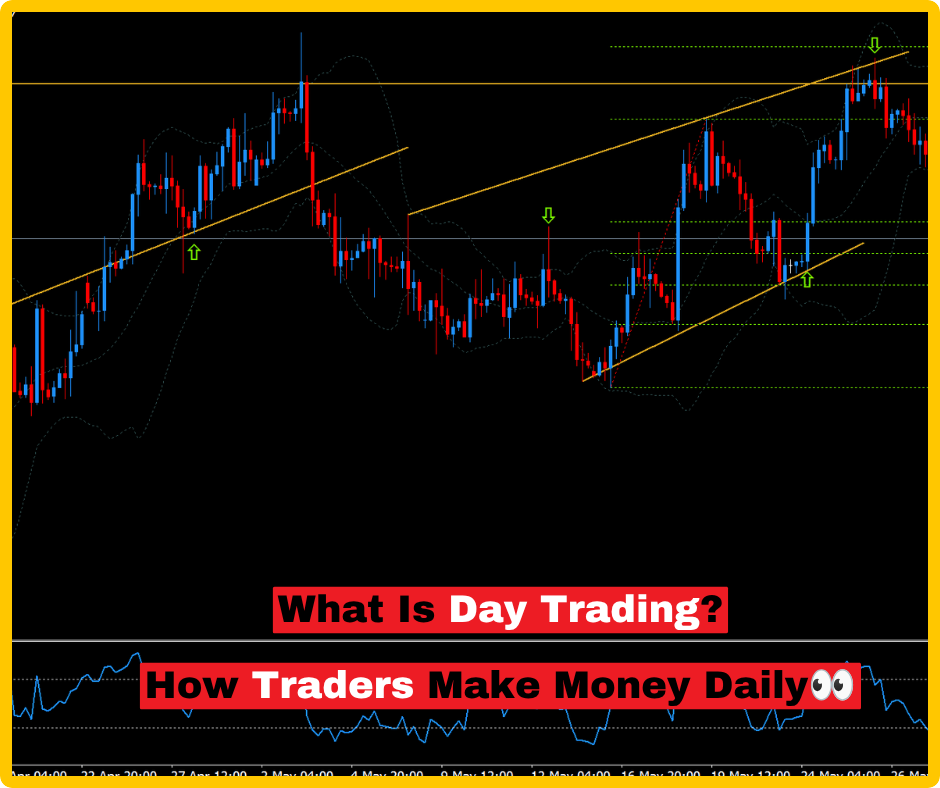
What Is Day trading is one of the most searched terms in financial markets today — and for good reason. Whether you are eyeing Bitcoin’s intraday swings or riding altcoin volatility, understanding day trading from the ground up can be the difference between consistent profits and a blown account. This guide covers everything: the definition, the legality, the Islamic perspective, the comparison with long-term investing, and whether Kraken is the right broker to get started.
What Is Day Trading and How Does It Actually Work?
At its core, day trading is the practice of buying and selling a financial asset within the same trading day. No position is carried overnight. Every trade opens and closes within hours, sometimes minutes, capturing short-term price movements rather than long-term market trends.
In the crypto space, this is especially potent. Bitcoin, Ethereum, and hundreds of altcoins move aggressively within a single 24-hour window, creating dozens of entry and exit opportunities every day. A skilled day trader reads price action, volume, and momentum to execute high-probability setups repeatedly.
The core mechanics rely on:
- Technical analysis: Chart patterns, moving averages, RSI, MACD, and Bollinger Bands guide entry and exit decisions.
- Risk management: Position sizing, stop-loss orders, and a disciplined risk-to-reward ratio protect capital.
- Execution speed: Fast order fills on a reliable exchange reduce slippage and maximize edge.
- Market liquidity: High-volume assets like BTC/USDT ensure orders execute at intended prices.
CONTINUE READING: Is Crypto Traceable? The Truth About Blockchain Privacy
What Is Pattern Day Trading and the PDT Rule?
Pattern day trading is a regulatory designation applied to traders who execute four or more round-trip day trades within any five consecutive business days — provided those trades represent more than 6% of total trading activity in that period.
Historically, the U.S. Financial Industry Regulatory Authority (FINRA) required pattern day traders to maintain a minimum account balance of $25,000 in their margin account. However, in a landmark regulatory shift, FINRA proposed scrapping the old rule in January 2026, and the SEC approved the proposal in April 2026. The new rules eliminating and replacing the PDT rule took effect on June 4, 2026, with an 18-month phase-in period available to brokers until October 2027.
For crypto traders, this rule has largely been irrelevant because crypto exchanges operate outside traditional securities regulation. You can trade Bitcoin intraday on Kraken or Binance without any PDT restrictions, regardless of account size.
Continue Reading: Hedera HBAR Price Prediction 2026 – Hidden Gem?
Is Day Trading Legal?
Yes, day trading is legal in the vast majority of countries, including the United States, United Kingdom, UAE, and across Europe. It is a legitimate financial activity regulated by bodies such as the SEC and FINRA in the U.S., the FCA in the UK.
Regulation varies by jurisdiction, but the activity itself is not prohibited. What differs country to country is:
- Licensing requirements for brokers and exchanges
- Tax treatment of short-term capital gains
- Leverage limits on retail accounts
- Restrictions on certain instruments like crypto derivatives
Always verify local tax obligations. In most jurisdictions, short-term trading profits are taxed as ordinary income, which is higher than long-term capital gains rates.
Is Day Trading Profitable? The Honest Data
This is where most guides avoid the truth. Day trading is profitable for a minority of consistent practitioners — and deeply unprofitable for the majority of beginners.
Research across global retail trading populations consistently shows that approximately 70% to 80% of retail day traders lose money over a 12-month period. The profitability gap typically comes down to:
- Emotional discipline: Fear and greed cause early exits or revenge trading after a loss.
- Strategy edge: Random entries with no statistical edge guarantee long-term losses.
- Fee drag: Even small per-trade fees compound into significant capital erosion over hundreds of trades.
- Leverage misuse: Amplified positions can wipe an account in a single bad trade.
That said, properly conducted, day trading can be hugely profitable. It requires significant discipline and experience to master, and even professional financial advisors tend to shy away from it. Those who succeed treat it as a full-time business, not a side activity.
Continue Reading: What Is Crypto Staking and How to Earn Passive Income
Is Day Trading Gambling? Understanding the Difference
This question is asked constantly, and the answer is nuanced. Gambling is driven by chance. Trading should be driven by informed judgment. Speed does not automatically equal reckless behavior, but reckless speed often does. If a method has rules and consistent risk limits, it does not resemble gambling. If a trader simply clicks and hopes, it does.
The key distinction is process vs. outcome thinking.
A gambler accepts random outcomes with fixed odds stacked against them. A disciplined day trader uses repeatable, rule-based strategies with a positive expected value over time. The presence of analysis, risk controls, and a defined trading plan separates professional trading from speculative gambling.
Day trading does become gambling-like when:
- Trades are entered without a clear setup or invalidation level
- Position sizes are doubled after losses in an attempt to recover
- The motivation is excitement rather than process execution
- Leverage is treated as a shortcut rather than a measured risk tool
Is Day Trading Haram? The Islamic Finance Perspective
This is one of the most searched questions among Muslim traders in the UAE, and across Southeast Asia. The answer is not a simple yes or no.
Islamic scholars are divided. Some believe day trading is haram because it resembles gambling, as traders buy and sell quickly without always assessing an asset’s real underlying value. Others think it can be halal, as long as certain rules are followed.
The primary Shariah concerns are:
- Riba (interest): Overnight swap fees on leveraged positions involve interest, which is prohibited. Intraday trading largely avoids this since positions are closed before rollover.
- Gharar (excessive uncertainty): Highly speculative trades with no analytical basis may fall under prohibited uncertainty.
- Maisir (gambling): Trading that relies purely on chance rather than skill and effort resembles gambling.
Day trading and options become haram specifically when they resemble gambling. For those making dozens of trades per day based on chart patterns alone, with no understanding of the underlying asset, this closely resembles maisir.
The practical guidance for Muslim traders is clear: use swap-free (Islamic) accounts, avoid short selling, base every trade on genuine analysis, and stay away from companies or assets operating in prohibited sectors. When trading is grounded in knowledge and structured risk management, many contemporary scholars consider it permissible.
Is Day Trading Worth It? Intraday vs. End of Day Trading
The question of whether day trading is worth it depends entirely on your goals, available time, risk tolerance, and psychological makeup.
Intraday Trading Pros and Cons
Intraday trading offers the highest potential return velocity. A skilled scalper can compound gains quickly within a single session. However, it demands constant screen time, near-instant decision-making, and ironclad emotional control. Transaction costs also accumulate faster.
End of Day Trading Pros and Cons
End-of-day trading suits those with careers or other commitments. Traders review charts after the market closes, set orders for the next session, and manage risk without watching tick-by-tick movements. The psychological pressure is lower, but so is the frequency of opportunities.
The honest verdict: For most people beginning their trading journey, end-of-day strategies are better starting points. They allow thorough analysis without reactive decision-making. Intraday trading is the superior approach for experienced, full-time traders with proven edge and capital.
Is Day Trading or Just Investing for Yourself Better?
This depends on what “better” means to you.
| Factor | Day Trading | Long-Term Investing |
|---|---|---|
| Time required | High (hours daily) | Low (review monthly) |
| Skill required | High (technical analysis) | Moderate (fundamental research) |
| Income frequency | Daily potential | Years-long horizon |
| Stress level | High | Low to moderate |
| Tax efficiency | Low (short-term rates) | High (long-term rates) |
| Barrier to entry | Low (capital + broker) | Low (any amount) |
For most individuals, a core-and-explore approach is optimal: the bulk of capital in a long-term portfolio (BTC, ETH, quality assets), with a smaller speculative allocation used for active day trading. This preserves wealth-building while allowing active market participation.
Is Kraken a Good Broker for Day Trading?
For crypto day traders, Kraken ranks among the top-tier options globally, and here is why.
Kraken launched in 2011, which in crypto years makes it practically ancient. That staying power means the exchange has weathered market downturns, regulatory shifts, and the collapse of competitors.
Key strengths for day traders:
- Fees: Kraken Pro fees range from 0% to 0.26%, compared to Coinbase which goes up to 1.49%. The platform uses a maker-taker fee schedule where rates decrease as 30-day trading volume increases.
- Leverage: Kraken offers futures leverage up to 50x on major cryptocurrencies, meaning a $100 deposit provides $5,000 in buying power.
- Asset selection: Kraken offers more than 550 cryptocurrencies and hundreds of trading pairs through its convert function.
- Advanced tools: Kraken Pro includes real-time market data, advanced charting tools, and customizable layouts available on both web and desktop platforms.
- Support: Kraken offers 24/7 live, multilingual phone support and a 24-hour web chat option.
The platform suits beginners and high-volume professionals alike. For traders managing significant capital, Kraken’s established security history offers greater confidence, particularly as a proven operator in U.S. markets with mature regulatory relationships.
The primary drawback is that some geographic regions face restrictions, and card deposit fees can be relatively high. For most traders, funding via bank transfer or crypto eliminates this issue.
Conclusion: What Is Day Trading and Should You Do It?
What is day trading comes down to this: it is a disciplined, skill-based approach to profiting from short-term price movements, executed within a single trading session. In crypto markets, it offers genuine opportunity given 24/7 operation and high daily volatility.
Day trading is legal globally, not inherently gambling when structured correctly, and can align with Islamic finance principles when executed through swap-free accounts with genuine analysis. It differs from long-term investing in time commitment, tax treatment, and required skill level.
Whether you choose intraday or end-of-day approaches, Kraken remains one of the most reliable platforms to execute a crypto day trading strategy in 2026. The critical differentiator between traders who succeed and those who fail is not the platform or even the strategy — it is consistent, rule-based discipline applied across hundreds of trades.
Start small, document every trade, and treat the learning phase as a tuition investment. The market will always be there. Your capital deserves protection while you develop genuine edge.
Frequently Asked Questions (FAQs)
How much money do I need to start day trading crypto?
There is no official minimum for crypto day trading (unlike U.S. stock PDT rules). Most exchanges allow trading with as little as $10 to $50. However, to meaningfully absorb losses while learning, a starting capital of $500 to $2,000 is a more realistic and responsible amount for beginners.
What is the best time of day to trade crypto?
Crypto markets operate 24/7, but volatility and volume peak during the overlap of the U.S. and European trading sessions — roughly 2:00 PM to 6:00 PM UTC. Bitcoin and Ethereum tend to see the sharpest intraday moves during these hours.
Can I day trade crypto without using leverage?
Absolutely, and for beginners, this is strongly recommended. Spot day trading means you only risk the capital you actually own. Leverage amplifies both gains and losses, and a single overleveraged trade can eliminate weeks of successful work.
What separates a successful day trader from one who fails?
The difference is almost never strategy. It is risk management and emotional discipline. Successful traders define their maximum loss per day (daily stop-loss), maintain a risk-to-reward ratio of at least 1:2 on every trade, keep a trading journal, and never deviate from their rules during a drawdown. Consistently following a process — even an imperfect one — outperforms brilliant but undisciplined trading every time.





Be First to Comment