
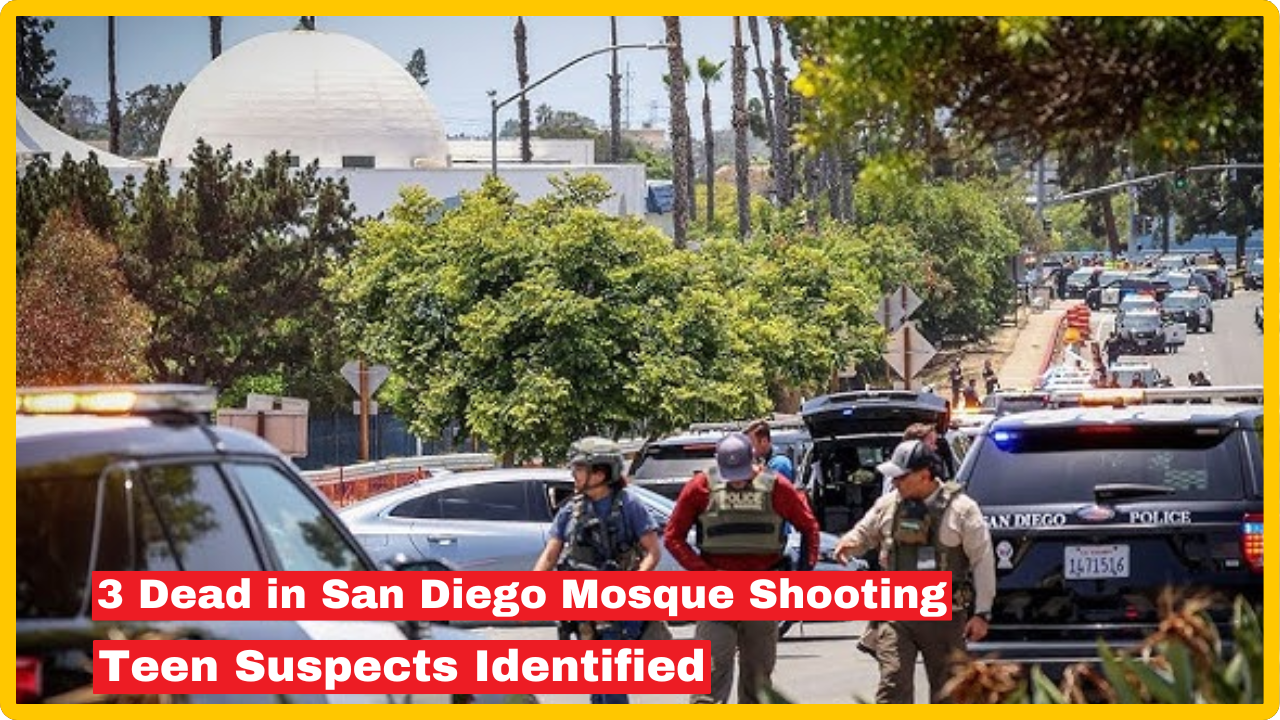
The San Diego shooting that unfolded on the morning of Monday, May 18, 2026, has left an entire city — and much of the nation – in mourning. Two teenage gunmen stormed the Islamic Center of San Diego, the largest mosque in San Diego County, killing three men before dying from self-inflicted gunshot wounds in a vehicle just blocks away.
Authorities are investigating the attack as a hate crime, and a manifesto laced with extremist ideology has been linked to the perpetrators. The tragedy occurred on the first day of Dhul Hijjah, one of Islam’s holiest periods, making the timing of the assault all the more devastating for the Muslim community.
San Diego Shooting: What Happened at the Islamic Center of San Diego
The events of May 18 began hours before the first shots were fired at the mosque. At 9:42 a.m., the San Diego Police Department received a 911 call from the mother of one of the perpetrators stating her son was missing, was suicidal, and was last seen wearing camo. She also said that her car — a white 2018 BMW X1 — and several of her firearms were missing.
Police immediately began attempting to locate the vehicle, dispatching units to a local mall and a school connected to one of the teens. They were still searching when the situation became catastrophic.
San Diego police reported that they were responding to reports of an active shooter at the mosque in the Clairemont neighborhood, roughly eight miles north of downtown San Diego, around noon local time on Monday. Officers arrived within four minutes of a 911 call to find three victims dead outside the Islamic Center.
A review of video shows that the suspects got into a gun battle with the security guard, who was killed outside the mosque. The security guard had managed to put out a lockdown protocol, which along with the sound of gunfire, allowed those in the main common areas of the mosque to go into hiding. There were approximately 140 children inside the facility at the time of the San Diego shooting.
The suspects moved room by room once inside but did not run into anyone. At one point, they are seen looking out a window, with one pointing to the window, before running out a nearby door, at which point they immediately engaged the two other victims outside in the parking lot.
Between 50 and 100 law enforcement officers entered the facility, breaching doors and searching room by room to secure the building. Police said around 1 p.m. local time that the threat had been neutralized.
Less than a quarter-mile from a landscaper who had been shot at but not struck, police found a vehicle in the middle of the street with the two teenagers believed to be the shooters inside. Both were dead.
San Diego Shooting Suspects: Who Were Cain Clark and Caleb Vazquez?
The two individuals identified as the perpetrators of the San Diego shooting were teenagers whose path to radicalization is now the subject of a major federal and local investigation.
The two gunmen were identified as Caleb Liam Vazquez, 18, of Chula Vista, and Cain Lee Clark, 17, of San Diego.
Cain Clark: The 17-Year-Old Online Student
Clark attended high school virtually and was set to graduate this month, according to a school district official. He also participated on the school’s wrestling team while he studied virtually — Madison would have been his high school if he had decided to attend in person. Clark was on the team for the 2024–25 season.
Longtime neighbors spoke to media, saying they last saw Clark a few hours before the shooting, waving as he got into the vehicle. They described his family as good neighbors and remembered when Cain was born, watching him and his older brother grow up.
In the manifesto, Cain described himself as a Christian ecofascist.
A Sonnenrad patch, depicting a neo-Nazi symbol, and what analysts assess is likely a patch for a militant accelerationist group, were both visible on the plate carrier worn by the person believed to be Clark. Additionally, writings were visible on a gun, including drawings of SS bolts and neo-Nazi insignias. Further symbols associated with neo-Nazism and militant accelerationism were found at the scene, including a flag with a Sonnenrad on it and a gas can with SS bolts drawn on it.
Caleb Vazquez: A History of Concern
According to ABC News, prior to the shooting, in 2025, the Chula Vista Police Department had spoken with Vazquez after a person who knew him expressed concern that Vazquez was interested in “extremist ideology and mass-casualty attacks.”
Despite that prior contact with law enforcement, no intervention or legal action appears to have occurred. That detail has since drawn intense scrutiny as investigators and the public ask whether the San Diego shooting could have been prevented.
In a later portion of the video livestreamed by the suspects, sources said the person believed to be Clark can be seen reaching into the backseat of the vehicle and then shooting Vazquez, before chambering a second round and taking his own life.
The Three Victims: Heroes in Their Final Moments
Every account from law enforcement and community leaders makes clear that the three men who died in the San Diego shooting acted with remarkable courage in the face of an unimaginable threat — and that their actions directly saved the lives of many others, including 140 children.
Amin Abdullah — The Security Guard
Abdullah immediately observed the threat as the suspects ran past him and began to engage them with gunfire, at which point both suspects returned fire.
Abdullah was hailed as a hero for having delayed, distracted, and ultimately deterred the suspects from targeting nearby areas of the mosque where there were as many as 140 kids. San Diego Police Chief Scott Wahl said that Amin Abdullah’s actions were pivotal in preventing more bloodshed.
Through tears, the daughter of Amin Abdullah called him a “loving father, husband, son, brother and uncle.” Her father was “all about education” and had dreamed more for his children. He took his job so seriously that he sometimes skipped taking breaks for meals out of fear something bad would happen. He stood against any form of hate and advocated for safety.
Sheikh Uthman Ibn Farooq, who had spoken with Abdullah’s son, said: “He wanted to defend the innocent, so he decided to become a security guard.”
Mansour Kaziha — The Caretaker Who Called for Help
Kaziha, a longtime cook, handyman, and caretaker at the Islamic center, was the first at the center to dial 911. Imam Taha Hassane said of him: “He was everything. I don’t know what I’m going to do at the Islamic Center without his assistance.”
Community members identified Kaziha, 78, who was known as Abu Ezz, as a man who had played a central role in responding to the assailants.
Nader Awad — The Neighbor Who Ran Toward Danger
Awad’s wife is a teacher at the Islamic school at the mosque, and Awad was a constant presence there. When he heard the shooting, he rushed toward it. Imam Hassane said: “He joined Mansour Kaziha. They died together.”
Kaziha and Awad were killed as they tried to draw the attention of the suspected shooters away from the mosque and into the parking lot.
The Manifesto and Hate Crime Investigation
Investigators are working to authenticate a document filled with extremist material posted online espousing anti-Islamic, antisemitic, and anti-LGBTQ views that purportedly details the perpetrators’ motivations, three senior law enforcement officials said.
Investigators are also examining the degree to which the attack could be tied to nihilistic violent extremism. The combination of a live-streamed video, neo-Nazi imagery, a written manifesto, and a targeted attack on a house of worship during a holy period has led federal authorities to treat the case as one of the most serious hate-motivated attacks in recent California history.
The Council on American-Islamic Relations noted that the attack comes amid rising anti-Muslim bias nationwide, citing a record 8,683 complaints of discrimination and Islamophobia reported in 2025.
Community, City, and National Response
The San Diego shooting provoked an outpouring of grief and solidarity at every level of government and civil society.
San Diego Mayor Todd Gloria issued a condemnation of the shooting on X, stating: “Anyone who seeks to do harm here should understand the response will be swift and you will be brought to justice.”
California Governor Gavin Newsom and First Partner Jennifer Sibel Newsom said in a statement that they were “horrified” by the attack, adding: “Worshippers anywhere should not have to fear for their lives.”
The Los Angeles Police Department announced it was stepping up patrols around mosques, Islamic centers, and other places of worship across the city. The New York Police Department also announced the deployment of more officers to mosques across New York City.
President Donald Trump called the shooting a “terrible situation” and stated: “I’ve been given some early updates but we’re going to be going back and looking at it very strongly.”
Clark’s grandfather released a statement following the shooting, saying: “We’re very sorry for what happened” and “It’s a shock.”
A candlelight vigil was held the evening of Tuesday, May 19, just a short walk from the mosque. Imam Taha Hassane, the director of the Islamic Center of San Diego, opened with prayers and said: “We used to sometimes watch horrible news coming from different parts of the world where a shooting takes place, and we see on TV the casualties, we see the frustration, we see the sorrow of that community — but when it happens at your home it is different. When you lose the pillars of the community, it is different.”
The Islamic Center of San Diego announced it would reopen on Wednesday for fajr prayers, a symbol of the community’s resolve to continue worshipping in the face of terror.
Conclusion
The San Diego shooting at the Islamic Center on May 18, 2026 stands as one of the most devastating hate-motivated attacks on a house of worship in recent American history. Three men — Amin Abdullah, Mansour Kaziha, and Nader Awad — gave their lives in the act of protecting their community, and their heroism prevented what could have been an even larger massacre.
As investigators continue to examine the manifesto, the suspects’ backgrounds, and the prior warning signs that went unaddressed, the nation is once again confronting urgent questions about radicalization, extremism, and the safety of religious spaces in America.
In light of the warning signs that were reported to law enforcement about one of the suspects a year before the attack, what changes – if any — do you think should be made to how authorities respond to reports of extremist ideology in young people?
Frequently Asked Questions (FAQ)
Q1: Who were the suspects in the San Diego mosque shooting, and what happened to them?
The two suspects identified in the San Diego shooting at the Islamic Center were Cain Lee Clark, 17, of San Diego, and Caleb Liam Vazquez, 18, of Chula Vista. Both were found dead in a vehicle a short distance from the mosque, having died from self-inflicted gunshot wounds following the attack.
Q2: Who were the three victims killed in the San Diego Islamic Center shooting?
The three men killed were Amin Abdullah, 51, an armed security guard at the mosque who engaged the gunmen and was credited with preventing further casualties; Mansour Kaziha, 78, a longtime cook and caretaker who was the first to call 911; and Nader Awad, a community member who lived across the street and rushed toward the shooting to help. All three were praised by police and community leaders as heroes.
Q3: Is the San Diego mosque shooting being investigated as a hate crime?
Yes. The San Diego Police Department and federal authorities confirmed that the shooting at the Islamic Center of San Diego is being investigated as a hate crime. Investigators are working to authenticate an extremist manifesto posted online by the suspects containing anti-Islamic, antisemitic, and anti-LGBTQ content, and are also examining links to neo-Nazi and militant accelerationist ideology based on symbols and materials found at the scene and on the suspects.


Be First to Comment