
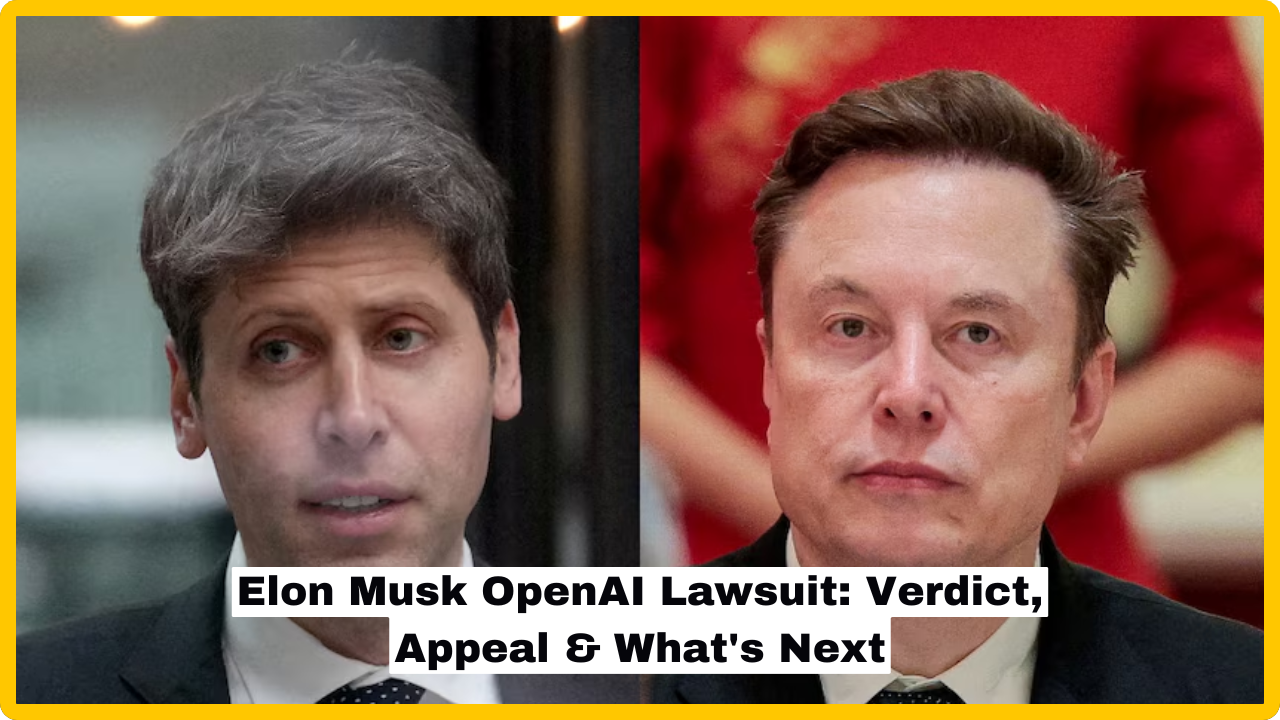
In one of the most closely watched legal battles in Silicon Valley history, a federal jury in Oakland, California, has ruled against Elon Musk in his high-profile Elon Musk OpenAI lawsuit. The verdict, delivered in less than two hours on May 18, 2026, marks a decisive — if procedural — win for OpenAI CEO Sam Altman and a significant setback for the world’s richest man.
But the story is far from over. Musk has already vowed to appeal, and the questions at the heart of the case — Who controls AI? Who benefits from it? And what happens when a charity becomes a trillion-dollar business? — will continue to define the future of artificial intelligence.
Here is everything you need to know about the Elon Musk OpenAI lawsuit: the background, the trial, the verdict, and what happens next.
What Was the Elon Musk OpenAI Lawsuit About?
To understand why Musk sued OpenAI, you have to go back to the beginning.
In 2015, Elon Musk co-founded OpenAI alongside Sam Altman, Greg Brockman, and several AI researchers. The original mission was bold and idealistic: to develop artificial intelligence safely, for the benefit of all of humanity — not for profit. Musk donated roughly $38 million in those early years, bankrolling a nonprofit lab that was supposed to keep AI out of the hands of any single corporation.
Then, over the next several years, OpenAI changed — dramatically.
In 2019, the organization created a for-profit subsidiary, allowing investors and employees to earn capped returns. Microsoft invested $1 billion. Then, in 2023, Microsoft poured in $10 billion more, receiving intellectual property rights and a share of future profits. By 2026, OpenAI was valued at approximately $852 billion and was moving toward what analysts expect to be one of the largest initial public offerings (IPOs) in history.
Musk, who had left OpenAI’s board in 2018, was furious. In February 2024, he filed the Elon Musk OpenAI lawsuit, accusing Altman, Brockman, and Microsoft of “stealing a charity” — abandoning a sacred commitment to humanity in the pursuit of personal wealth.
The Key Claims Musk Made in Court
The Elon Musk OpenAI lawsuit was built on several core allegations:
- Breach of charitable trust: Musk argued that OpenAI had violated its founding agreement to remain a nonprofit dedicated to public benefit.
- Unjust enrichment: He claimed that Altman and Brockman had enriched themselves at the expense of OpenAI’s charitable mission.
- Microsoft’s role: Musk alleged that Microsoft knew about and actively aided this alleged breach through its massive investment in OpenAI’s for-profit arm.
Musk’s legal team sought staggering remedies — demanding that OpenAI and Microsoft return up to $180 billion in alleged wrongful gains, that Altman and Brockman be removed from their leadership positions, and that OpenAI’s corporate restructuring be entirely unwound.
What Happened During the Trial?
The trial began on April 27, 2026, in the courtroom of U.S. District Judge Yvonne Gonzalez Rogers, and ran for three weeks. It was, by any measure, a spectacle unlike anything Silicon Valley had seen.
The witness list read like a who’s who of the tech industry: Sam Altman testified. So did Greg Brockman, OpenAI’s co-founder and president. Microsoft CEO Satya Nadella took the stand. And Elon Musk himself testified — making the rare move of appearing in court to argue his own case.
Hundreds of pages of private emails, internal text messages, and meeting notes were submitted as evidence. Personal details emerged that had never been made public, including Brockman’s private diaries and texts between Musk and Meta CEO Mark Zuckerberg discussing a potential joint bid to acquire OpenAI together.
Perhaps most surprisingly, the trial revealed that Musk himself had, at various points, floated the idea of creating a for-profit structure for OpenAI — on the condition that he retain control. OpenAI’s attorneys argued this was critical: Musk’s objection was never really about nonprofit principles; it was about power.
Mr. Musk may have the Midas touch in some areas, but not in AI,”
OpenAI’s lead attorney, William Savitt, told the jury in closing arguments.
The Verdict: Why Did Musk Lose?
The jury’s decision did not come down to whether OpenAI had truly betrayed its founding mission. Instead, it came down to a much more technical legal issue: the statute of limitations.
The jury found, unanimously, that Musk had waited too long to file his lawsuit. Under California law, claims must be filed within a specific time window from when the plaintiff became aware of the wrongdoing. The jury determined that Musk had reason to sue as early as 2021, when OpenAI’s commercial direction had become unmistakably clear — meaning his 2024 lawsuit was filed years past the legal deadline.
Judge Yvonne Gonzalez Rogers accepted the jury’s findings immediately, stating she had “a substantial amount of evidence” to support their conclusion.
OpenAI’s legal team framed the outcome bluntly. “This lawsuit is a hypocritical attempt to sabotage a competitor,” attorney William Savitt declared after the verdict. “They kicked it exactly where it belongs — just to the side.”
The ruling also rejected Musk’s claims against Microsoft, with a spokesperson confirming the company remained committed to its partnership with OpenAI going forward.
How Did Musk Respond?
True to form, Musk did not take the loss quietly.
Within hours of the verdict, he posted on X — the social media platform he owns — calling the decision a “calendar technicality” and attacking Judge Gonzalez Rogers as a “terrible activist judge.” He insisted that the jury and the court had never actually ruled on the substance of his claims — only on the timing.
“There is no question to anyone following the case in detail that Altman and Brockman did in fact enrich themselves by stealing a charity,” Musk wrote. “The only question is WHEN they did it!”
His legal team immediately signaled plans to appeal the decision to the Ninth Circuit Court of Appeals. Musk’s attorney, Steven Molo, told reporters the appeal would be based in part on a legal theory called the “continuing violation doctrine,” which can extend statutes of limitations when there is an ongoing pattern of wrongful behavior — a concept the trial judge had refused to include in jury instructions.
Musk’s other attorney, Marc Toberoff, offered a characteristically terse summary when reached for comment: “One word: Appeal.”
What Does the Verdict Mean for OpenAI?
For OpenAI, the verdict removes a significant existential threat — at least for now.
Had Musk won, the court could have forced OpenAI to restructure entirely, potentially derailing its plans for a historic IPO. With that threat gone, Altman and his team can focus on what’s next: expanding its products, deepening its partnership with Microsoft, and preparing for a public offering that analysts believe could value the company in the trillions.
“OpenAI is a not-for-profit, mission-driven organization that has been and will continue to be faithful to that mission,” Savitt said after the verdict.
That claim will continue to be contested — including in ongoing proceedings by state attorneys general who are separately reviewing OpenAI’s nonprofit obligations as part of its corporate restructuring process.
The Bigger Picture: AI, Power, and Accountability
Whatever you think of Elon Musk or Sam Altman personally, the Elon Musk OpenAI lawsuit raised questions that extend far beyond two billionaires fighting in court.
Who controls AI? OpenAI started as a public-interest nonprofit. It is now a company worth nearly $1 trillion, majority-backed by a single corporation — Microsoft. The transition happened largely outside of public view, and no regulatory body formally approved it.
Who benefits from AI? The original OpenAI mission explicitly stated that the technology should benefit all of humanity. Today, OpenAI’s most powerful models are commercial products behind paywalls, and its most significant investors stand to gain enormous wealth.
Can charities be held to their founding promises? This is perhaps the most lasting legal question the case raised — and the statute of limitations ruling means it was never definitively answered. Musk’s appeal, whatever its outcome, will keep this question alive in the courts.
These are not just legal questions. They are among the most important societal questions of our time. As AI systems grow more powerful and more deeply embedded in daily life, the governance structures around them matter enormously. The Musk-Altman courtroom drama was, in many ways, a proxy battle for a much larger debate about whether the development of transformative AI can be trusted to a small group of profit-motivated actors.
What Happens Next?
The Elon Musk OpenAI lawsuit is not over. Here is a quick timeline of what to expect:
- Musk’s appeal to the Ninth Circuit is expected to be filed in the coming months. Legal experts say appeals focused on statute of limitations rulings face a high bar, but the continuing violation doctrine argument is not without merit.
- OpenAI’s IPO is expected to move forward following the verdict. Analysts had cited the lawsuit as a potential obstacle; with it dismissed, the path appears clearer.
- State-level scrutiny of OpenAI’s nonprofit-to-for-profit conversion will continue independently of this case.
- The AI industry will be watching closely. Both xAI (Musk’s company) and OpenAI are racing toward public markets in what is expected to be a defining period for the sector.
Frequently Asked Questions About the Elon Musk OpenAI Lawsuit
Why did Elon Musk sue OpenAI?
Musk sued because he believed OpenAI violated its founding promise to remain a nonprofit dedicated to benefiting humanity, instead transforming into a profit-driven company worth hundreds of billions of dollars.
Did Elon Musk win his lawsuit against OpenAI?No. A federal jury ruled against Musk in May 2026, finding that his lawsuit was filed outside the statute of limitations. He has announced plans to appeal.
What did Musk want from the lawsuit?
Musk sought up to $180 billion in damages paid back to OpenAI’s nonprofit arm, the removal of Sam Altman and Greg Brockman from leadership, and a reversal of OpenAI’s corporate restructuring.
Is Musk appealing the OpenAI verdict?
Yes. Musk and his legal team have confirmed they will appeal the decision to the U.S. Ninth Circuit Court of Appeals.
How much did Musk donate to OpenAI?
Musk donated approximately $38 million to OpenAI in its early years as a nonprofit.
What is OpenAI worth now?
As of the time of the trial, OpenAI was valued at approximately $852 billion, with an expected IPO that could push that valuation even higher.
Final Thoughts
The Elon Musk OpenAI lawsuit will be remembered as one of the most dramatic corporate legal battles of the AI era. It pulled back the curtain on how the most powerful artificial intelligence company in the world was built, who funded it, what promises were made, and how those promises were — or were not — honored.
The jury’s verdict may have settled the immediate legal question. But the deeper questions it raised about AI governance, nonprofit accountability, and the concentration of technological power in the hands of a few remain wide open.
And with Musk’s appeal headed for the Ninth Circuit, the legal chapter is not yet closed either.
For more coverage of AI, technology, and legal battles shaping the future, explore our latest articles below.



Be First to Comment