
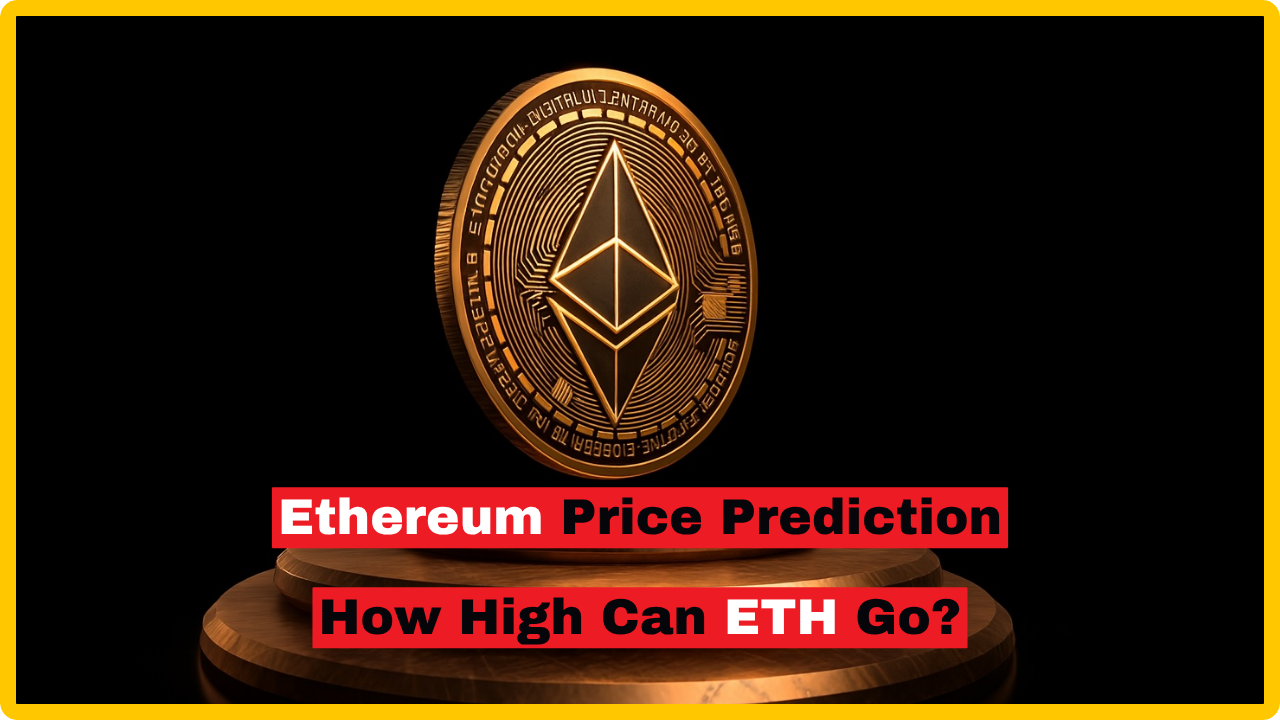
Ethereum price prediction 2026 is the most searched crypto question right now — and for good reason. ETH hit an all-time high near $4,954 in August 2025, then shed over 55% of its value by early 2026. Today, with ETH trading around $1,970, traders are demanding answers: Is this a buying opportunity or a value trap? Here’s what the data, institutional positioning, and on-chain fundamentals actually say.
Why 2026 Is a Pivotal Year for Ethereum
Three forces are converging simultaneously in 2026 that make this year unlike any before for ETH:
- The Glamsterdam upgrade — the most consequential execution-layer overhaul in years — went live in late May 2026, slashing gas fees by ~78% and setting all-time high daily transaction records.
- Spot ETH ETFs have now accumulated over $11.6 billion in cumulative net inflows, with BlackRock’s staking-enabled ETHB product launching on Nasdaq in March 2026.
- Regulatory clarity is arriving via the CLARITY Act, cementing Ethereum’s status as a commodity and opening the door for traditional finance integration at scale.
This isn’t speculation — these are live, measurable developments reshaping ETH’s supply/demand dynamics right now.
Ethereum Price Prediction 2026: What Analysts Say
The range of forecasts is unusually wide — a reflection of genuine uncertainty and competing macro narratives.
Institutional and Expert Price Targets for ETH in 2026
| Forecaster | Prediction | Scenario |
|---|---|---|
| Standard Chartered | $7,500 | Base case, year-end |
| Citigroup | $3,175 | Conservative average |
| Tom Lee (Fundstrat) | $12,000 | Base case |
| InvestingHaven | $1,800 – $3,500 | Range |
| Jeremy Britton (BostonTrading) | $9,000 | Bull case |
| Alexander Kuptsikevich (FxPro) | $2,000 | Bear/cautious |
| Polymarket Prediction Markets | ~34.5% chance of $3,500+ | Market consensus |
The majority analyst base case clusters between $2,800 and $4,200 by year-end 2026, assuming Glamsterdam delivers, ETF inflows stay positive over 90 days, and staking yield holds above 3%.
Bull, Base, and Bear Case Breakdown
🐂 Bull Case ($6,500 – $9,000) Requires a Q3/Q4 risk-on rotation in equities, a weakening US Dollar Index, sustained ETF inflows above $50M/month, and DeFi Total Value Locked (TVL) crossing $300 billion. If Hegotá (the second 2026 upgrade) deploys cleanly and sovereign wealth funds enter, some analysts see a path to $8,000–$9,000.
📊 Base Case ($2,800 – $4,200) The most credible scenario according to the majority of serious forecasters. ETH reclaims $3,000 and tests the $3,600 resistance zone as Glamsterdam’s fee reduction attracts renewed DeFi and RWA activity.
🐻 Bear Case ($1,500 – $2,200) A US recession, rising interest rates reducing crypto’s yield appeal versus risk-free government bonds, or a regulatory setback could keep ETH range-bound or lower.
The Glamsterdam Upgrade: Why It Changes Everything
If there’s one catalyst that defines the ethereum price outlook for H2 2026, it’s Glamsterdam.
What Glamsterdam Actually Does
The upgrade, which went live in late May 2026, introduced three core changes:
- Parallel transaction processing — dramatically increasing throughput toward 10,000 transactions per second (TPS)
- EOF (EVM Object Format) activation — cleaner smart contract bytecode, lowering audit costs for institutional deployers
- Enshrined Proposer-Builder Separation (ePBS) — decentralizing block building and tightening MEV windows
The result? Gas fees down ~78%. A Uniswap swap that cost $200 in 2021 peak congestion now costs fractions of a cent. The network just processed all-time high daily transactions — while simultaneously posting historically low fees. That combination has never happened before on Ethereum.
Why Markets Are Slow to Price This In
As one analysis noted, AWS didn’t make Amazon’s stock jump the week it launched either. Infrastructure improvements compound over quarters. With ETH still trading well below its cycle highs, the Glamsterdam catalyst has not fully landed in price yet — which is precisely why institutional desks are paying attention.
Spot ETH ETFs and the Supply Shock Thesis
Institutional positioning in 2026 is fundamentally different from any prior cycle.
BlackRock’s ETHB — its staking-enabled Ethereum ETF — launched on Nasdaq in March 2026, staking 70–95% of holdings and distributing monthly yield to shareholders. This creates what analysts describe as a “strategic ETH reserve dynamic”: large, yield-motivated institutional holders with long time horizons who don’t trade on short-term sentiment.
Simultaneously, approximately 30% of all circulating ETH (roughly 37 million tokens) is staked across 1.1 million active validators. Add another 18 million ETH locked in DeFi protocols, and over half of all Ethereum supply is effectively illiquid.
The supply shock thesis is straightforward: any sustained demand increase — from ETF inflows, corporate treasury accumulation, or broader market rotation — hits a historically thin liquid float. The math is asymmetric to the upside.
Ethereum’s 2026 Upgrade Roadmap: Glamsterdam Is Just the Beginning
Ethereum has committed to a twice-a-year upgrade schedule, and 2026 has two major hard forks:
Glamsterdam (H1 2026 — Now Live)
- Parallel execution, ePBS, EOF activation
- 78% gas fee reduction, ATH transaction throughput
- Institutional staker exit queue significantly improved
Hegotá (H2 2026 — Upcoming)
- Verkle Trees introduction (moving toward statelessness)
- Enhanced censorship resistance
- Stronger 128-bit security architecture
Cathie Wood’s ARK Invest projected Ethereum’s market cap could reach $20 trillion by 2032, implying a per-token price of approximately $166,000 based on current circulating supply. While that target is long-horizon and speculative, it signals the size of the institutional thesis being built around ETH’s infrastructure role.
Ethereum vs. Competitors: Does ETH Still Have the Edge?
The narrative that Solana, Base, or emerging L1s are “Ethereum killers” has been tested against actual data in 2026.
Layer 2 networks — Arbitrum, Optimism, Base, zkSync — now handle roughly 95% of total Ethereum transaction throughput. Rather than cannibalizing the base layer, they’re reinforcing it: each L2 settles back to Ethereum mainnet, driving demand for ETH as the ultimate settlement asset.
Ethereum also commands 52% market share of the tokenized real-world assets (RWA) sector, which has grown to $180 billion. Stablecoins, tokenized Treasuries, and institutional debt instruments are predominantly issued on Ethereum. This isn’t a speculative use case — it’s live revenue and activity.
Key Risks That Could Suppress ETH Price in 2026
No honest analysis ignores the downside scenarios:
- Macro headwinds — Rising interest rates make risk assets less attractive. A US recession would slash institutional risk appetite and delay ETF inflows.
- Upgrade execution risk — Hegotá introduces Verkle Trees, a complex architectural change. Any implementation setback would create a negative news cycle.
- Sell-the-news dynamics — Technical upgrades are often priced in ahead of delivery. Post-Glamsterdam consolidation is a real possibility before the next leg up.
- ETH/BTC ratio weakness — Many bull-case scenarios require ETH to outperform Bitcoin significantly. If BTC dominance continues rising, ETH outperformance isn’t guaranteed.
- DeFi/RWA growth stalling — The base and bull cases rely on TVL expansion and RWA inflows sustaining. A regulatory reversal or major protocol exploit could halt both.
Is Ethereum a Good Investment in 2026?
This is the question every trader is asking, and the honest answer depends entirely on time horizon and risk tolerance.
Short-term (next 3 months): The market is searching for direction. Without a confirmed volume breakout above the $2,500–$3,000 zone, ETH remains in a recovery pattern. Macro uncertainty and the post-Glamsterdam “sell the news” overhang are real risks.
Medium-term (H2 2026): The technical setup is the strongest it’s been in years. Glamsterdam has delivered. Hegotá is incoming. ETF staking yield is attracting long-horizon capital. The base case of $3,500–$4,200 by year-end is achievable under normal risk conditions.
Long-term (2027 and beyond): Standard Chartered projects $15,000 by 2027. Finder’s panel of 45+ analysts averages $11,712 for ETH by 2030. The infrastructure thesis — ETH as the global settlement layer for stablecoins, RWAs, and institutional DeFi — is being actively built out, not just theorized.
The structural picture is compelling. But ETH has a history of requiring patience.
Ethereum Price Prediction 2026: Month-by-Month Outlook
| Period | Estimated Range | Key Driver |
|---|---|---|
| June 2026 | $1,972 – $2,365 | Glamsterdam integration, post-ATH recovery |
| Q3 2026 (Jul–Sep) | $2,200 – $3,500 | ETF inflows, Hegotá anticipation |
| Q4 2026 (Oct–Dec) | $2,400 – $4,200+ | Year-end institutional allocation, Hegotá delivery |
| Peak Bull Scenario | $6,500 – $9,000 | Full catalyst stack fires |
Frequently Asked Questions (FAQs)
What is the realistic Ethereum price target for end of 2026?
The majority consensus among institutional analysts and research desks places the realistic year-end 2026 target between $2,800 and $4,200, with Standard Chartered holding the most bullish institutional call at $7,500. The base case assumes Glamsterdam’s fee reduction drives renewed network activity, ETF inflows remain positive, and macro conditions stabilize.
Will Ethereum reach $5,000 in 2026?
It’s possible but not the base case. Reaching $5,000 requires the bull scenario to materialize: sustained ETF inflows above $50M/month, DeFi TVL crossing $300 billion, Hegotá deploying smoothly, and a broader risk-on rotation in global equities. Prediction market data currently gives ETH a 34.5% probability of reaching even $3,500 by year-end, suggesting $5,000 would require significantly more favorable conditions.
How does the Glamsterdam upgrade affect ETH price?
Glamsterdam reduces gas fees by ~78% and enables 10,000 TPS, which structurally lowers the barrier to DeFi, RWA, and institutional smart contract activity. More network activity means more ETH burned (via EIP-1559), reducing circulating supply. The price impact is historically a lagging effect — infrastructure improvements take quarters to fully reflect in price, making the current undervaluation potentially significant.
Is Ethereum better than Bitcoin as an investment in 2026?
ETH and BTC serve different investment theses. Bitcoin is primarily a store of value and macro hedge; Ethereum is a programmable settlement layer with yield, utility, and institutional adoption drivers. In 2026, ETH’s staking yield (~3.2% APR) and supply lockup story make it uniquely attractive for yield-seeking institutional capital. However, ETH has historically underperformed BTC in risk-off environments. Standard Chartered has explicitly called 2026 “the year of Ethereum” — but BTC dominance trends remain a key variable to watch.
What is the biggest risk to Ethereum’s 2026 price prediction?
The single biggest risk is a US recession combined with rising interest rates. This would reduce the appeal of crypto yield vs. risk-free government bonds, stall institutional ETF inflows, and delay corporate treasury allocations. Secondary risks include Hegotá upgrade delays, DeFi exploit contagion, or a significant deterioration in the ETH/BTC ratio driven by continued Bitcoin dominance.
Conclusion
The ethereum price prediction 2026 story is ultimately about whether a fundamentally stronger network — one with lower fees, higher throughput, institutional-grade ETF products, and a shrinking liquid supply — can convert its structural improvements into price recovery.
The technical and on-chain evidence is more compelling today than at any point since Ethereum’s Merge in 2022. The Glamsterdam upgrade has delivered. Institutional capital is positioning through ETFs. Over half of all ETH is locked or staked. And two more upgrades remain on 2026’s calendar.
What’s missing is the macro tailwind. When that turns, the setup is already in place.
Range to watch: $2,800 – $4,200 base case by year-end 2026. $6,500+ if the full catalyst stack fires.
Disclaimer: This article is for informational purposes only and does not constitute financial advice. Cryptocurrency markets are highly volatile. Always conduct your own research and consult a qualified financial advisor before making investment decisions.



Be First to Comment