
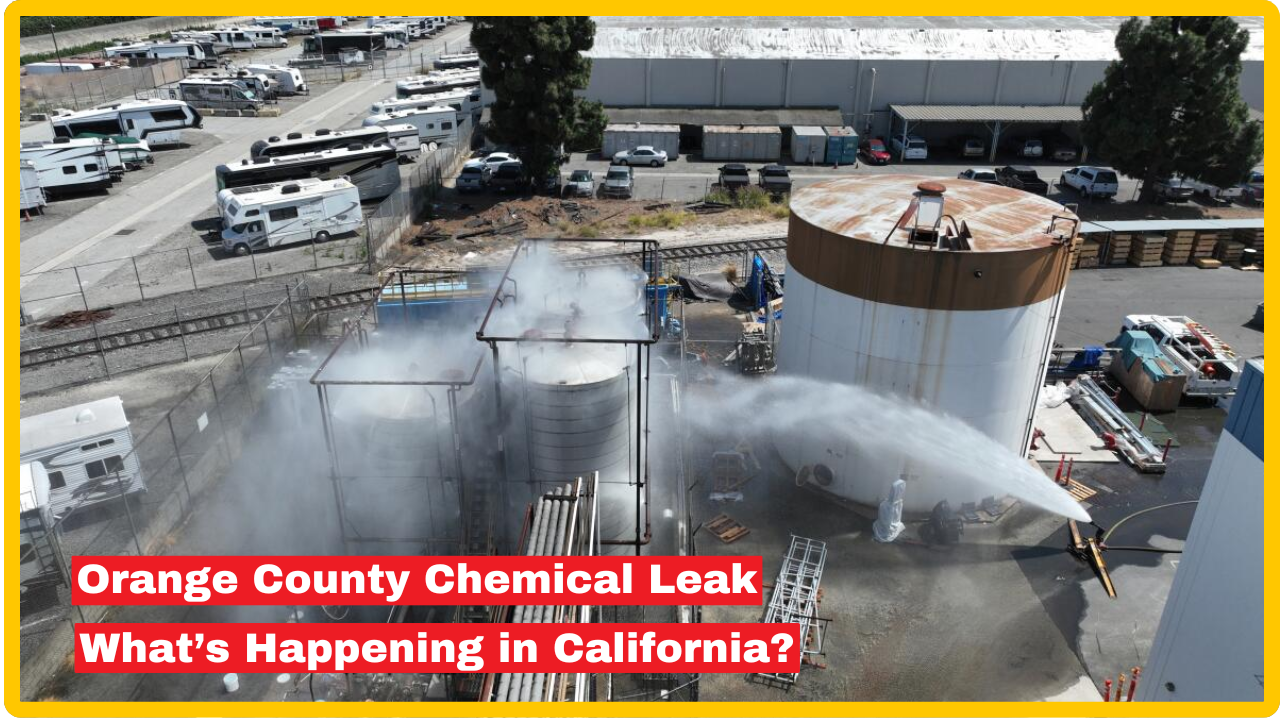
The Orange County chemical leak crisis stretching from Garden Grove across six surrounding cities has now entered its fourth day with no resolution in sight — but a cautious glimmer of hope emerged Sunday morning when fire officials revealed that a potential crack in the compromised methyl methacrylate tank at the GKN Aerospace facility may be naturally relieving pressure that had put tens of thousands of residents at risk of a catastrophic explosion.
As of Sunday, May 24, 2026, approximately 50,000 people remain under mandatory evacuation orders, California Governor Gavin Newsom’s state of emergency remains active, the Orange County District Attorney has launched a criminal probe, and a class-action lawsuit against GKN Aerospace has already been filed on behalf of displaced residents.
Orange County Chemical Leak Latest Update: A Crack in the Tank Could Change Everything
The development that shifted the tone of Sunday’s briefings came from an overnight reconnaissance mission carried out by fire crews who risked entering the danger zone to get eyes directly on the troubled tank.
“Our firefighters went in, and they were able to visualize the tank. What they found was a potential crack in the tank, which could potentially be relieving some of the pressure in there,”
Orange County Fire Authority Interim Fire Chief TJ McGovern said Sunday. McGovern said the discovery was “a step in the right direction” and asked the public for their patience. McGovern told reporters there is currently no leak or impact on air quality, adding that continuous air monitoring at the scene has shown readings remain within normal limits and nothing is currently escaping from the tank.
A damaged chemical tank in Southern California may have cracked — potentially lowering the risk of a cataclysmic explosion — though an evacuation order remains in effect for some 50,000 area residents with no timeline on when they can return, a fire official said Sunday. Orange County Fire Authority Capt. Wayhowe Huang said officials will be continuing to evaluate the tank Sunday after emergency crews spotted the potential crack overnight.
If confirmed, the crack could alter the entire response strategy — allowing crews to potentially scale back the evacuation zone as the immediate explosion risk diminishes. However, officials cautioned that nothing has been confirmed yet and that residents must stay out of the evacuation zone until authorities provide a formal all-clear.
How the Orange County Chemical Leak Began: A Timeline
The whole ordeal began around 3:30 p.m. Thursday when a leak was reported at the GKN Aerospace facility at 12122 Western Avenue in Garden Grove, California.
The 34,000-gallon storage tank at the facility began releasing methyl methacrylate — a colorless, highly volatile, and flammable liquid used to manufacture acrylic plastics, including Plexiglass. In the early hours after crews arrived, the situation appeared manageable. Then, approximately four hours into the response, temperatures inside the tank began to rise, activating both a pressure relief valve and an overhead sprinkler cooling system.
By Friday morning, the situation had become what one 32-year veteran fire division chief described as the worst he had ever seen. Despite what initially appeared to be progress cooling the tank from the outside using a continuous stream of water, internal temperature readings obtained during an overnight crew incursion showed the temperature rising at approximately one degree per hour — reaching 95 degrees Fahrenheit at its peak.
Fire officials described only two likely outcomes unless a solution was found: the tank fails and spills 6,000 to 7,000 gallons of highly toxic MMA into the surrounding parking lot, or the tank goes into thermal runaway and explodes — triggering secondary explosions from other chemical storage vessels at the facility.
“Or two, the tank goes into a thermal runaway and blows up, affecting the tanks that are around it that have fuel or chemicals in them as well,” Orange County Fire Authority Division Chief Craig Covey said.
On Saturday, Covey acknowledged his team was evaluating potential third options, offering a cautious note of optimism. Sunday’s crack discovery appears to be one potential version of that third path.
The Evacuation Zone: Six Cities, 50,000 People
The Orange County chemical leak evacuation zone has grown significantly since the crisis began, now encompassing a defined perimeter across multiple communities.
Residents and commuters are being strongly urged to avoid the designated evacuation zone, which spans from Ball Road to Trask Avenue and from Dale Street to Valley View Street.
The affected cities include Garden Grove at the center of the incident, as well as Cypress, Stanton, Anaheim, Buena Park, and Westminster. Evacuation orders were expanded Friday as fire crews determined they could not stop the leak overnight.
About 15% of people — or about 6,000 residents — from the evacuation area had refused to leave, Garden Grove Police Chief Amir El-Farra said. Some school districts in the evacuation zone announced they would be moving to online learning.
Shelters were opened at multiple locations, including the Freedom Hall in Fountain Valley and Savanna High School in Anaheim, which stayed open throughout the Memorial Day weekend. The American Red Cross deployed teams throughout the region, and California state-owned properties were made available for additional shelter capacity following the governor’s emergency declaration.
In an update Saturday evening, Harry Allen with the EPA said the agency had deployed 24 stationary monitors, which operate around the clock and have not picked up any contaminants. Air should be safe outside the evacuation zone, said the state’s chief air quality officer, urging people to leave the affected area.
Disneyland and Knott’s Berry Farm: What Visitors Need to Know
The proximity of the GKN Aerospace facility to two of Southern California’s most iconic tourist destinations has prompted widespread questions from visitors and concerned families planning Memorial Day weekend trips.
The industrial facility sits just a few miles from some of Southern California’s premier tourist attractions, including Disneyland and Knott’s Berry Farm. The hazardous materials incident is located approximately six miles from Disneyland and four miles from Knott’s Berry Farm.
Disneyland Resort is approximately five miles from the incident and at this time is not inside the evacuation zone. While the situation remains fluid and there may be road closures and minor traffic disruptions, there is no direct impact on park operations at this time. Disneyland is actively monitoring the situation and taking guidance from local authorities.
While blast zone maps released by officials indicate that several residential neighborhoods remain at risk, emergency personnel have confirmed that the region’s major entertainment venues are secure. The OCFA emphasized that an explosion could result in severe structural damage and significant harm for any areas caught within the blast radius.
In practical terms: both Disneyland and Knott’s Berry Farm remain open and operational as of Sunday, May 24, 2026, but visitors should monitor local traffic conditions and road closure updates before traveling to either destination, as road diversions in the evacuation zone may affect access routes.
District Attorney Opens Criminal Investigation
As the physical crisis has unfolded, a parallel legal and investigative response has been launched with serious implications for GKN Aerospace and its operators.
The Orange County District Attorney’s Office began looking into the incident on Friday, with investigators surveying the area via drones. The DA’s office shared a release asking anyone who knows more about operations at GKN Aerospace to come forward with information.
Orange County DA Todd Spitzer framed the investigation in direct terms, making clear that criminal liability is very much on the table. With what Spitzer called a “volatile situation” on their hands, he wanted to make sure that his team was preserving the evidence in the event that it eventually ended up in litigation.
The DA stated publicly that his office was “not getting satisfactory answers” from the company about the circumstances that led to the overheating and venting of the MMA tank. Investigators are expected to conduct a formal examination of the facility, its maintenance records, inspection history, and safety protocols once the site has been stabilized enough to safely access.
Class-Action Lawsuit Filed Against GKN Aerospace
Residents did not wait for the crisis to resolve before pursuing legal accountability. A class-action lawsuit was filed on Saturday, even as the emergency was still actively unfolding.
The lawsuit was filed by The X-Law Group P.C. and Presidio Law Firm LLP on behalf of two residents living in the evacuation zone. It alleges that GKN Aerospace Transparency Systems Inc. and other responsible parties had failed to adequately protect the surrounding community from a known hazardous condition. The suit seeks:
accountability for residents facing evacuation orders, property disruption, potential health risks, loss of use of their homes, related expenses, and diminished property values.
Roughly 100 to 120 other residents have already expressed interest in joining the case. The lawsuit claims the company’s handling of the chemical created dangerous conditions that threatened public health and safety by creating an ongoing risk of fire, explosion, toxic chemical exposure, and environmental contamination that affected tens of thousands of residents, businesses, and schools near the facility.
Lawyers for residents argued that regardless of what happens next, property values in the surrounding community are sure to be impacted. “There is no good outcome here for the people who live nearby,” the lawyers wrote in a statement.
GKN Aerospace declined to comment on the lawsuit on Sunday.
GKN Aerospace’s Role and Statement
GKN Aerospace is a major manufacturer of structural components used in both commercial and military aircraft. The Garden Grove facility specifically focuses on aerospace plastics and transparency systems — the acrylic and composite windows and panels used in cockpit and cabin applications — which explains why large volumes of methyl methacrylate, the primary ingredient in acrylic plastic production, are stored on site.
A spokesperson for GKN Aerospace previously said: “The situation at our Garden Grove site remains ongoing, and we are fully focused on working with emergency services and the relevant authorities to ensure the safety of our employees and the local community.” The company also apologized to residents and businesses who’ve had to evacuate and thanked Orange County Emergency Services for their assistance.
The company has not publicly addressed questions about the specific maintenance history of the tank, the circumstances that led to the initial overheating event, or how long the tank had been operating in its current condition prior to the failure.
Air Quality, Health Risks, and What Residents Should Know
Throughout the crisis, officials have been emphatic that air quality outside the evacuation zone remains within safe limits, providing some reassurance to the broader Orange County and Los Angeles County population.
Continuous air monitoring at the scene has shown readings remain within normal limits and nothing is currently escaping from the tank. The EPA’s 24 stationary monitors, operating continuously since the crisis began, have not detected hazardous concentrations of MMA in the ambient air outside the designated evacuation zone.
Methyl methacrylate has a distinctive strong, fruity odor. Officials have noted that detecting the odor does not automatically indicate harmful exposure, though residents near the perimeter of the evacuation zone are still urged to avoid extended time outdoors as a precaution.
The EPA notes that MMA can cause skin and respiratory irritation, headaches, coughing, and wheezing upon significant exposure, and has been studied — though not conclusively — in relation to certain digestive cancers with long-term occupational exposure.
Residents with specific air quality concerns can reach the Orange County emergency hotline at 714-741-5444.
Conclusion
The Orange County chemical leak at GKN Aerospace in Garden Grove has entered its fourth day as a full-scale regional emergency — one that has displaced 50,000 people across six cities over a Memorial Day weekend, attracted a state-level emergency declaration, triggered a criminal investigation, and produced a federal class-action lawsuit, all while crews work around the clock to prevent either a toxic spill or a potentially catastrophic explosion.
Sunday’s discovery of a possible crack in the tank represents the first genuinely positive development in days, but officials are urging patience and continued compliance with evacuation orders until the situation is formally declared safe. The investigation into how this happened — and who bears legal and criminal responsibility — is only just beginning.
Given that GKN Aerospace manufactures components for military aircraft and stores thousands of gallons of highly volatile chemicals just miles from densely populated residential neighborhoods and world-famous tourist attractions, do you think California needs significantly stricter siting and inspection laws for industrial hazmat facilities located in or near residential communities?
Frequently Asked Questions (FAQ)
Q1: Is Disneyland being evacuated due to the Orange County chemical leak?
No. As of Sunday, May 24, 2026, Disneyland Resort is not in the evacuation zone and remains open to guests. The GKN Aerospace facility at the center of the crisis is approximately five to six miles from Disneyland and approximately four miles from Knott’s Berry Farm. Both parks are operating normally, though visitors are advised to check local road conditions before traveling, as some surrounding roads are affected by the evacuation zone.
Q2: What is methyl methacrylate (MMA), and how dangerous is the chemical leak in Garden Grove?
Methyl methacrylate is a colorless, highly volatile, flammable liquid used to manufacture acrylic plastics, including Plexiglass. It has a strong fruity odor. Exposure can cause skin and respiratory irritation, headaches, and coughing.
The danger in the Garden Grove chemical leak comes not only from exposure to the chemical itself, but from the risk of the overheated storage tank either rupturing and spilling thousands of gallons into the community, or undergoing a thermal runaway explosion that could cause structural damage and a toxic plume across a wide area. EPA air monitors deployed across the region have not detected hazardous levels of MMA outside the evacuation zone.
Q3: What legal action has been taken against GKN Aerospace following the chemical leak?
Two separate legal actions are underway. First, the Orange County District Attorney’s Office opened a criminal investigation on Friday, deploying drone surveillance and calling on witnesses to come forward with information about GKN Aerospace’s facility operations. Second, a proposed class-action lawsuit was filed on Saturday against GKN Aerospace Transparency Systems Inc.
on behalf of evacuated residents, alleging the company negligently stored and handled methyl methacrylate, creating dangerous conditions that caused property disruption, health risks, loss of home use, and diminished property values. As of Sunday, approximately 100 to 120 additional residents had expressed interest in joining the lawsuit.




Be First to Comment