
A rapidly escalating industrial emergency has gripped Southern California’s Orange County this weekend, as the Garden Grove chemical leak at the GKN Aerospace facility on Western Avenue threatens to become one of the most serious hazardous materials disasters in the region’s history. As of Saturday, May 23, 2026, more than 50,000 residents remain under mandatory evacuation orders, fire officials have warned that the compromised chemical tank will “inevitably fail,” and California Governor Gavin Newsom has declared a state of emergency for Orange County — unlocking state resources to support a situation that local fire chiefs have described as unlike anything seen in decades of service.
Garden Grove Chemical Leak: What Happened at GKN Aerospace
The crisis began without dramatic warning on the afternoon of Thursday, May 21, 2026. Authorities first responded to reports of a “vapor release” from multiple chemical storage tanks at the facility on the 12100 block of Western Avenue in Garden Grove at about 3:22 p.m. Thursday.
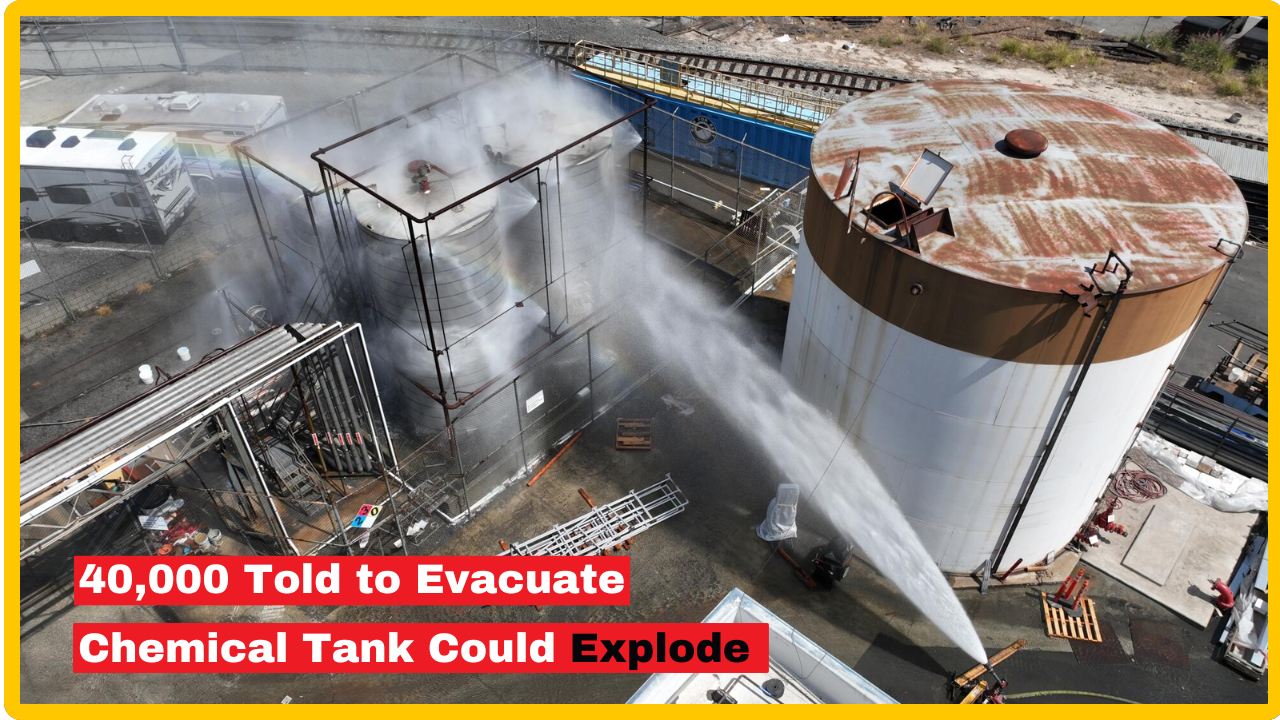
Crews arrived Thursday afternoon at the GKN Aerospace facility after receiving a hazardous materials call just before 3:40 p.m. The chemical in the industrial tank initially stayed at the same temperature, officials said. However, about four hours after firefighters arrived, the temperature rose, causing a relief valve and sprinkler system to activate near the tank.
What began as a manageable hazmat response rapidly deteriorated. Firefighters spent the overnight hours of Thursday into Friday attempting to stabilize the tank and remove the chemical product, making what officials initially described as progress. But by Friday morning, the situation had changed dramatically.
The OCFA said crews initially made progress toward removing the chemical product but determined Friday morning that the “tank that is in the biggest crisis is in fact unable to be secured and mitigated.”
The 34,000-gallon storage tank at the GKN Aerospace facility spewed toxic chemicals into the air on May 21, 2026, triggering the emergency response that has now stretched into its third day.
The Chemical at the Center: What Is Methyl Methacrylate?
At the heart of the Garden Grove chemical leak is a substance called methyl methacrylate — a chemical that most people encounter in its finished form every day without knowing it.
The industrial tank at the Garden Grove facility is estimated to contain 7,000 gallons of methyl methacrylate, a “highly volatile” and “highly flammable” toxic substance used in the production of plastics, said Orange County Fire Authority Chief Craig Covey.
The tank contains methyl methacrylate, a colorless, volatile, flammable liquid chemical used in the manufacture of resins and plastics that can irritate the skin, eyes and nose in humans. The substance is most commonly associated with the production of acrylic glass, known commercially as Plexiglass, and is widely used across aerospace manufacturing, automotive, and construction industries.
According to the US Environmental Protection Agency, methyl methacrylate can cause lung and skin irritation, headaches, coughing and wheezing, and has been suggested — but not proven — as a possible cause of colon and rectal cancers.
The 7,000-gallon tank contains methyl methacrylate. “MMA does have a very strong fruity odor,” one official said Saturday. “Smelling it doesn’t mean that it will have health impacts.”
The EPA has been actively engaged in the response. The EPA is supporting local authorities with air monitoring throughout the crisis zone.
Fire Chief: “This Thing Is Going to Fail”
The most alarming development in the Garden Grove chemical leak crisis came during a blunt and extraordinary press conference held by Orange County Fire Authority Division Chief Craig Covey on Friday afternoon.
This is gonna happen unless some brilliant guy behind me here figures out how we can mitigate this incident,” Covey said. “This thing is gonna fail. We don’t know when.” He added: “This is as bad as I’ve ever seen.
Covey went further, describing the two stark scenarios that emergency crews are now working to manage.
We’re doing our best to figure out when or how we can prevent it. There are literally two options left remaining. One, the tank fails and spills a total of about 6,000 to 7,000 gallons of very bad chemicals into the parking lot in that area. Or two, the tank goes into a thermal runaway and blows up.
Those words — spoken by a 32-year veteran of fire service — set the tone for a weekend of tense, around-the-clock response operations. Crews attempted an overnight mission inside the danger zone on Friday to assess a secondary tank near the primary leaking vessel.
“We did put people in harm’s way last night … with an attempt to go in and neutralize the additional tank,” Covey said on Saturday, explaining that crews entered the zone in an attempt to ensure an additional tank near the leaking tank was stable.
The result of that mission was not reassuring. After crews embarked on a risky operation inside the danger zone, they learned temperatures were increasing at a rate of about one degree per hour. The tank was at 90 degrees on Friday night after starting the day at 77. At one point, the tank reached at least 95 degrees.
50,000 Residents Evacuated Across Six Cities
The scale of the evacuation triggered by the Garden Grove chemical leak has grown steadily since the crisis began, expanding from Garden Grove alone to a wide swath of Orange County.
Officials ordered residents in Garden Grove to leave and expanded evacuation orders Friday to some residents of five other Orange County cities — Cypress, Stanton, Anaheim, Buena Park and Westminster — after being unable to stop the leak overnight.
Orange County officials expanded evacuation orders on Friday to homes in a one-mile radius in several cities, including Garden Grove, Cypress, Stanton, Anaheim, Buena Park and Westminster. Evacuation orders were issued for people living in the zone that included: Western border expanded to Valley View St.; Northern border expanded to Ball Rd.; Southern border expanded to Trask Ave.
The “crisis situation” has forced 50,000 people out of their homes, leaving them wondering when this will all end. Some schools were also closed on Friday.
Shelters were opened across the region to accommodate the thousands of residents who could not stay with family or friends. People’s belongings are spread out on cots in the Freedom Hall in Fountain Valley, after taking refuge due to the chemical leak at GKN Aerospace, on Saturday, May 23, 2026. The city of Anaheim kept a center at Savanna High School open throughout the weekend. The American Red Cross has teams on standby.
An emergency hotline was established for residents with questions: 714-741-5444.
Newsom Declares State of Emergency
California Governor Gavin Newsom’s office announced the emergency declaration around noon Saturday, two days after the incident was first reported at GKN Aerospace on Western Avenue.
The proclamation directs the California Governor’s Office of Emergency Services and all state government agencies to support Orange County and impacted local jurisdictions to address the emergency.
The declaration also unlocks additional emergency response resources and authorities, including making state-owned properties and fairgrounds available to provide shelter for evacuated residents as necessary, the governor’s office said in a statement.
The governor had already been publicly directing residents to comply with evacuation orders before the formal declaration, posting on X:
If you’re in the area impacted by this incident in Garden Grove, follow local evacuation orders and guidance from local emergency officials.
GKN Aerospace Responds
GKN Aerospace, which manufactures parts for both commercial and military aircraft, has acknowledged its responsibility at the center of the crisis.
GKN Aerospace posted a statement on its website on Saturday, saying the team is fully focused on working with emergency services and specialized teams to ensure everyone’s safety. They also apologized to residents and businesses who’ve had to evacuate and thanked Orange County Emergency Services for their assistance.
“The situation at our Garden Grove site remains ongoing, and we are fully focused on working with emergency services and the relevant authorities to ensure the safety of our employees and the local community,” a GKN Aerospace spokesperson said.
The cause of the leak remains under investigation. No injuries have been reported. That last point — no injuries — has been a consistent note of relief in an otherwise deeply alarming situation, a testament to the speed and scope of the evacuation response.
Experts Working Around the Clock for Solutions
With the two grim options of spill or explosion still on the table as of Saturday morning, emergency management and chemical engineering specialists from across the country have been brought in to help devise a solution.
Authorities are preparing for the tank to fail, as well as talking to experts from across the country to find a way to mitigate the crisis.
California’s chief air quality officer previously called the emergency unprecedented: “This is a unique situation.” The combination of the chemical’s volatility, the compromised valve system that has made standard mitigation approaches unworkable, and the density of the surrounding residential population has created a scenario with no simple playbook to follow.
The OCFA has a dedicated emergency hotline active and is providing regular briefings. Residents in the evacuation zone are urged not to return home until official all-clear notices are issued through official channels.
Conclusion
The Garden Grove chemical leak at the GKN Aerospace facility has evolved from a localized industrial incident into a multi-day emergency of regional proportions, displacing 50,000 residents across six cities and prompting a state of emergency declaration from the governor of California. With fire chiefs warning the tank will fail, chemical experts being consulted around the clock, and a community in limbo, the situation remains fluid and unresolved as of Saturday, May 23, 2026. The fact that no injuries have been reported thus far is a testament to swift and coordinated emergency response — but the hardest hours may still lie ahead.
Given the unprecedented nature of this industrial chemical emergency in the middle of a densely populated Orange County neighborhood, do you think industrial facilities like GKN Aerospace should be subject to stricter siting regulations that prevent high-risk chemical storage from operating in close proximity to residential communities?
Frequently Asked Questions (FAQ)
Q1: What caused the Garden Grove chemical leak at GKN Aerospace?
The Garden Grove chemical leak began on the afternoon of Thursday, May 21, 2026, when a 34,000-gallon storage tank at the GKN Aerospace facility on Western Avenue overheated and began venting vapors. About four hours after firefighters arrived, the temperature inside the tank rose further, activating a relief valve and the facility’s sprinkler cooling system. The precise cause of the initial overheating remains under investigation as of May 23, 2026.
Q2: What is methyl methacrylate, and how dangerous is it?
Methyl methacrylate (MMA) is a colorless, highly volatile, and highly flammable liquid used to manufacture resins, plastics, and acrylic glass products such as Plexiglass. It is widely used in aerospace, automotive, and construction industries. According to the EPA, it can cause lung and skin irritation, headaches, coughing, and wheezing upon exposure. It has a strong fruity odor. Officials have noted that smelling the chemical does not automatically mean a person has experienced harmful health impacts, but exposure to significant concentrations poses serious health risks.
Q3: When can evacuated residents return home?
As of Saturday morning, May 23, 2026, no timeline has been given for when the roughly 50,000 evacuated residents across Garden Grove, Cypress, Stanton, Anaheim, Buena Park, and Westminster can return home. Fire officials have said the compromised tank will inevitably fail — either by spilling thousands of gallons of toxic chemicals or potentially exploding — and residents should not return until official all-clear notices are issued by the Orange County Fire Authority. Residents with questions can call the emergency hotline at 714-741-5444.




Be First to Comment