
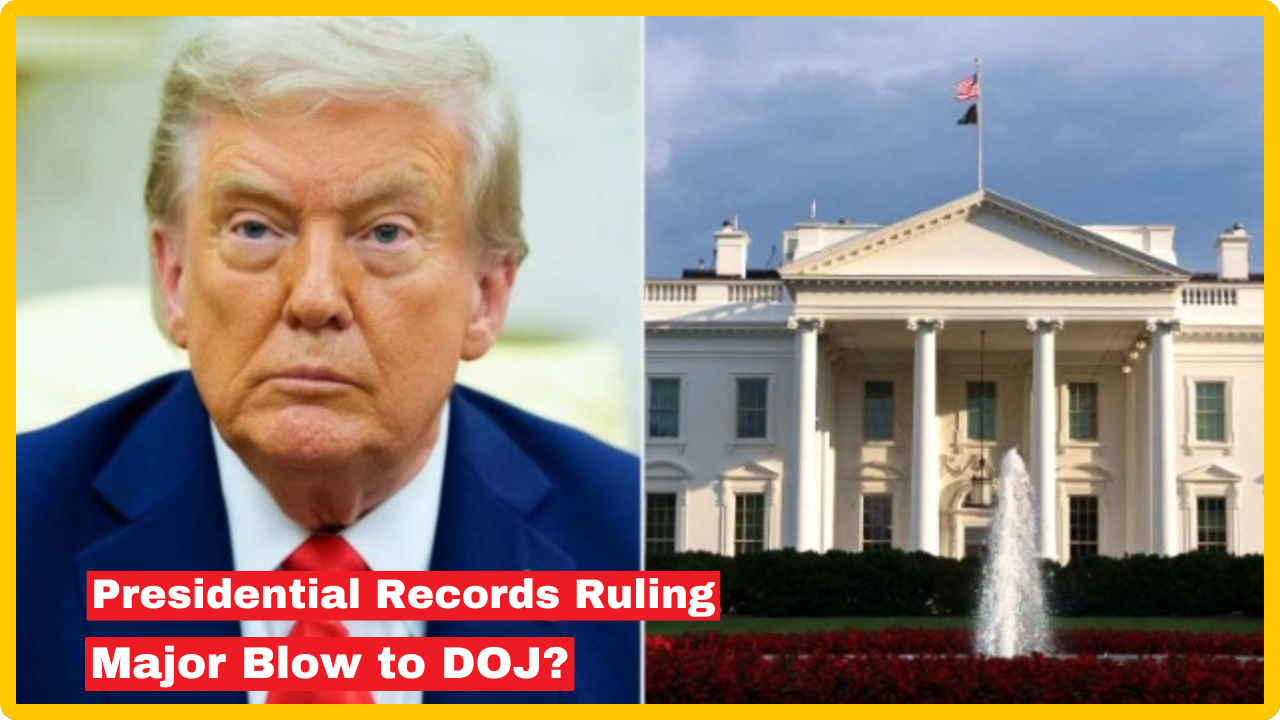
In one of the most significant legal confrontations between the judiciary and the executive branch in decades, a federal judge issued a sweeping Presidential Records Act ruling on Wednesday, May 20, 2026, ordering White House staff to continue complying with the nearly half-century-old law — and directly rejecting a Department of Justice opinion that had declared the entire statute unconstitutional.
The decision, authored by US District Judge John D. Bates of the District of Columbia, runs to 54 pages and stands as a pointed, detailed rebuttal of the Trump administration’s position that a sitting president has the authority to destroy or withhold official government records.
What the Presidential Records Act Ruling Says?
A federal judge on Wednesday ordered White House personnel to continue complying with the decades-old Presidential Records Act after the Justice Department argued in a legal opinion last month that the law was unconstitutional and that President Donald Trump has the authority to destroy presidential records from his term.
In response to a lawsuit challenging that memo, US District Judge John Bates found the 1978 law is likely constitutional and issued a preliminary injunction effectively blocking the legal opinion released by the Justice Department’s Office of Legal Counsel.
The judge’s reasoning was direct and grounded in constitutional law. “On the merits, the Records Act is likely constitutional. It was validly enacted by Congress under the Property Clause because Congress may prospectively designate presidential records as federal property and then regulate that property,” Bates wrote in the 54-page ruling.
The Presidential Records Act ruling also drew a deliberate and pointed historical reference, invoking the Watergate scandal that gave birth to the law in the first place. “To adopt the government’s position that the Act is unconstitutional would disable Congress and future Presidents from reflecting on experience, in defiance of the very words engraved on the National Archives Building in Washington:
‘What is past is prologue,'” Bates wrote. “And while the presidency is a singularly important institution, that gravity does not free it from modest constraint. Quite the opposite. Each branch of government derives its authority from the trust placed in it by the People, and Congress has validly determined that this Act helps to maintain that trust by shining some light on the activities of the President and his aides.”
What Triggered the Legal Battle: The DOJ Opinion
To understand why this Presidential Records Act ruling matters so profoundly, it is essential to understand the sequence of events that led to the lawsuit.
Rejecting a decades-old law enacted after the Watergate scandal to ensure the preservation of presidential records, Assistant Attorney General T. Elliot Gaiser stated last month that the Presidential Records Act was unconstitutional and
“untethered from any valid and identifiable legislative purpose.”
The Justice Department’s Office of Legal Counsel went further, articulating a sweeping theory of executive power. The DOJ’s 52-page opinion said:
“The PRA exceeds the oversight power because it serves no identifiable and valid legislative purpose. It exceeds any preservation power because Congress cannot preserve presidential records merely for the sake of posterity.”
In practical terms, the opinion signaled that the Trump administration did not intend to be bound by the law when the current term ends. That opinion argued that President Trump does not have to turn over his presidential records at the end of his term.
Bates noted that the OLC’s legal opinion on the Records Act relied on a “stark misreading” of Supreme Court precedent when it decided that Trump “need not further comply” with the act. He also rejected the Justice Department’s argument that the act was unconstitutional because presidential papers were considered personal property until the law was enacted in 1978.
Who Brought the Lawsuit?
Today’s ruling centers on a request for emergency court intervention filed by the American Historical Association and American Oversight, and the Freedom of the Press Foundation last month, seeking the court to block the Trump administration from disregarding the PRA and to prevent the destruction or loss of presidential records. The motion argued that without urgent court intervention, records documenting presidential decision-making could be “lost to history.”
The plaintiffs framed their case not merely as a legal dispute but as a fight for democratic accountability. Chioma Chukwu, executive director of American Oversight, called it an “important victory for presidential accountability.” She added:
The court’s decision helps ensure that the American people — not the White House — retain ownership over the historical record of the presidency. It reaffirms a basic democratic principle: presidents do not get to decide unilaterally what history will remember and what the public will never see.
Who Must Comply — and Who Is Exempt
The scope of the Presidential Records Act ruling injunction is precise and carefully drawn, reflecting the constitutional limits on what courts can order a sitting president to do.
The order covers the White House Office, the National Security Council, the Council of Economic Advisers, the US Secret Service within the Executive Office, and senior aides including chief of staff Susie Wiles and deputy chief of staff Stephen Miller. Those officials must preserve presidential and vice-presidential records, avoid using non-official messaging accounts unless copies are promptly forwarded to government systems, and re-establish record-retention policies in line with the statute.
However, the injunction stops short of directly commanding the president himself. Bates noted that courts generally may not “enjoin the President in the performance of his official duties” — a long-standing principle of separation of powers that limits judicial authority to directly command the executive. The order also excludes the National Archives and Records Administration, the archivist, the Justice Department, and the attorney general.
President Trump and Vice President JD Vance are not covered by the judge’s directive.
The Injunction’s Timeline and Compliance Requirements
The injunction, which takes effect at 9:00 a.m. on May 26, enjoins the White House Office, the National Security Council, the US DOGE Service, and all advisors to the president to comply in full with the PRA. Defendants are also required to circulate a copy of the order to covered employees and file a notice with the court on or before May 28, 2026, describing steps that have been taken to comply with the court’s order.
The decision places the Trump administration in an urgent legal position, with the order set to take effect on May 26 and the possibility of an emergency appeal.
The Historical Context: Watergate, Nixon, and Why This Law Exists
The Presidential Records Act, which Congress passed in the wake of the Watergate scandal, establishes that presidential records belong to the public and must be preserved and eventually transferred to the National Archives.
Judge Bates invoked that history directly and deliberately in his opinion. He observed that the absence of another Watergate-level scandal since Richard Nixon’s downfall
suggests that the sunshine disinfectant of the Records Act is working as intended.
The law was signed by President Jimmy Carter in 1978, fundamentally reversing the prior legal understanding under which presidential papers were considered the personal property of a departing commander-in-chief. Richard Nixon had famously sought to retain and control his White House records after his resignation in 1974, a battle that helped drive Congress to establish a clear legal framework for all future administrations.
The Trump administration’s DOJ opinion, had it gone unchallenged, would have effectively returned the legal landscape to its pre-1978 state — a position that the court found lacking both in precedent and in constitutional validity.
The Pattern: Trump’s First Term and Mar-a-Lago Records
This is not the first time the Presidential Records Act ruling framework has intersected with the Trump presidency. After leaving office in 2021, President Donald Trump initially refused to fully comply, forcing the National Archives to travel to Mar-a-Lago to retrieve large quantities of records, including classified documents. Later, the FBI executed a search warrant to retrieve more classified materials. Special Counsel Jack Smith investigated Trump’s handling of classified documents and in 2023, a grand jury indicted him, partially under the Espionage Act. That case was thrown out in 2024 by Judge Aileen Cannon. Daily Gazette
The pattern of conduct across both terms has added urgency to the current legal challenge, with plaintiffs and oversight advocates arguing that the DOJ opinion was not merely a theoretical legal argument but a practical blueprint for another records confrontation at the end of Trump’s second term in January 2029.
What Happens Next?
The Trump administration now faces a choice: comply with the order by 9:00 a.m. on May 26 and file a compliance notice with the court by May 28, or mount an emergency appeal to the US Court of Appeals for the District of Columbia Circuit. Legal observers widely expect an appeal, given the high stakes involved and the administration’s clearly stated view that the law is unconstitutional.
The preliminary injunction is not a final ruling on the merits. The Presidential Records Act ruling is a preliminary injunction — not a final determination — meaning the underlying constitutional question will continue to be litigated. If the case ultimately reaches the Supreme Court, it could produce a landmark decision on the scope of executive power, the authority of Congress to regulate presidential conduct, and the public’s right to the historical record of the presidency.
Conclusion
The Presidential Records Act ruling issued by Judge John Bates on May 20, 2026 is far more than a procedural order in a government records dispute. It is a direct judicial rejection of a sweeping theory of executive power — one that, if left unchecked, would have allowed a sitting president to determine unilaterally what official records the public would ever see. With the injunction taking effect May 26 and an appeal likely imminent, this legal battle is just beginning. The outcome will shape not only how this administration handles its records, but how every future administration will be held accountable to history.
Given that the Presidential Records Act has stood unchallenged for nearly 50 years, do you believe the courts will ultimately uphold the law — or do you think this case could reach the Supreme Court and reshape the boundaries of presidential power over government records?
Frequently Asked Questions (FAQ)
Q1: What is the Presidential Records Act, and why was it passed?
The Presidential Records Act is a federal law enacted in 1978 in the aftermath of the Watergate scandal. It establishes that all official records created during a presidential administration belong to the American public — not to the president personally — and must be preserved and transferred to the National Archives when the president leaves office. It was designed to prevent any future president from withholding or destroying records of their time in office.
Q2: Why did the DOJ say the Presidential Records Act was unconstitutional?
In April 2026, the Justice Department’s Office of Legal Counsel issued a 52-page legal opinion arguing that the Presidential Records Act exceeds Congress’s authority, serves no identifiable legislative purpose, and infringes on presidential autonomy. The opinion concluded that President Trump was not legally required to comply with the law and could potentially retain or destroy records from his second term. Judge Bates rejected this reasoning as a “stark misreading” of constitutional precedent.
Q3: Who is specifically required to comply with Judge Bates’ May 20, 2026 order?
The preliminary injunction requires compliance from the White House Office, the National Security Council, the Council of Economic Advisers, the US DOGE Service, and named senior officials including White House Chief of Staff Susie Wiles and Deputy Chief of Staff Stephen Miller. Notably, President Trump and Vice President JD Vance are not covered by the order, as courts generally cannot directly command a sitting president in the performance of official duties.





Be First to Comment