
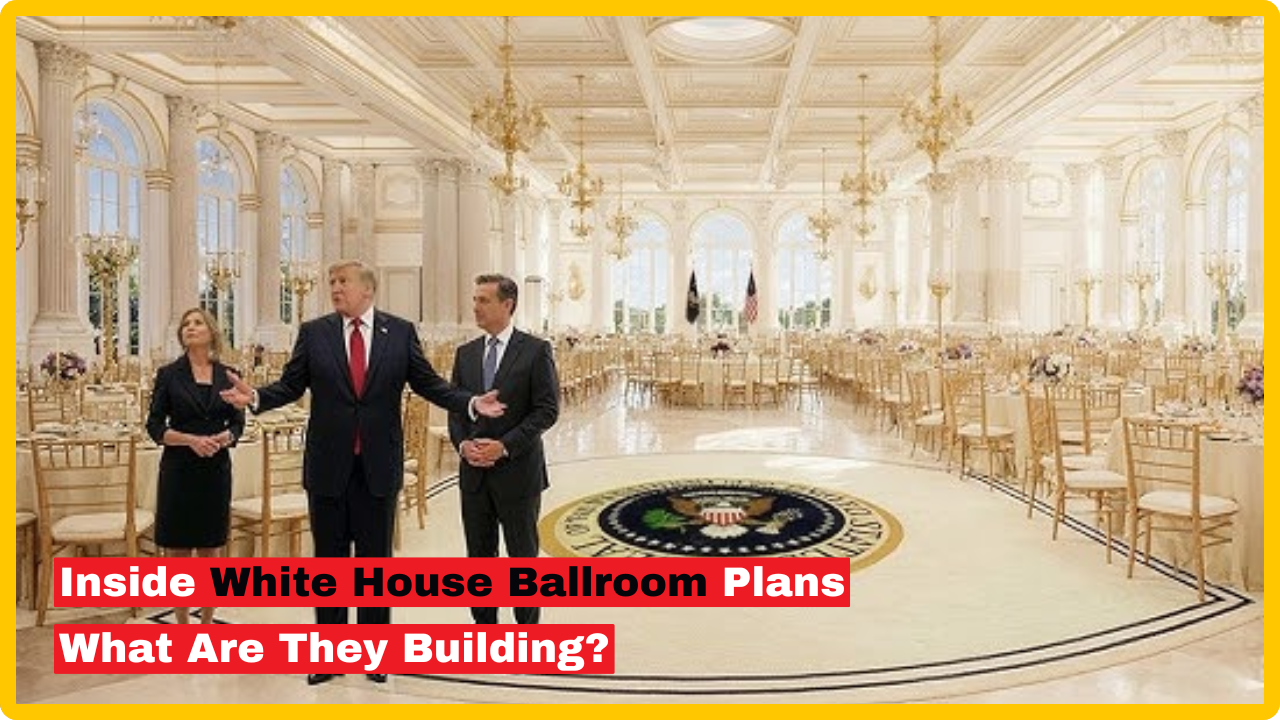
We are going to take a closer look at White House State Ballroom. Fifteen years after Donald Trump first floated the idea of adding a grand event space to the White House complex, the White House state ballroom is no longer a concept sketch on a Mar-a-Lago napkin. It is an active construction site, a legal battleground, a political lightning rod, and, according to the president himself, the future home of presidential inaugurations.
The 89,000 to 90,000-square-foot neoclassical structure being built on the footprint of the demolished East Wing has already cost two historic trees, the original Presidential Emergency Operations Center, and tens of millions of dollars in donor contributions — with the final bill now estimated at $400 million and climbing. Here is everything known about the White House state ballroom plans, construction progress, cost, rendering history, legal status, and completion date.
White House State Ballroom Plans: From Announcement to Approval
Trump formally announced the White House state ballroom project in July 2025, describing it as the fulfillment of a presidential desire stretching back more than 150 years – though historians were quick to note that no previous president had sought a venue of this scale or character on the White House grounds. The stated purpose was straightforward: the East Room, the largest room in the existing White House, seats a limited number of guests for formal state dinners and events, constraining the president’s ability to host large gatherings at the official residence. A dedicated ballroom of nearly 90,000 square feet would give the White House an events capacity comparable to the finest private venues in Washington and New York.
The White House state ballroom plans call for a structure built in the neoclassical style, intended to harmonize aesthetically with the existing White House exterior. The project was designed by Shalom Baranes Associates, an architecture firm brought on board in December 2025 after disputes reportedly arose between the president and the original architect. The design includes floor-to-ceiling windows described by the White House as high-grade bulletproof glass — a detail that takes on additional significance given what lies beneath the structure.
The National Capital Planning Commission, the federal agency responsible for overseeing proposed construction on federal land in the Washington area, voted 8-1 to approve the project’s final design on April 2, 2026 — a significant regulatory milestone, though one achieved with a commission whose membership included three Trump appointees and a chair who is the president’s former personal attorney.
White House State Ballroom Construction: What Has Been Built So Far
White House state ballroom construction began on the site in September 2025, with the formal demolition of the original East Wing of the White House taking place in October of the same year. The demolition was conducted with little advance public notice, and the spectacle of construction equipment dismantling a wing of one of the world’s most recognized buildings drew crowds of curious onlookers to the surrounding streets – an impromptu tourist attraction that generated its own wave of media coverage and social media documentation.
The demolition was not without controversy beyond the political. Two magnolia trees believed to have been planted as commemorative trees for Presidents Warren G. Harding and Franklin D. Roosevelt — in 1922 and 1942 respectively — are believed to have been removed during the site clearance. Their loss drew condemnation from historic preservation advocates who argued the trees were irreplaceable living connections to American presidential history.
White House State Ballroom:
Beneath the surface, the construction project has a dimension that remains classified. The Presidential Emergency Operations Center – a hardened underground facility located beneath the former East Wing and used as a secure command post in national security emergencies — was dismantled as part of site preparation. It is being replaced by what Trump has described publicly as “a massive complex” being built by the military beneath the ballroom. The president told reporters in March:
“The military is building a big complex under the ballroom,” adding that the ballroom itself “essentially becomes a shed for what’s being built under.”
The cost of the below-grade military facility to taxpayers has not been disclosed on national security grounds.
Construction continued even during the federal government shutdown of October 2025, with the White House Office of Management and Budget confirming in a memo that the above-ground project was funded by private donors and would not be affected by federal budget negotiations.
As of April 18, 2026, construction was allowed to proceed under a court order granting the project legal authorization to continue until June 2026, at which point the situation will be reassessed by the courts.
White House State Ballroom Cost: From $200M to $400M
When the White House state ballroom was first announced in July 2025, the White House estimated the project would cost approximately $200 million, to be funded entirely by private donations. By October 2025, that estimate had risen to $300 million. By April 2026, the most recent publicly available cost estimate placed the total at $400 million — a doubling of the original figure in less than a year, with construction still far from complete.
Beyond the ballroom itself, the White House’s broader renovation and repair budget for fiscal year 2026 stands at $377 million, with an additional $174 million projected for fiscal year 2027 — representing an 866 percent increase over the approximately $39 million spent on White House repairs in fiscal year 2025.
Trump has maintained from the outset that the White House state ballroom cost will be borne entirely by private donors rather than American taxpayers. The White House released a list of 37 donor organizations in October 2025 that includes some of the most recognizable names in American corporate life: Apple, Amazon, Google, Meta Platforms, Microsoft, Lockheed Martin, Comcast, and Coinbase, as well as individual and family donors including Blackstone CEO Stephen Schwarzman, Commerce Secretary Howard Lutnick’s family, the Adelson Family Foundation, and cryptocurrency billionaires Cameron and Tyler Winklevoss.
One donor arrangement attracted particular scrutiny. In October 2025, Trump announced that the ballroom would receive a $37 million donation of steel from an unnamed company. In April 2026, a New York Times investigation identified the donor as ArcelorMittal, a Luxembourg-based steel company. The investigation also found that just two days after Trump announced the steel donation, the White House had issued a proclamation halving tariffs on automotive steel from a Canadian plant that ArcelorMittal uses to supply the American market — a sequence of events that critics characterized as a direct conflict of interest.
White House State Ballroom Rendering: Design Flaws and a Last-Minute Revision
An Exterior Staircase That Led to Nowhere
The White House state ballroom rendering history has been one of steady public scrutiny and last-minute course correction. Architects reviewing the plans identified multiple significant design problems, including an exterior grand staircase leading up to a side of the building that contained no door, columns positioned in ways that would block interior views and natural daylight, fake windows included for aesthetic symmetry rather than function, and a staircase that would disrupt the symmetry of the White House driveway layout designed by Frederick Law Olmsted in the 1930s.
Following a March 29, 2026 news investigation that detailed these design flaws, Trump revealed an updated version of the ballroom the following day that addressed some — though not all — of the identified problems. The exterior grand staircase leading to nowhere was removed in the revised design.
White House State Ballroom: On Hold, Judge, and Legal Status
The White House state ballroom on hold question has been shaped almost entirely by the ongoing legal challenge brought by the National Trust for Historic Preservation, which filed suit against the Trump administration in December 2025. The NTHP argued that the project failed to observe required federal historic preservation guidelines and, critically, that the scale of the project required explicit congressional authorization that the administration had not sought or obtained.
US District Judge Richard J. Leon has been the most consequential figure in the ballroom’s legal journey. On February 26, 2026, he ruled that construction could continue while he considered additional arguments from the NTHP. Later, in a ruling that drew a sharp public response from Trump, Judge Leon determined that the project could not move forward without congressional authorization — stating memorably: “The President of the United States is the steward of the White House for future generations of First Families. He is not, however, the owner!”
Trump rejected the ruling emphatically, posting that congressional approval had “never been given on anything, in these circumstances, big or small, having to do with construction at the White House.” The administration appealed, and a three-judge panel of the US Court of Appeals for the DC Circuit ruled 2-1 that construction could continue temporarily while the lower court reviews the case further. As of April 18, construction has authorization to proceed until June 2026.
The White House state ballroom judge question — specifically whether the project will ultimately require an act of Congress — may eventually reach the Supreme Court, with the administration having already signaled it would pursue that avenue if necessary.
White House State Ballroom Completion Date: Trump Wants It Done by 2029
“The Finest Ballroom Ever Built Anywhere in the World”
Trump has expressed hope that the White House state ballroom completion date will fall before the end of his current term in January 2029. He told reporters in early 2026 that the project was “ahead of schedule and within budget” — a characterization disputed by critics who pointed to the doubling of the official cost estimate. In a Truth Social post, Trump wrote: “When completed, it will be the finest Ballroom ever built anywhere in the World, one that has been sought by Presidents for over 150 years.”
He has also floated the possibility that future presidential inaugurations — traditionally held on the steps of the US Capitol – could be moved to the ballroom. No formal plans for that change have been announced.
Conclusion
The White House state ballroom is simultaneously a construction project, a legal case, a political statement, and a question about the limits of presidential authority over the nation’s most historic residence. With the cost now estimated at $400 million, the design approved by a planning commission stacked with Trump allies, courts divided on whether Congress must weigh in, and an undisclosed military complex being built beneath the ballroom’s foundation, the project embodies both the ambition and the controversy that have defined the Trump era’s approach to the institutions of American government.
Given the doubling of the ballroom’s cost estimate, the destruction of historic trees, and the ongoing legal dispute over whether congressional approval is required, do you think the White House state ballroom represents a worthwhile enhancement of one of America’s most important national landmarks — or an inappropriate use of donor influence and executive power over a property that belongs to all Americans?
Frequently Asked Questions (FAQ)
Q1: What are the White House state ballroom plans and what will the structure look like?
The White House state ballroom is a planned 89,000 to 90,000-square-foot neoclassical event space being built on the footprint of the demolished East Wing of the White House. Designed by architecture firm Shalom Baranes Associates, the structure features high-grade bulletproof glass windows, a neoclassical exterior intended to complement the existing White House, and event space designed to dramatically expand the White House’s capacity for formal state dinners and other large gatherings.
The National Capital Planning Commission approved the final design in an 8-1 vote on April 2, 2026. Early renderings drew criticism for design flaws including a staircase that led to no door, which was subsequently removed in a revised version released in March 2026.
Q2: What is the White House state ballroom cost and who is paying for it?
The cost of the White House state ballroom has escalated significantly since the project was announced. The original estimate in July 2025 was $200 million. By October 2025 it had risen to $300 million, and by April 2026 the most current estimate placed the cost at $400 million — double the original figure with construction still underway.
The Trump administration has maintained the project is being funded entirely by private donors rather than taxpayers. A list of 37 donors released in October 2025 includes Apple, Amazon, Google, Meta, Microsoft, Lockheed Martin, Comcast, and Coinbase, among others.
An October 2025 steel donation from ArcelorMittal worth $37 million attracted scrutiny after the White House issued a tariff reduction for the company’s products just two days later.
Q3: What is the legal status of the White House state ballroom and when is the completion date?
The White House state ballroom faces an active legal challenge from the National Trust for Historic Preservation, which argues the project requires congressional authorization and failed to follow federal historic preservation requirements. US District Judge Richard Leon ruled that the project cannot proceed without congressional approval — a ruling the Trump administration is appealing.
As of April 18, 2026, an appeals court has allowed construction to continue until June 2026 pending further court review. The administration has signaled it may seek Supreme Court intervention if lower courts ultimately block the project. Trump has stated he hopes the ballroom will be completed before his current term ends in January 2029, describing it as the
“finest Ballroom ever built anywhere in the World.”





Be First to Comment