
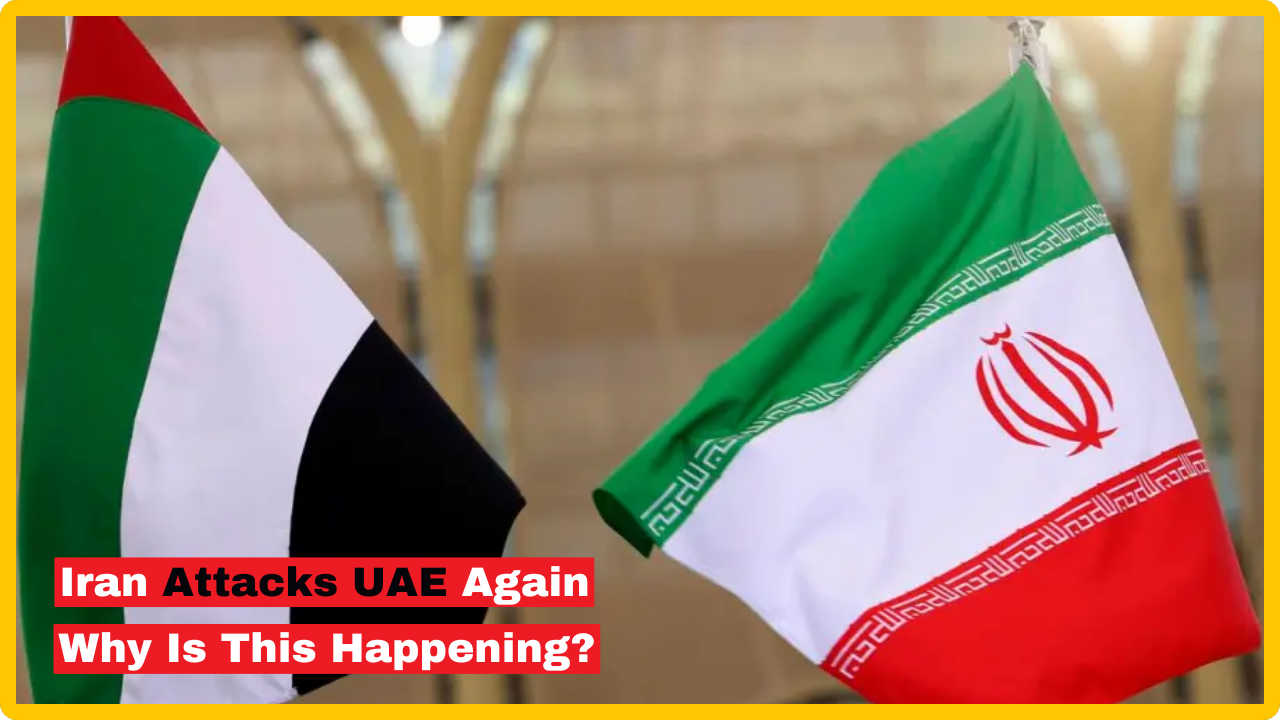
We are going to understand that Why Iran Is Attacking UAE Again & What “Project Freedom” Has to Do With It as May 4, 2026 will be remembered as the day the already fragile US-Iran ceasefire came closer to total collapse than at any point since it was first announced nearly a month ago. Iran launched a barrage of missiles and armed drones at the United Arab Emirates — a key American ally and the Gulf’s most commercially important economy – striking oil infrastructure, triggering missile sirens across the country, causing airspace restrictions that turned commercial aircraft around in midflight, and igniting a major fire at the Fujairah Oil Industry Zone.
Simultaneously, in the waters of the Strait of Hormuz, the United States military sank six small Iranian boats attempting to interfere with commercial shipping, while two American-flagged vessels made the first successful transit of the waterway under US military protection in more than two months.
The trigger for all of it was a single decision by President Donald Trump, announced just hours earlier: “Project Freedom” — a US military-led operation to escort stranded commercial ships through the Strait of Hormuz and break Iran’s stranglehold on the world’s most consequential energy passage.
What Is Project Freedom — and Why Did Iran React With Force?
Trump’s Humanitarian and Strategic Gamble
Project Freedom was announced by President Trump on Sunday, May 3, framed simultaneously as a humanitarian mission and a strategic assertion of American naval dominance. According to the White House, hundreds of commercial vessels carrying thousands of stranded seafarers have been trapped inside the Persian Gulf since Iran effectively shut down the Strait of Hormuz on March 4 — the day Tehran declared the waterway closed in retaliation for the US-Israeli air campaign that began on February 28 under Operation Epic Fury.
Trump described the mission as designed to “guide” commercial ships — tankers, cargo vessels, and container ships — out of the Persian Gulf through the narrow strait and into the Gulf of Oman and Arabian Sea beyond. Admiral Brad Cooper, commanding US Central Command, confirmed that American forces had established what the US-led Joint Maritime Information Center termed an “enhanced security area” along the Omani side of the strait, advising vessels to route through Omani waters to minimize exposure to Iranian sea mines that have been laid throughout the passage.
By Monday afternoon, CENTCOM announced that two US-flagged ships had safely transited the waterway under American military protection — the first vessels to do so since the war began. Danish shipping giant Maersk confirmed that one of its ships was among those that made the passage. At the same time, Admiral Cooper confirmed that US forces had sunk six small Iranian speedboats that attempted to intercept and interfere with the commercial shipping movements in the strait.
Iran’s reaction was both swift and severe. Iranian state media denied that any ships had successfully transited. Iranian Foreign Minister Abbas Araghchi wrote on social media that “Project Freedom is Project Deadlock,” warning that “events in the Strait of Hormuz make clear that there is no military solution to a political crisis.” More concretely — and more dangerously — Iran’s Islamic Revolutionary Guard Corps directed missile and drone attacks against the UAE within hours of the US operation’s launch.
Why Iran Is Attacking UAE Again: Strategic Logic Behind the Escalation
To understand why Iran chose to attack the UAE on May 4, it is essential to understand the specific target it hit: the emirate of Fujairah, located on the Gulf of Oman outside the Strait of Hormuz. Fujairah is not a random target. It is the terminus of the Abu Dhabi Crude Oil Pipeline – a 370-kilometer overland route that allows the UAE to bypass the strait entirely, piping its crude oil directly to the Arabian Sea coast without passing through the chokepoint Iran controls.
By striking the Fujairah Oil Industry Zone – causing a major fire and injuring three Indian nationals — Iran sent an unmistakable message: that it can and will target the alternative energy export infrastructure its adversaries are using to circumvent its blockade of the Strait of Hormuz. Iran’s attack on an ADNOC crude oil tanker with drones as it attempted to transit the strait reinforced the same point from another direction.
The logic is coherent from Tehran’s perspective, however destructive its execution. The UAE’s support for US operations — including its hosting of American military assets and, critically, the fact that an Israeli air defense battery deployed in the UAE was involved in intercepting some of the Iranian missiles on Monday — places Abu Dhabi squarely within Iran’s definition of a co-belligerent. Iran’s military has made clear through public statements that it considers any country hosting US or Israeli military infrastructure to be a legitimate target in the current conflict.
The UAE’s Response: Four Missile Alerts, Airspace Restrictions, and Outright Condemnation
“Renewed Treacherous Iranian Aggression”
The UAE’s response to Monday’s attack was measured in public but deeply significant in its practical implications. The country’s air defense systems engaged 19 Iranian missiles and drones — with the UAE Defense Ministry confirming in real time that its systems were “currently dealing with missile attacks and incoming drones from Iran.” Four separate missile alerts were issued urging UAE residents to seek shelter — the first since the ceasefire took hold in early April.
Commercial aviation in and out of Dubai and Abu Dhabi — two of the world’s busiest aviation hubs — was severely disrupted. The UAE restricted its airspace for a full week, causing flights to turn around in midair and others to be diverted. The cascading effects on international air travel were immediate and visible across global flight-tracking platforms.
The UAE’s Foreign Ministry issued a sharp denunciation, describing what it called “renewed treacherous Iranian aggression” and calling for an immediate halt to the attacks, adding: “These attacks represent a dangerous escalation and an unacceptable violation.” Separately, authorities in Oman reported that a residential building near the strait was struck by what appeared to be an errant projectile, injuring two foreign workers.
Iran’s initial official response was characteristically ambiguous. An unnamed Iranian military official told state media that Tehran had “no plan” to target the UAE or its oil infrastructure, attributing the Fujairah facility attack to what it described as “US military adventurism to create an illegal passage.” However, a social media account associated with the IRGC subsequently posted what it claimed were images of the drone and missile strikes on Fujairah and a ship on fire in the strait — an apparent contradiction of the official denial.
The Ceasefire: Technically Intact, Functionally Shattered
Trump Refuses to Say It’s Over – But the Facts Say Otherwise
The most consequential diplomatic question hovering over Monday’s events is whether the US-Iran ceasefire — announced by Trump on April 7 and extended indefinitely on April 21 — still exists in any meaningful sense. The events of May 4 involved direct exchanges of fire between US and Iranian forces, Iranian missile strikes on a US-allied country hosting American military assets, and the destruction of six Iranian naval vessels by the US military.
Despite all of that, Trump declined to declare the ceasefire over. In a call with ABC News journalist Jonathan Karl following the day’s events, the president avoided explicitly saying that hostilities had resumed, even as he warned in a Fox News interview that Iran would be “blown off the face of the earth” if it targeted American ships in the Strait of Hormuz. Trump also posted on Truth Social that a South Korean cargo ship had come under fire from Iran in the waterway — a report confirmed by Seoul’s foreign ministry, which said the vessel caught fire after an explosion and was being towed to a nearby port.
Treasury Secretary Scott Bessent, appearing on Fox News on Monday morning, claimed that the United States had “absolute control” of the Strait of Hormuz and dismissed Iran’s navy as “a band of pirates.” Shipping companies told a different story: Hapag-Lloyd stated flatly that it considered transit through the strait still not possible, and industry executives reiterated that military convoys alone are insufficient to allow the resumption of normal commercial traffic.
Diplomatic Track: Araghchi Warns of a “Quagmire”
Even as missiles flew and boats were sunk, Iran’s foreign minister was simultaneously engaging in diplomatic communications. Araghchi wrote on social media that the ongoing talks with the United States were “making progress with Pakistan’s gracious effort,” warning Washington and Abu Dhabi against being dragged into a “quagmire by ill-wishers.” The dual-track approach — fighting and negotiating simultaneously — has become characteristic of Iran’s conduct throughout the conflict, a pattern that reflects both its desire to maintain bargaining leverage and its awareness that a full resumption of US airstrikes would be devastating.
Conclusion
Monday’s events represent the most serious test yet of the US-Iran ceasefire and of Project Freedom’s viability as a strategy for reopening the Strait of Hormuz. Iran’s attacks on the UAE and on shipping in the waterway demonstrate that Tehran is prepared to respond with force to any American effort to break its grip on the passage – even at the cost of attacking a relatively neutral Gulf state and risking a full resumption of US military action. For the global economy, which is already absorbing the shock of months of disrupted energy flows, Monday’s escalation is another reminder that the path from ceasefire to peace remains extraordinarily long and perilous.
Given Iran’s willingness to attack the UAE and sink ships in response to Project Freedom, do you think the United States was right to launch the operation and force the issue on the Strait of Hormuz — or did doing so risk blowing up the ceasefire and reigniting a full-scale war before diplomacy had a real chance to succeed?
Frequently Asked Questions (FAQ)
Q1: What is Project Freedom and why did Trump launch it?
Project Freedom is a US military-led maritime operation announced by President Trump on Sunday, May 3, 2026, designed to escort commercial vessels that have been stranded inside the Persian Gulf through the Strait of Hormuz and out to open sea. Since Iran declared the strait closed on March 4 following the launch of Operation Epic Fury, hundreds of commercial ships carrying an estimated 20,000 seafarers have been trapped in the Persian Gulf, unable to transit safely.
Trump framed the mission in both humanitarian terms — freeing stranded seafarers — and strategic terms, positioning it as an assertion of the US Navy’s right and ability to ensure freedom of navigation through one of the world’s most critical shipping lanes. Under the operation, the US-led Joint Maritime Information Center established an “enhanced security area” along the Omani side of the strait, and two ships made the first successful transit under US protection on May 4.
Q2: Why did Iran attack the UAE specifically, and what was hit?
Iran targeted the UAE on May 4 in direct response to Project Freedom, firing 19 missiles and drones that the UAE’s air defense systems engaged. The primary target was Fujairah — an emirate on the Gulf of Oman coast that serves as the terminus of the Abu Dhabi Crude Oil Pipeline, a strategic bypass route that allows the UAE to export oil without passing through the Strait of Hormuz.
A major fire broke out at the Fujairah Oil Industry Zone following a drone strike, injuring three Indian nationals. An ADNOC crude oil tanker was also struck by drones as it attempted to transit the strait. Iran’s targeting of Fujairah reflects a deliberate strategy: by striking the UAE’s alternative export infrastructure, Tehran signaled it can punish countries that help circumvent its blockade, regardless of whether they participate directly in the military campaign.
Q3: Is the US-Iran ceasefire still in effect after the May 4 events?
In a technical sense, neither the United States nor Iran formally declared the ceasefire broken following the May 4 exchanges. Trump, when contacted by reporters after the events, declined to say that the ceasefire had been violated, even though US forces sank six Iranian boats and Iranian missiles struck US-allied territory. However, the practical reality on the ground is significantly more complicated: direct exchanges of fire between US and Iranian forces occurred for the first time since April 7, Iran attacked the UAE — which hosts US and Israeli military assets — with ballistic missiles and armed drones, and a South Korean-operated ship was set on fire in the strait.
Shipping companies including Hapag-Lloyd stated they still considered transit through the Strait of Hormuz unsafe. Iranian Foreign Minister Araghchi simultaneously claimed that diplomatic talks were “making progress” through Pakistani mediation, suggesting Tehran was attempting to maintain the negotiating track while asserting military pressure through the simultaneous escalation.


Be First to Comment