
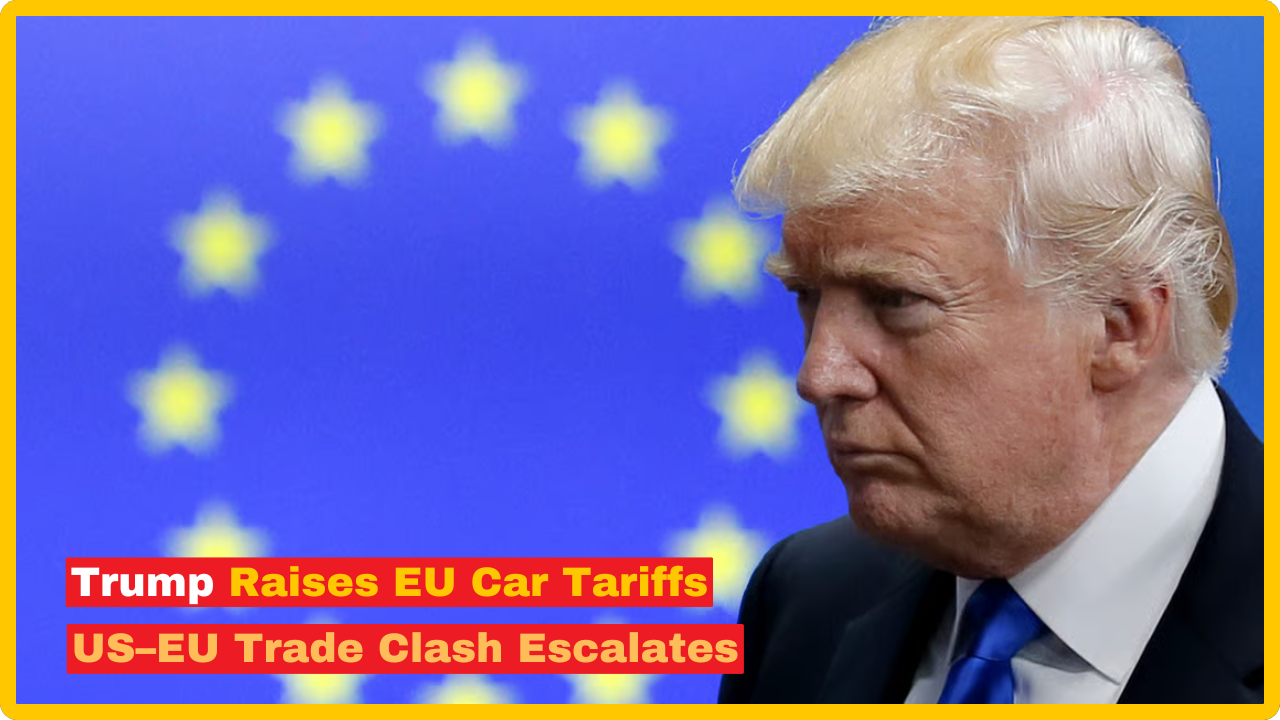
Trump EU Tariffs on AUTO Rise to 25% as A Single Truth Social Post Threatens to Upend Transatlantic Trade and Jolt a Fragile World Economy. With characteristic abruptness, President Donald Trump posted to his Truth Social platform on Friday afternoon and announced that he would be raising Trump EU auto tariffs on cars and trucks imported from the European Union to 25 percent – effective next week – accusing the bloc of failing to comply with the Turnberry Agreement, a trade framework the two sides negotiated with considerable fanfare last summer.
The announcement came without a press conference, without a detailed policy briefing, and — crucially — without any specification of what the EU had actually done to violate the agreement. It landed on financial markets and in European capitals like a thunderclap, threatening to blow apart a trade architecture that had taken months to assemble and to deliver a further shock to a global economy already reeling from the effects of the US-Iran war and elevated energy prices.
“Based on the fact the European Union is not complying with our fully agreed to Trade Deal,”
Trump wrote,
“next week I will be increasing Tariffs charged to the European Union for Cars and Trucks coming into the United States. The Tariff will be increased to 25%.”
He added a carrot alongside the stick: companies that manufacture cars and trucks in American plants, he noted, would face no tariff at all.
The Turnberry Agreement: What Was Agreed & What Is Now in Jeopardy
To understand the stakes of Friday’s announcement, it is essential to revisit the deal Trump is now accusing the EU of breaking. The Turnberry Agreement – named, characteristically, after Trump’s golf course on the west coast of Scotland — was finalized last July between Trump and European Commission President Ursula von der Leyen as a mechanism to de-escalate the trade war that had erupted when Trump imposed sweeping “reciprocal” tariffs on most of America’s trading partners.
Under the terms of the agreement, the United States capped tariffs on most EU goods at 15 percent – significantly below the 30 percent rate Trump had previously threatened – and European automakers were given a measure of relief from the 25 percent Section 232 tariffs that had been levied on foreign vehicles on national security grounds since March 2025. The EU had publicly calculated that the bilateral deal would save European automakers between 500 and 600 million euros per month – a significant financial lifeline for an industry already under pressure from the transition to electric vehicles and slowing demand in key markets.
Both sides had repeatedly affirmed their commitment to the agreement in the months since. As recently as February 2026, following a Supreme Court ruling that cast some of the tariffs’ legal foundations into doubt, the European Commission stated publicly:
“A deal is a deal. The EU expects the US to honor its commitments.”
That expectation has now been shattered.
The Legal Authority: Section 232 Returns to Center Stage
The White House, in the hours following Trump’s Truth Social post, confirmed that the president would be implementing the new Trump EU auto tariffs under Section 232 of the Trade Expansion Act of 1962 – the same legal authority used to impose the original 25 percent tariffs on foreign vehicles in March 2025. Section 232 allows the president to adjust imports of goods that the Secretary of Commerce has determined are being imported in quantities or under circumstances that threaten to impair national security.
The invocation of Section 232 is significant for several reasons. First, it sidesteps the “reciprocal” tariff framework that the Supreme Court struck down earlier this year, which had invalidated some of Trump’s broader tariff regime and forced a renegotiation that ultimately produced the current structure. By using Section 232 — a distinct statutory authority explicitly tied to national security rather than trade reciprocity – the administration is attempting to put the tariff increase on firmer legal ground.
Scott Lincicome of the libertarian Cato Institute’s Center for Trade Policy Studies said the president would likely rely on Section 232 for the increase and used the moment to make a broader point about the durability of Trump-era trade agreements. He characterized them as frameworks that “rely on handshakes and winks and hopes that Trump doesn’t get mad about something” — a critique that Friday’s announcement appeared to validate in real time.
European Reaction to Trump EU Tariffs on AUTO’s
The European response to Friday’s Trump EU auto tariffs announcement moved quickly from shock to organized pushback, though the tone remained carefully calibrated to avoid triggering an immediate escalation.
The European Commission flatly rejected Trump’s claim that the EU was failing to comply with the Turnberry Agreement. A Commission spokesperson stated that Brussels remained “fully committed to a predictable, mutually beneficial transatlantic relationship” while making clear that the EU would “keep our options open to protect EU interests” if the United States did not honor the deal it had already signed.
Bernd Lange, a lead member of the European Parliament currently overseeing the implementation of the Turnberry Agreement with EU member states, was more pointed in his assessment. He described Trump’s announcement as a demonstration of “clear unreliability” and accused the United States of repeatedly breaking its trade commitments — language that reflects growing frustration in Brussels with what European officials increasingly characterize as the fundamental unpredictability of negotiating with the Trump administration.
Hildegard Mueller, the president of Germany’s VDA auto industry association, struck a more measured tone but conveyed the same underlying concern. Mueller urged both the US and EU to honor the existing trade agreement and resolve the dispute quickly, warning that the cost of additional tariffs would be “enormous” and would likely impact American consumers as much as European manufacturers — a point echoed by trade economists on both sides of the Atlantic.
Who Gets Hit Hardest: The German Auto Industry in the Crosshairs
Among the European automakers that stand to be most severely affected by the new Trump EU auto tariffs, three names stand out immediately: Mercedes-Benz, BMW, and Volkswagen. All three import a substantial share of the vehicles they sell in the American market from manufacturing plants in Europe — primarily in Germany, which accounts for the largest portion of EU automotive exports to the United States by both volume and value.
Germany’s VDA association had previously highlighted the critical importance of the Turnberry Agreement to its members, noting that the 15 percent tariff ceiling represented a manageable burden that allowed German manufacturers to remain competitive in America’s premium vehicle segment. A sudden jump to 25 percent — applied without warning and without a clear explanation of what compliance failure triggered it — fundamentally changes that calculation.
The timing is particularly painful. German carmakers have spent billions of euros investing in American manufacturing capacity in response to exactly the incentive Trump described in his Truth Social post: the promise of zero tariffs for vehicles assembled in the United States. Announcements of new plants and expanded production have been made across the American South and Midwest. But those facilities take years to come online, and the vehicles being sold in American showrooms today are, for the most part, still arriving from European factories.
The Broader Context: Trade War Meets Iran War
A World Economy Already Under Strain
The announcement of elevated Trump EU auto tariffs arrives at a moment when the global economy is already navigating significant turbulence. The US-Israeli war against Iran, which began on February 28, has driven oil prices to approximately $108 per barrel, with the dual blockade of the Strait of Hormuz disrupting roughly 20 percent of the world’s traded energy supply. Supply chain disruptions, elevated shipping costs, and rising consumer prices have made the economic environment unusually fragile even before Friday’s tariff announcement.
The automotive sector is particularly sensitive to these conditions. Car manufacturing depends on complex, multi-country supply chains for components including semiconductors, steel, aluminum, and specialized electronics — all of which have already seen price increases and supply constraints. Adding a tariff shock of this magnitude to an industry already navigating those headwinds will compress margins, delay investment decisions, and — as industry representatives noted on Friday — ultimately be paid for by consumers at the dealership.
Trump’s own justification for the tariff included a forward-looking argument: that over $100 billion was being invested in American automobile manufacturing plants “that will be opening soon.” He did not specify the source of that figure, but the clear implication was that the tariff increase is designed to accelerate the reshoring of auto production from Europe to the United States — and that European manufacturers who want to avoid the duty have a straightforward path to doing so by building cars in America.
The Diplomatic Subtext: Iran, NATO, and a Pattern of Punishment
The announcement of the Trump EU auto tariffs increase came one day after Trump publicly criticized German Chancellor Friedrich Merz for comments about the Iran war, telling the chancellor to focus on ending the Ukraine conflict rather than “interfering” in American strategy in the Middle East. Trump has also spent the preceding week threatening to withdraw US troops from Italy and Spain, calling Italy and Spain “absolutely horrible” for their refusal to support American military operations against Iran.
Trade analysts and European officials noted on Friday that the timing of the tariff announcement — coming directly after the escalating confrontation with European NATO allies over Iran — was unlikely to be coincidental. While the White House framed the tariff increase in purely commercial terms, citing non-compliance with the Turnberry Agreement, the pattern of the past two weeks strongly suggests that the broader transatlantic relationship — encompassing security cooperation, diplomatic alignment, and now trade — is being managed as a single integrated package of leverage rather than as a set of discrete policy domains.
Conclusion
Friday’s announcement of 25 percent Trump EU auto tariffs represents a potentially decisive rupture in the Turnberry Agreement framework that had provided a measure of stability to transatlantic trade since last summer. With the EU flatly denying it has violated the deal, the administration offering no specifics about the alleged non-compliance, and a world economy already under strain from energy disruption and elevated inflation, the stakes of this confrontation are unusually high.
European automakers face a difficult set of choices with no good short-term options, and American consumers may ultimately bear a significant share of the cost through higher vehicle prices.
Given that both the US and EU confirmed their commitment to the Turnberry Agreement as recently as February 2026, and Europe has denied any breach, do you think Trump’s 25 percent tariff escalation on European cars is a legitimate enforcement of trade commitments – or is it primarily a tool of political pressure linked to European reluctance to support the Iran war?
Frequently Asked Questions (FAQ)
Q1: What is the Turnberry Agreement and what tariff rates did it establish?
The Turnberry Agreement is a US-EU trade framework negotiated last July between President Trump and European Commission President Ursula von der Leyen. Named after Trump’s golf course in Scotland, it was designed to de-escalate the trade tensions that arose when Trump imposed sweeping reciprocal tariffs on most American trading partners. Under the agreement, the United States capped tariffs on most EU goods at 15 percent – substantially below the 30 percent rate Trump had previously threatened — and provided European automakers with relief from the 25 percent Section 232 tariffs on foreign vehicles. \
The EU estimated the deal was saving European car manufacturers between 500 and 600 million euros per month. Friday’s announcement, if implemented, would effectively nullify the automotive component of that agreement by raising the rate back to 25 percent.
Q2: What legal authority is Trump using to raise EU auto tariffs to 25 percent?
The White House confirmed Friday that President Trump will implement the new tariff increase using Section 232 of the Trade Expansion Act of 1962. Section 232 grants the president authority to impose tariffs on goods that the Secretary of Commerce has determined are being imported in quantities or under circumstances that threaten to impair national security. Trump first used Section 232 to impose 25 percent tariffs on all foreign vehicles in March 2025.
Those tariffs were subsequently lowered under the Turnberry Agreement framework. By invoking Section 232 again, the administration is attempting to sidestep the reciprocal tariff framework that the Supreme Court struck down earlier in 2026, which had forced the renegotiation that produced the current lower rates. The legal challenge to the president’s authority to use Section 232 for sweeping trade actions is ongoing.
Q3: Which European automakers will be most affected by the new 25 percent tariff?
The European automakers most exposed to the new tariff rate are Mercedes-Benz, BMW, and Volkswagen — all German manufacturers that import a significant proportion of the vehicles they sell in the American market directly from European manufacturing facilities. Germany accounts for the largest share of EU automotive exports to the United States by both volume and value, and the VDA auto industry association immediately called on both sides to honor the existing trade agreement and resolve the dispute quickly.
While all three automakers have made announcements about expanding American manufacturing capacity — incentivized by exactly the zero-tariff promise Trump reiterated on Friday — those new facilities are not yet operational, meaning the vehicles currently being sold in American dealerships are largely still arriving from Europe and would bear the full cost of the new tariff rate.



Be First to Comment