
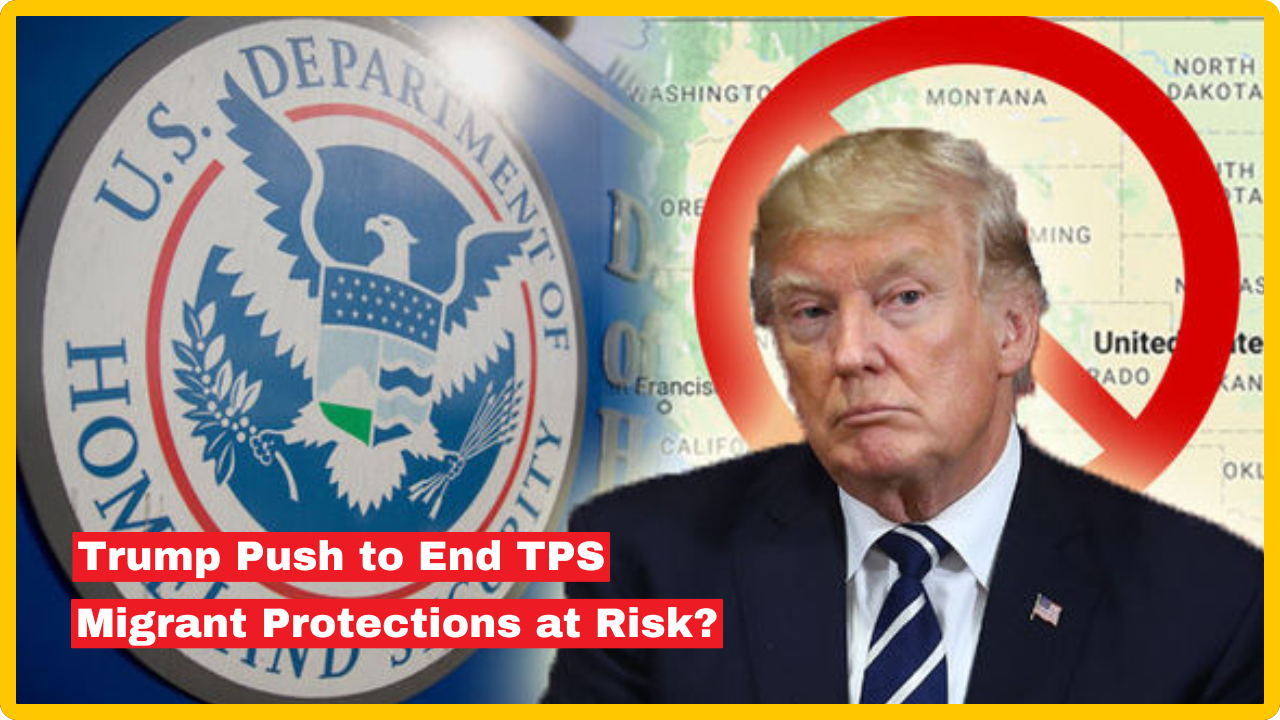
As Supreme Court TPS Case is In one of the most consequential immigration cases to reach the nation’s highest court in years, the Supreme Court heard oral arguments Wednesday on the Trump administration’s effort to terminate Temporary Protected Status for approximately 350,000 Haitian migrants and 6,000 Syrian nationals currently living legally in the United States.
The Supreme Court TPS case, closely watched by immigration advocates, civil rights attorneys, and millions of affected immigrants, revealed a court clearly divided along ideological lines – with the conservative majority appearing broadly sympathetic to the administration’s arguments that TPS termination decisions are beyond the reach of judicial review, and the three liberal justices pressing forcefully on whether racial animus played an unlawful role in the administration’s decision-making.
A ruling is expected by the end of June, and its stakes could scarcely be higher. If the administration prevails, it would clear the path for mass deportations of people who have lived legally in the United States for years — in some cases for well over a decade.
What Is Temporary Protected Status & Why Does It Matter?
A Humanitarian Program Established in 1990
Temporary Protected Status is a program that permits eligible individuals to live and work in the United States if they cannot return to their home countries because of natural disasters, armed conflicts, and other extraordinary or temporary conditions.
TPS doesn’t operate like most other immigration benefits. It applies only to people who have continuously lived in the United States legally since the most recent TPS country designation. Recipients must go through a rigorous vetting process that involves biometrics, background checks, and screening against all government databases. Two misdemeanors are sufficient to lose eligibility. In addition, TPS holders must renew every 18 months and repeat the entire process.
Supreme Court TPS Case
As of March 2025, approximately 1.3 million people from 17 countries had TPS, according to the National Immigration Forum. Haitians have been eligible to apply since the catastrophic 2010 earthquake that killed more than 200,000 people and left over a million homeless. Syrians received designation amid the country’s devastating civil war.
Twenty-one Republican attorneys general are supporting the administration in the case, among them Kansas Attorney General Kris Kobach, who argues:
“Temporary protected status was never intended to be a de facto amnesty. That status, as its name suggests, is temporary.”
The Administration’s Case: Courts Have No Business Here
“Judicial Micromanagement” of Foreign Policy
The Trump administration’s core legal argument, articulated at the Supreme Court by Solicitor General D. John Sauer, is sweeping in its scope. The administration contends that allowing courts to review TPS designations amounts to
“judicial micromanagement” of executive foreign policy decisions, and that cases “directed at a specific TPS designation, termination, or extension”
are entirely unreviewable.
The administration’s briefs argue that the 1990 TPS statute “covers the waterfront,” barring judicial review of all the provisions of the law. In Sauer’s framing, traditional Supreme Court deference to the executive branch on immigration matters — which the court has historically justified by pointing to the “critically important” dimensions of national security and public safety – counsels strongly against allowing district courts to second-guess the executive’s TPS determinations.
Sauer told the justices that unless the court resolves the reviewability question definitively,
“this unsustainable cycle will repeat again and again, spawning more competing rulings and competing views,” urging the court to “break that cycle.”
The administration’s termination of Haiti’s TPS was issued by then-Secretary of Homeland Security Kristi Noem. Noem gave two reasons: first, that there are no extraordinary conditions in Haiti preventing TPS holders from returning home safely; and second, that even if Haiti were unsafe, termination is still required because it is “contrary to the national interest.” She made similar findings for Syria, citing vetting concerns and pointing to two Syrians under criminal investigation, neither of whom actually held TPS.
The Migrants’ Case: Due Process, Not Racial Animus
Lawyers Argue the Process Was Fundamentally Flawed
Advocates for the Haitian and Syrian migrants, represented by attorney Ahilan Arulanantham, mounted a two-pronged defense. Their first argument holds that the provision barring court review applies only to one specific section of the law, not to the procedural requirements that govern how the administration must conduct its review. Their second argument is that the Trump administration failed to comply with the mandatory procedures established in the TPS statute and the Administrative Procedure Act – the foundational 1946 law that sets the rules of the road for how federal agencies develop, issue, and enforce regulations.
A lower federal court judge had already ruled that it was “substantially likely” that then-Secretary Noem had ended the Haitian TPS designation “because of hostility to nonwhite immigrants,” and found she had failed to consult with other agencies as required under the APA.
Arulanantham told the justices that people should still be able to have “some faith in government” to conduct a thorough and lawful review – and that what happened here was anything but.
The Liberal Justices: Was Racial Animus the Real Driver?
The three liberal justices – Sonia Sotomayor, Elena Kagan, and Ketanji Brown Jackson – were the most pointed questioners from the bench, repeatedly returning to the issue of whether discriminatory intent on the part of the president and administration officials should place the TPS terminations beyond the reach of the normal rules that bar judicial review.
Justice Sotomayor cited Trump’s statement that Haiti was a “filthy, dirty and disgusting shithole country,” saying the remark was an example of “showing that a discriminatory purpose may have played a part in this decision.” She also pointed to Trump’s complaints that the United States “takes people from such countries instead of people from Norway, Sweden or Denmark,” and his assertion that immigrants he associated with TPS were “poisoning the blood of America.”
Solicitor General Sauer responded that those statements referred to “problems like crime, poverty, welfare dependence, drugs, and drug importation” — an explanation that Sotomayor did not appear to accept.
Sotomayor pressed that she did not see how Trump’s statements were not “showing that a discriminatory purpose may have played a part in this decision,” while Sauer argued that Trump’s comments did not relate to race.
The Conservative Justices: Skeptical of Court’s Authority to Review
While liberal justices focused on racial animus, the court’s conservative wing concentrated its questioning almost entirely on the threshold legal question: whether courts have any authority at all to review a TPS determination.
Justice Samuel Alito pointed to the ordinary meaning of the term “determination” in the statute, saying, “If we apply ordinary meaning of that term here, I really don’t understand how you can prevail.” Justice Clarence Thomas similarly pressed the migrants’ attorney on what other issues are reviewable, noting that the statutory language “seems pretty broad.”
Justice Amy Coney Barrett, along with several other colleagues, questioned the rationale that the law barred only the final TPS determination — suggesting her skepticism of the migrants’ more nuanced reading of the statute’s scope.
Justice Brett Kavanaugh acknowledged a factual point that added texture to the administration’s argument: that the situation on the ground in Syria is materially different today than it was when the country was first designated for TPS – a reference to the fall of the Assad regime and the uncertain but changed political conditions there.
The Broader Stakes: Millions of Lives in the Balance
Conservative justices appeared ready to back Trump and potentially end temporary protected status for some migrants, with a decision in the case expected by the end of June.
The political dimensions of the case extend beyond the courtroom. Earlier this month, the House of Representatives broke with Trump by voting to reinstate TPS for Haitians, with a handful of Republicans joining Democrats. But the Senate has yet to act, and the White House has vowed to veto any such legislation.
If the Supreme Court TPS ruling sides with the administration and finds that TPS decisions are entirely unreviewable, the practical implications would extend far beyond the Haitian and Syrian communities directly at issue in Wednesday’s arguments. As part of his broader crackdown on both legal and illegal immigration, Trump has ended rather than extended – TPS for all 13 countries whose designations were set to expire since taking office. A sweeping ruling affirming unreviewability would effectively insulate all of those decisions from legal challenge in any federal court.
Conclusion
Wednesday’s oral arguments in the Supreme Court TPS case left the court’s ideological divisions in sharp relief. The conservative majority’s deep skepticism of judicial reviewability, combined with the administration’s sweeping argument that TPS decisions are executive prerogatives entirely beyond judicial reach, suggests that the Trump administration is likely to prevail – with potentially enormous consequences for hundreds of thousands of people who have lived, worked, and built lives in the United States legally for years.
Whether the court will grapple with the racial animus question raised by the liberal justices — or sidestep it by ruling entirely on reviewability grounds – may ultimately determine just how far-reaching the decision becomes when it is issued in June.
Given that many TPS holders have lived legally in the United States for more than a decade and go through rigorous vetting every 18 months, do you believe the executive branch should have unreviewable authority to end their protections — or should some form of judicial oversight remain available to check potential abuses?
Frequently Asked Questions
Q1: What is Temporary Protected Status and who currently holds it?
Temporary Protected Status is a humanitarian immigration program established by Congress in 1990 that allows people from countries experiencing war, natural disasters, or other extraordinary conditions to live and work legally in the United States. Recipients must meet strict eligibility requirements, undergo biometric vetting and background checks, and renew their status every 18 months. As of early 2025, approximately 1.3 million people from 17 countries held TPS. The cases currently before the Supreme Court involve approximately 350,000 Haitian nationals — whose TPS eligibility dates to a catastrophic 2010 earthquake — and approximately 6,000 Syrian nationals who received protection amid that country’s civil war.
Q2: What is the central legal question the Supreme Court is deciding?
The core issue is whether federal courts have any legal authority to review a presidential administration’s decision to terminate a country’s TPS designation. The Trump administration argues that the 1990 TPS statute bars all judicial review of TPS determinations, characterizing court oversight as improper “judicial micromanagement” of executive foreign policy.
Lawyers for the Haitian and Syrian TPS holders counter that the no-review provision applies only to the final designation decision itself, and that courts retain the authority to evaluate whether the administration followed the proper procedural requirements under the TPS statute and the Administrative Procedure Act — and whether discriminatory intent infected the process. A ruling is expected by the end of June 2026.
Q3: What happens if the Supreme Court rules in favor of the Trump administration?
If the court sides with the administration and finds that TPS termination decisions are unreviewable by federal courts, the practical consequences would be significant. The administration would be immediately cleared to proceed with ending TPS for the approximately 350,000 Haitians and 6,000 Syrians at issue in the current cases, potentially triggering deportation proceedings for those who have no other legal immigration status. More broadly, a ruling affirming unreviewability would shield from legal challenge the administration’s termination of TPS for all 13 countries whose designations it has ended since January 2025 – a move that could ultimately affect hundreds of thousands of additional people currently protected under those designations.



Be First to Comment