
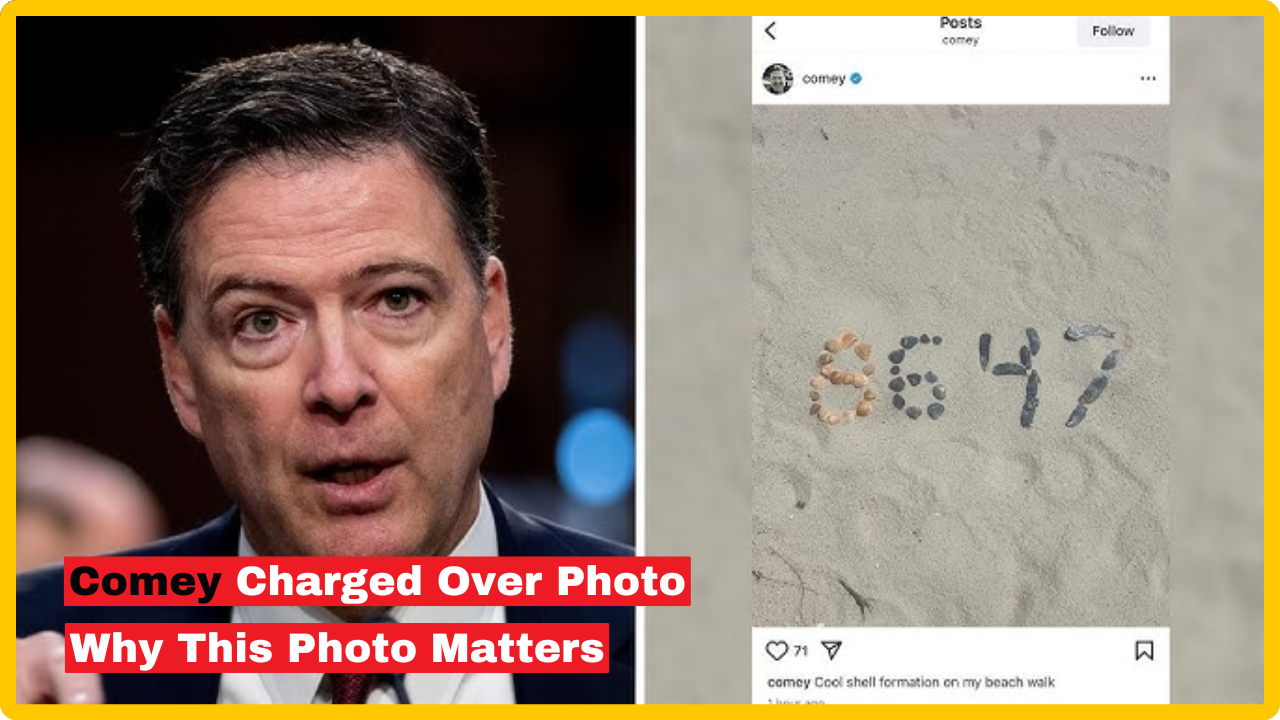
Former FBI Director Faces Up to 10 Years in Prison Over a Single Social Media Post. In one of the most striking and legally debated prosecutorial moves of the Trump administration’s second term, from a federal grand jury former FBI Director James Comey Charged over a photograph he posted on Instagram in May 2025 — an image showing seashells on a North Carolina beach arranged to spell out the numbers “86 47.” The James Comey indicted seashell photo case, brought in the U.S. District Court for the Eastern District of North Carolina, charges Comey with two federal counts:
making a threat against the president of the United States and transmitting a threat in interstate commerce. Each count carries a maximum prison sentence of ten years.
The indictment was unsealed Tuesday afternoon and immediately triggered fierce debate across the legal and political worlds, with the Justice Department framing the charges as routine enforcement of federal law and critics characterizing the prosecution as a politically motivated attack on one of President Trump’s most prominent adversaries.
The Post That Started It All
“Cool Shell Formation on My Beach Walk”
The origins of this case lie in a single Instagram post published on May 15, 2025. Comey, who owns a beach house in North Carolina, uploaded a photograph of seashells arranged on the sand in a formation that read “86 47.” He captioned the image:
“Cool shell formation on my beach walk.”
The numbers ignited immediate controversy. “86” is a term with multiple meanings in American slang — most commonly associated with removing or disposing of something, originating in the restaurant industry to mean discontinuing a menu item. It has also, more rarely, been used as slang meaning to kill or eliminate. “47” is a direct reference to Trump’s current status as the 47th president of the United States.
Republicans immediately accused Comey of calling for the assassination of the president. Trump himself, in a Fox News interview days after the post was made, accused Comey of knowing “exactly what that meant.” Then-Secretary of Homeland Security Kristi Noem stated publicly that it could be a call “for the assassination” of the president and said the Secret Service would investigate.
Comey deleted the post shortly after the backlash erupted. In a written statement, he said: “I didn’t realize some folks associate those numbers with violence. I oppose violence of any kind, so I took the post down.” At the time, he said he had assumed the arrangement of shells – which he suggested he had found rather than created — was simply a political message.
The Indictment: What the Government Alleges
“A Serious Expression of Intent to Do Harm”
The two-count indictment, filed in the Eastern District of North Carolina – the district where Comey’s beach house is located and where the photograph was taken — lays out the government’s case in stark legal terms. According to the charging documents, Comey
“did knowingly and willfully make a threat to take the life of, and to inflict bodily harm upon, the President of the United States”
by posting a photograph depicting seashells arranged to spell out “86 47,” which prosecutors allege “a reasonable recipient who is familiar with the circumstances would interpret as a serious expression of an intent to do harm to the President.”
The grand jury also issued an arrest warrant for Comey. Acting Attorney General Todd Blanche, speaking at a press conference Tuesday shortly before appearing at the White House, addressed the case directly.
“Threatening the life of the President of the United States will never be tolerated by the Department of Justice,” Blanche said. “While this case is unique and this indictment stands out because of the name of the defendant, his alleged conduct is the same kind of conduct that we will never tolerate.”
When pressed by reporters about how the government could prove that Comey acted knowingly and willfully – a core and legally demanding element of the charges — Blanche said there had been a “tremendous amount of investigation” without offering specific evidence in a public setting. He noted that intent is generally proved through witnesses, documents, and potentially the examination of the defendant.
A Second Indictment: The First Case and How It Collapsed
The Pattern of Prosecution
The James Comey indicted seashell photo case is notable not only on its own terms but as the second federal indictment brought against the former director since Trump’s second term began in January 2025.
The first indictment, brought in September 2025 in the Eastern District of Virginia, charged Comey with making a false statement to Congress and obstructing a congressional investigation. The charges centered on Comey’s 2020 Senate testimony, in which he stated he had not authorized any third party to speak to the press about an ongoing FBI investigation. Federal prosecutors, appointed under Trump, charged him just days before the statute of limitations on those alleged offenses expired.
That case came apart in federal court. A judge dismissed both the indictment against Comey and a separate parallel indictment against New York Attorney General Letitia James, citing a shared and fatal flaw:
the prosecutor who brought both cases, Lindsey Halligan – a former personal attorney to Trump — had been installed as interim U.S. attorney without proper Senate confirmation, rendering her appointment unlawful. The Justice Department has appealed that ruling.
Comey Responds: “I’m Still Not Afraid”
A Defiant Video Statement
Comey responded to the new indictment with a video posted to his Substack newsletter, titled simply “Seashells.” His tone was defiant.
“I’m still innocent, I’m still not afraid, and I still believe in the independent federal judiciary, so let’s go,” Comey said. He added: “But it’s really important that all of us remember that this is not who we are as a country. This is not how the Department of Justice is supposed to be. And the good news is we get closer every day to restoring those values. Keep the faith.”
Comey also referenced the prior investigation and the new timing of the charges. “They’re back,” he said of the administration. “This time about a picture of seashells on a North Carolina beach a year ago. And this won’t be the end of it.”
Legal Community Divided: Protected Speech or Criminal Threat?
The James Comey indicted seashell photo prosecution has drawn sharp criticism from legal scholars and former prosecutors who argue the charges represent a significant overreach that runs into clear First Amendment protections for political speech.
Jimmy Gurulé, a University of Notre Dame law professor and former federal prosecutor, called the indictment “an embarrassment to the American justice system.” Several legal experts noted that the government faces a high burden to prove both that the post constituted a “true threat” under the applicable Supreme Court standard and that Comey posted it with a subjective awareness that it would be perceived as threatening — a standard the Supreme Court clarified in recent years in a way that makes prosecutions of this type more difficult.
Merriam-Webster itself, the dictionary of record for the Associated Press, defines “86” primarily as meaning “to throw out” or “to get rid of.” It explicitly notes that the meaning “to kill” is a recent and sparsely used extension of the term, one the dictionary does not formally enter because of its limited prevalence.
The Political Backdrop
The indictment arrived just three days after the shooting at the White House Correspondents’ Dinner, in which a gunman opened fire at the event Trump was attending. The timing prompted critics to argue that the administration was capitalizing on heightened public anxiety about threats to the president to advance a legally questionable prosecution against a political opponent.
Senate Judiciary Committee ranking member Dick Durbin released a statement calling the charges “another case of a weaponized Justice Department lashing out on behalf of a vengeful President,” echoing language he used when the first Comey indictment was announced last September.
The case has been assigned to U.S. District Judge Louise Flanagan, a George W. Bush appointee who sits in the Eastern District of North Carolina.
Conclusion
The second indictment of James Comey over a beach photograph represents one of the most contested and closely watched prosecutorial decisions of the current administration. Whether a jury in North Carolina will ultimately find that a photograph of naturally arranged seashells — or a beach walk photo whose subject matter Comey said he discovered rather than designed – meets the high legal threshold for a criminal threat against a sitting president is a question that will now be tested in federal court.
For supporters of the prosecution, the case represents consistent enforcement of laws protecting the president from threats. For critics, it stands as the clearest example yet of the Justice Department being deployed as an instrument of political retaliation.
Do you believe the federal government has a legally sufficient case to prove that a photograph of seashells posted on Instagram constitutes a criminal threat against the president — or does this indictment cross a line that should concern all Americans regardless of party?
Frequently Asked Questions (FAQ)
Q1: What exactly is James Comey charged with in the seashell photo case?
James Comey Charged as he have already faced two federal counts: making a threat against the president of the United States and transmitting a threat in interstate commerce, both arising from a May 2025 Instagram post depicting seashells arranged to spell “86 47.” Each charge carries a maximum sentence of ten years in federal prison. The indictment, brought by a grand jury in the Eastern District of North Carolina — where Comey owns a beach house and where the photograph was taken — alleges that a reasonable person familiar with the context would interpret the image as a serious expression of intent to harm the president.
Q2: This is Comey’s second indictment. What happened to the first case?
Firstly James Comey Charged was in September 2025 on charges of making a false statement to Congress and obstruction of a congressional investigation, related to his 2020 Senate testimony about whether he had authorized an FBI insider to speak with a journalist. That case was dismissed by a federal judge who ruled that the prosecutor who brought the charges – Lindsey Halligan, a former personal attorney for Trump who had been installed as interim U.S. attorney without Senate confirmation — had been unlawfully appointed. The Justice Department is appealing that dismissal. Comey denied all wrongdoing in the first case, as he does in the current one.
Q3: What has the legal community said about whether this prosecution is valid?
Reaction from legal scholars and former prosecutors has been sharply critical. Several experts have argued that the post falls within the bounds of First Amendment protection for political speech, and that the government will face a steep uphill battle proving that Comey “knowingly and willfully” made a threat – the subjective intent standard the Supreme Court has required in recent threat-related prosecutions.
A University of Notre Dame law professor and former federal prosecutor called the indictment
“an embarrassment to the American justice system.” Acting Attorney General Todd Blanche, when pressed at a press conference about how the government plans to prove intent, declined to offer specifics, saying only that there had been a “tremendous amount of investigation.”



Be First to Comment