
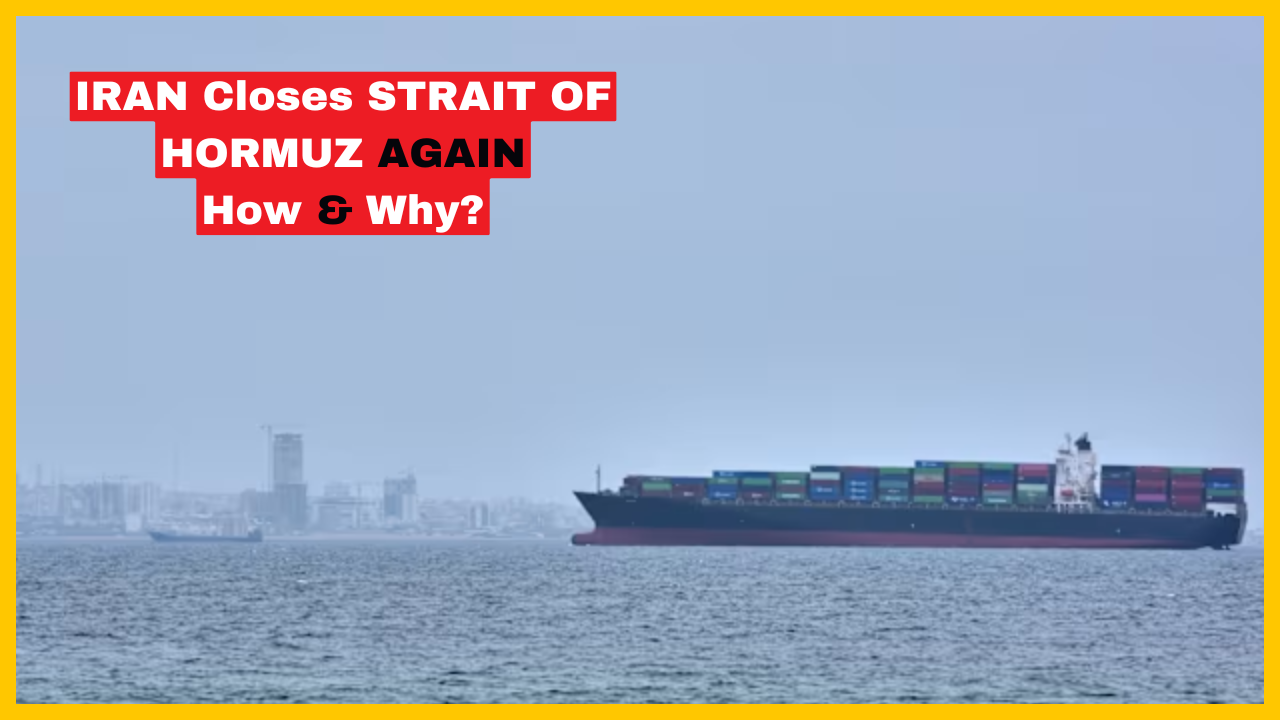
Iran closes Strait of Hormuz officially for the second time, firing on commercial oil tankers attempting to pass through the waterway on Saturday, April 18, 2026 – directly escalating tensions with the United States just one day after a short-lived reopening that briefly calmed global markets. The closure came after Washington refused to lift its naval blockade of Iranian ports, prompting Tehran to reverse course and once again seal the world’s most critical oil shipping route, through which approximately 20 percent of global seaborne oil trade normally flows.
What Happened: The Full Breakdown
The situation escalated rapidly within hours of what many had hoped would be a turning point. On Friday, April 17, Iran’s Foreign Minister Abbas Araghchi announced the strait would remain open to all commercial vessels for the duration of a fragile ceasefire declared between Israel and Hezbollah in Lebanon. Global oil prices reacted immediately, dropping sharply on the news. Markets breathed a momentary sigh of relief.
That relief lasted less than 24 hours.
US President Donald Trump quickly clarified that despite the ceasefire announcement, the American naval blockade on vessels entering or departing Iranian ports would remain fully in force. Iran’s Supreme National Security Council responded without delay, calling Washington’s continued blockade a direct violation of the ceasefire terms. Tehran announced that any conditional or partial reopening of the strait was off the table, and by Saturday morning, the Strait of Hormuz was closed again.
Iran Closes Strait of Hormuz
What followed made headlines worldwide. Iran’s Islamic Revolutionary Guard Corps (IRGC) opened fire on commercial tankers attempting transit through the strait. According to the UK Maritime Trade Operations centre (UKMTO), at least two attacks were reported. A US defence official confirmed to Axios that at least three commercial ships came under fire on Saturday, with at least one vessel sustaining damage, though no fatalities were immediately reported. Audio recordings from one of the incidents revealed that a ship had been given prior clearance to enter the strait — and was fired upon regardless.
Among the vessels targeted were two Indian-flagged merchant ships, one reportedly carrying two million barrels of Iraqi crude oil. India’s Ministry of External Affairs responded swiftly, summoning the Iranian ambassador in New Delhi to formally protest what it described as a “serious incident,” particularly given that Tehran had previously listed India among its so-called “friendly nations” and had allowed Indian-flagged vessels to pass freely in recent weeks.
By mid-morning on Saturday, ship-tracking data showed that while at least eight tankers had successfully crossed the strait, an equal number had reversed course and turned back after receiving conflicting signals from both sides of the standoff. Maritime analyst Eytan Buchman told Al Jazeera: “Ships have been attempting transit since the announcement, but it looks like many of them are heading back because the situation is unclear. There is contradictory information being issued by all parties.”
What Iran Said: “Acts of Piracy”
The IRGC issued a formal statement describing the ongoing US blockade of Iranian ports as “acts of piracy and maritime theft.” The statement made Tehran’s position unmistakable: the Strait of Hormuz would remain under strict military control until Washington agreed to restore complete freedom of navigation for vessels travelling to and from Iran.
“Until the US restores full freedom of navigation for vessels travelling from Iran to their destinations and back, the status of the Strait of Hormuz will remain tightly controlled,” the IRGC statement read, as cited by Iranian state media.
Iran’s Supreme National Security Council reinforced this position, adding that since most supplies to US military bases in the Gulf pass through the strait, Tehran was determined to maintain oversight and control over all strait traffic until the war ended completely — not just temporarily.
Iran’s new Supreme Leader, Ayatollah Mojtaba Khamenei – who rose to the position following his father’s death in Israel’s opening military strike in late February – issued a defiant public statement on Saturday, saying Iran’s navy stands “ready to inflict bitter defeats on its enemies.” He has made few public appearances since assuming the role.
The US Position: Blockade Stays
From Washington’s side, the message was equally firm. Trump told reporters aboard Air Force One on Friday that the blockade would remain in full effect until Iran agreed to a comprehensive deal — one that included, critically, Iran’s agreement to halt its nuclear weapons programme. When asked whether a deal could be reached before the ceasefire’s Wednesday expiry, Trump said: “I think it’s going to happen.” He added, however: “Maybe I won’t extend it. So you’ll have a blockade, and unfortunately we’ll have to start dropping bombs again.”
US Central Command confirmed that 23 ships had complied with American instructions to turn around since the naval blockade began earlier in the week, though it remained unclear how many of those orders came before or after Saturday’s renewed closure announcement.
Pakistani Foreign Minister Ishaq Dar said on Friday that Islamabad was working to “bridge” differences between Washington and Tehran. Pakistan is expected to host a second round of direct negotiations between the two sides early next week, and Iran’s Supreme National Security Council confirmed it had received “new proposals” from the United States, raising cautious hope that diplomacy still has a path forward.
How the World Got Here:-
The roots of this crisis stretch back to February 28, 2026, when the United States and Israel launched coordinated airstrikes on Iran under Operation Epic Fury, targeting military installations, nuclear sites, and key leadership figures. Iran retaliated by effectively closing the Strait of Hormuz — the narrow, 34-kilometre-wide waterway between Iran and Oman that serves as the only maritime exit point from the Persian Gulf.
The closure sent shockwaves through the global economy. The International Energy Agency reported in April 2026 that oil shipments through the strait had fallen from over 20 million barrels per day before the war to just 3.8 million barrels per day by early April — a reduction of over 80 percent. The International Monetary Fund slashed its 2026 global growth forecast, projecting that the crisis could reduce global GDP growth by as much as 2.9 percentage points if the closure persists through mid-year.
Iran briefly reopened the strait under a temporary ceasefire in early April, then began charging transit fees of over one million dollars per ship, leading Trump to declare a full US naval blockade on April 13. Peace talks in Islamabad collapsed when Iran refused to accept American demands regarding its nuclear programme, forcing both sides back to the brink.
The Atlantic Council noted in a detailed analysis published this week that the collapse of shipping through the strait represented “two problems at once” — an immediate supply shock across global commodities from fuel to fertiliser, and a longer-term logistical disruption whose economic aftershocks would continue to be felt even after the strait eventually reopened.
The Global Economic Fallout
The economic consequences of a prolonged closure are stark. According to researchers at the Federal Reserve Bank of Dallas, a single-quarter shutdown of the strait could push WTI crude oil prices to approximately $98 per barrel and cut global GDP growth by nearly 3 percentage points on an annualised basis. A two-quarter closure could see prices peak at $132 per barrel. Some Wall Street analysts have not ruled out prices reaching $200 per barrel in a worst-case scenario.
UNCTAD warned in March that the disruption was already pushing up Brent crude above $90 per barrel, with knock-on effects for food costs, fertiliser prices, freight rates, and inflation in the world’s most import-dependent economies. The IMF cut its 2026 forecast for Iran itself by 7.2 percentage points, projecting a GDP contraction of 6.1 percent — one of the largest country-level downward revisions the fund has issued in recent years.
Airlines across Europe and Asia have been cancelling flights and scaling back routes in response to surging jet fuel costs. One European airport group warned this week that a “systemic jet fuel shortage” was possible if Hormuz traffic did not return to normal levels by the end of April.
What Happens Next:-
The next 72 hours are widely considered critical. Pakistan’s second round of mediated negotiations between the US and Iran is expected to begin early next week, with both sides said to have exchanged preliminary proposals. Iran has made its demands clear: full sanctions relief, the unfreezing of frozen assets, security guarantees, regional stability assurances, and a resolution of the nuclear question on its own terms. Washington’s bottom line remains equally firm – no nuclear weapons capability for Iran.
The temporary ceasefire between Israel and Hezbollah is scheduled to expire on Wednesday, April 22. If that truce collapses, the already-fragile diplomatic environment could deteriorate further, potentially closing off the last remaining off-ramps from a broader regional war.
For shipping companies, energy markets, and governments around the world, the message from Saturday is uncomfortable but clear: the Strait of Hormuz remains one of the most dangerous and unpredictable flashpoints on earth, and the global economy is paying the price every single day it stays closed.
Will diplomacy succeed before Wednesday’s ceasefire deadline runs out — or is the world heading into a deeper energy crisis? Share your thoughts in the comments below.


Be First to Comment